Showing posts with label book review. Show all posts

Wednesday, June 15, 2022

Book Review: A Place to Belong


The following book review was done by MommyMaestra guest contributor, Stacie Farias. All thoughts and opinions are her own.

Diversity... in Homeschooling?


It has previously been the case that my family was the only BIPOC family in our local homeschool community. Having homeschooled around the country and overseas, we have experienced different levels of welcome in different communities, but we have never wavered from our decision to homeschool because of the lack of diversity.  If anything else, the lack of diversity in homeschooling has motivated me further to speak openly about our experiences as a Hispanic family with our homeschooling friends because I have often felt that we, my family as well as the other BIPOC homeschooling families of the last decade, have been laying the groundwork for what will be a beautiful and dramatic shift in the homeschool population.  Working with Mommy Maestra and helping moderate the Hispanic and Bilingual Homeschoolers FB group, has given me a front row seat to the colorful influx of new homeschoolers that started on this journey (initially due to COVID but have decided to stay) and what an incredible sight it is to behold.  


A Place to Belong


Emerging as a leading voice in the BIPOC homeschooling community is Amber O’Neal Johnston, already a blogger, Charlotte Mason devotee, and homeschooling speaker, Johnston is now a published author.  Her book, A Place To Belong: Celebrating Diversity and Kinship in the Home and Beyond, is destined to take its place in the pantheon of great homeschooling books like Sarah Mackenzie’s Teaching From Rest and Julie Bogart’s The Brave Learner.  Reading this book, I cried, I laughed, I felt seen. 


A Place To Belong is a blueprint for ANY family, not just Hispanic like mine or African American like Johnston’s, who is looking to add more to their homeschooling experience in terms of diversity but also when to use the usual books in the Western canon.  Just like her blog, Heritage Mom: Homeschooling Children With Mirrors and Windows, Johnston believes that parents should build, “a library that intentionally melds beautiful literature, contemporary stories, and books as mirrors and windows so children can see themselves, value and embrace others, and become part of a story that enlarges the borders of what is worthy, significant, and possible.” 


Johnston also provides a framework for discussing difficult subjects with your family, found in books and media.  Let’s face it.  We live in times where echoes of the difficult past of our country, continent, hemisphere, is played out on the news.  How do we talk to our children about topics like chattel slavery, racism, stereotypes, violence, etc.? How do we address divisive issues found in books, media, and in real life?  How can we build community and friendships with people who are different from us? Johnston tackles this and more in A Place To Belong. 


Johnston is also painfully and beautifully honest about her experiences as a homeschooler and what it is like to parent her children in a world that, at times, does not recognize their dignity.  There are too many instances in the book to name but several stand out in my mind that I will never forget including the incident with the hand-dryer on page 54, the list of questions on page 74, and specifically ALL of Chapter 9 “From Tragedy To Triumph: Bringing Hard History into the Home.”  Johnston’s retelling of her family’s experiences filled me with intense sorrow, righteous anger, and above all the motivation to do better for my family and my homeschooling community. 


Simply put, this book is remarkable.  As you can tell from the well-loved cover in the picture at the top of this post, it is something I personally have been waiting to read for a long, long time.  If you cannot afford this book, because we have to squeeze every penny out of our homeschool budgets, ask your library to purchase it for you.  Suggest this book for your mother’s book club (there is a discussion guide in the back). Look for it on Overdrive, Libby, and Hoopla or recommend your library purchase it digitally.  Borrow it from a friend.  But please, read it while you are picking out what books to use next year.  Read it while you are discerning how to raise compassionate and thoughtful children. Read it while you are overwhelmed with the endless barrage of difficult headlines and offensive memes and despairing over whether everyone will just stop being so mean to each other.  I promise, you will feel renewed.


“As I raise my kids, I will infuse in them all the beauty of who they are and where they come from while ensuring that they see you and your children as friends and not foes. I’ll give them windows into other families and their ways of life alongside the mirrors reflecting our own culture to them.  I will lead them to love themselves.  And I will teach them to love you.” - Johnston


Thank you for writing this, Amber! We are so grateful!


You can purchase your copy here:


Other Posts You May Enjoy


Wednesday, April 20, 2022

Book Review: Book Fiesta!


The following review originally ran on the Latin Baby Book Club. It contains affiliate links.

Every year, on April 30th, people all across this country celebrate Día de los niños, Día de los libros.

Looking back over all the content we have on MommyMaestra for Día, I was pretty surprised to discover that we don't have a review of Book Fiesta! (aff link). It was written by Día founder and author, Pat Mora, in honor of the holiday.

This picture book is an artistic and literary celebration of both children and books. Pat Mora’s poetic format is simple and engaging, and provides an excellent balance for López’s colorful illustrations. The book reflects the beauty of diversity, of culture, of literacy, and of children.

This month, as we celebrate Día, our goal is to focus on literacy and diversity within the Latino culture. With the Latino literacy rate at a dismal low, we believe that it is important to emphasize how our role as parents is crucial to our child’s literacy success. A child raised in a home with books and reading is far more likely to be a successful student with a positive outlook towards learning. Children with poor literacy skills, however, are more likely to become high school dropouts and live below the poverty level.

A love of books and reading develops a child’s imagination and improves their performance in school. It also expands their knowledge and understanding of other cultures. This breaks down discrimination and fear, which is why it is so very important for parents to supply their children with a variety of books that reflect not only their own heritage, but that of other children as well.

Unfortunately, in this country Latino children’s literature only makes up around 6% of the number of children’s books on the market. We should all, therefore, strive to support the field and purchase these books for our children so that they might find a voice that reflects their own identity in a positive and uplifting way. Our children need to see themselves as the protagonists of their own stories. They need this encouragement and inspiration to succeed and flourish.

Book Fiesta! is the recipient of the 2010 Belpré Illustrator Medal Book, the 2010 ALA Notable Book, 2010 CCBC Choices, and the 2010 Notable Children's Books in the Language Arts Award. All of which are well deserved. Both the language and the illustrations are bright and joyous, engaging the reader and making him or her smile with each page. Mora's lyrical style is easy and attractive to young ears and minds.

This book comes with full text in both Spanish and English. It is primarily a picture book, and is geared for children ages 4 to 8. 

The author also includes a page in the back with ideas for celebrating Día de los niños, Día de los libros.

Purchase your copy on Amazon or Bookshop.org.


Other Posts for Día You May Enjoy:


Monday, December 20, 2021

Book Review: Mis Cuentos Ecológicos

The following is a sponsored post with Nacho Books. All thoughts and opinions are the writer's own.

This review is one of a series of educational books in Spanish available from the new Nacho Books website. Find additional reviews in this series here. 

Stories about Caring for the Planet

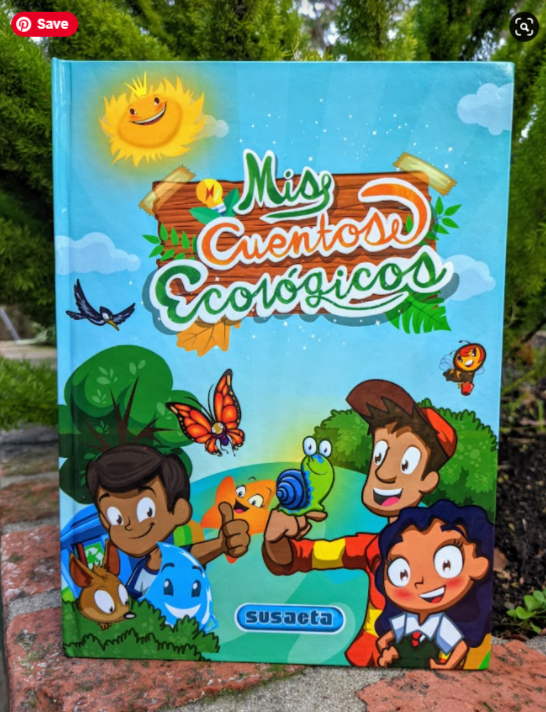
Mis Cuentos Ecológicos is a hard-cover Spanish story book from Nacho Books that transports children to a magical world through nine short fairy tale-like stories that focus on the importance of taking care of the natural world. Each tale introduces how human actions harm nature and how personal decision making can make a difference in keeping animals and the environment clean and happy. 

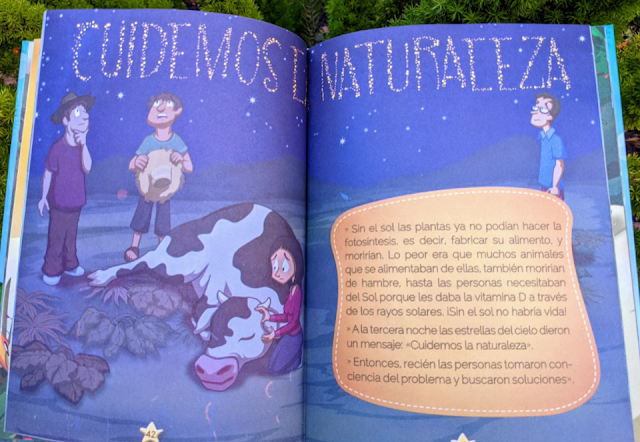
Talking animals, walking trees, messages in the sky all implore humans to reverse their ways before nature is destroyed. The protagonists in each story realize the value of recycling, stopping deforestation, not using pesticides, keeping land and water clear of trash and reducing harmful pollution. 

The full-page illustrations are vibrant and full of emotion. Each page shows the contrast of emotional responses from animals and humans when the right and wrong decisions are made. 

It’s target audience is beginner and fluent Spanish speakers in K-2nd grade (5-8 years old). The stories present a clear right and wrong choice for the environment, and consequences for the wrong choices like littering, polluting, or not recycling are severe. They do not shy away from the stark reality that some human behaviors can have dire consequences. 


Animals, humans and mythical beings send clear messages about what the right choices should be and the stories always end with people realizing their errors and restoring the environment to what it was. It also presents the government and companies as being easily and quickly convinced of what needs to change and their being on board for immediate and dramatic action. 

The book presents several environmental issues as clear moral choices. Possible conversations that could develop from these stories could be about personal choices and systemic change and what role young people can play in taking care of the planet as well as who the power holders are, i.e. governments and companies. 

Click over to Nacho Books to order this and other titles to support your child’s emerging reading and listening comprehension in Spanish as well as their understanding of pressing environmental issues. 

-----

Monika Aldarondo is a former arts educator, and current photographer and creative shape-shifter with Puerto Rican roots. She posts about her bilingual home/un-schooling journey on Instagram @librolovinmama. Her photography and creative projects can be found at laancla.com.

Tuesday, March 23, 2021

The Three Golden Oranges


Over the coming weeks and months, MommyMaestra is going to try and feature a different children's book by a Hispanic author every week. I know there are a lot of great new books coming out now, but I also want to draw your attention to older books, which I will include, that have been on the market for a while but you might not have heard about. There are so many wonderful stories!  

Today, I'm starting off with Alma Flor Ada’s The Three Golden Oranges (aff link). Ada’s adaptation of the classic Spanish fairytale is spectacular with changes to the original story line that create a tale that flows simply and beautifully.

The story of three brothers who wish to marry and set out to find the woman of their dreams, they first visit the wise old woman who lives in a cave on the edge of a cliff. Spinning her wool, the old woman tells them how to find the brides that they are seeking. Naturally, two of the brothers (Santiago and Tomás) do not heed the old woman’s advice and promptly get into trouble, but the third, Matías, follows the directions as best he can and is eventually rewarded with the apparition of the kind and joyful, Blancaflor. The two quickly return to the castle to rescue both Matías’ brothers (trapped in the castle dungeon) and Blancaflor’s mother and sisters - who, along with Blancaflor, had been cruelly transformed into an orange tree with –tada! – three golden oranges!

Unlike most fairytale endings in which the handsome prince is rescuing the princess with his extraordinary strength, agility and dashing good looks, Three Golden Oranges emphasizes the value of honesty, selflessness, honor, and dedication. When asked what type of wife he wants, Matías asks for one who is "kind, joyful and someone I could love very much" as opposed to his brothers who desire wealth and beauty. And in a novel turn of events, it is the sweet Blancaflor who chooses Matías to be her husband, rather than the other way around! Yay! Altogether what a great message…and one that I hope to impart to my own son and daughter.


Set in rural Spain, the illustrations are fantastic. Reg Cartwright does a great job depicting the Spanish characters in both their attire and features (aquiline noses are just so Mediterranean – I should know!) And his colorful, rounded artwork vividly reflects the Spanish countryside and small towns with a folk art style.

I have an older ex-library copy that I used years ago with my now teenage children. But it is so special that I've kept it and am looking forward to reading it to my youngest when he is old enough.

This book is great for those studying Spain, world cultures, folktales, legends, family, and values.

For an additional activity, download a coloring page from the book here. 

Order your copy online:

Happy reading!

Wednesday, November 11, 2020

Book Review: Me & the World

The following is a sponsored book post. All thoughts and opinions are my own. 

There's a new book on the market that as a homeschooler and parent raising global citizens I absolutely love! Have you seen Me and the World: An Infographic Exploration?

This post contains affiliate links.

For kids who love technology - especially its data style of presentation - this title is a must have. Me and the World by Mireia Trius is a colorful book that is rich in information about global communities all packed into carefully organized infographics. Seriously, there is SO MUCH information here, you can pick up this book again and again and learn something new. You can spend a long time on one or two pages, so you might even be able to break it up and read a little bit one day and a little bit the next. Take a look at some of the pages...


The topics of the infographics focus on things that children are curious about: the popular pets in different countries, the most popular names around the world, breakfast foods, bestselling books, different houses found across the globe, what kids wear to school, and so much more. 

It's a small story within a much bigger one as it follows the story of Lucia from Spain. She's our guide in this book that takes readers around the world, then around again to see new things, and then around again! Lucia tells us with each infographic what her life is like as it relates to the topic. Then the reader can look around the page to see what it is like in other countries.

Mireia Trius (the author) is actually the founder of Zahorí Books in Spain. Before she started her publishing company, she was a gallery owner and art representative. So she has a great eye for creating innovative books for children. Don't you think?

You can find Me and the World here on Bookshop.org. 

And on Amazon here:

This book is also available in Spanish - the language in which it was originally written.


Friday, November 6, 2020

New Alphabet Books


I've often talked about my obsession with abecedarios, or alphabet books. So when some new titles landed on my desk recently and wanted to share them with you. I know many of you love them as much as I do!

The following links are affiliate links.


¡Todos al Rodeo! A Vaquero Alphabet Book
by Ma. Alma González Pérez

What an absolutely fabulous book! With full text in both English and Spanish, this alphabet book takes the readers on an in-depth look at the history of el vaquero. Children will LOVE the subject matter, as well as the images used to represent each word (and letter) of the alphabet.

From arena to lazo/lasso to rodeo, the author focuses on Spanish words that have been absorbed/adopted by the English language in the tradition of linguistic borrowing. I think your children will be fascinated to read about the origins of so many words associated with cowboy culture.

As I mentioned, this book doesn't have illustrations, but instead uses actual photographs that feature Hispanic influence. And the back of the book also contains a picture glossary and a list of Mexican and U.S. rodeo events. 

This is the third alphabet book in a series by the author.


ABC: Discover Critters from A to Z 
by Rosa C. Lopez

I follow artist Rosa C. Lopez on Instagram. She's the illustrator of the Martín y Pepe book series, which I absolutely love! So when I saw she had a new book out, I bought it. 

ABC: Discover Critters from A to Z is such a sweet book for helping children learn their alphabet. Rosa's warm and whimsical illustrations are engaging for children. Each letter of the alphabet includes an animal that begins with the letter, and few words about what each one is doing. 

It's important to note that the book only shows capital letters, so keep that in mind if you are looking for one that shows both upper and lowercase.

My 3yo enjoys the illustrations and the simple storyline. And at the back of the book, there are a few pages to allow children to practice writing their letters. 


Olinguito, from A to Z! ~ ¡Olinguito, de la A a la Z!
by Lulu Delacre

Olinguito, from A to Z! ~ ¡Olinguito, de la A a la Z! is a rare glimpse into the heart of a cloud forest. We're there on a mission: to help the zookeeper from Washington, D.C. find the elusive olingo. Along the way we discover beautiful treasures. There is a richness to the illustrations that captures the reader. You can read about the whole process of creating the layered illustrations here on Lee & Low's website and here on the author's website.

Each page of this book is filled with the flora and fauna that are unique to cloud forests. Lulu's attention to detail makes this book especially remarkable. You'll find plant and animals that few people in this part of the world have seen in the wild, such as orchids and bromeliads and Collared Inca Hummingbirds and Spectacled Bears.

The best part of the book is the full text in both English and Spanish. And it should be obvious to any bilingual speaker that the book was originally written in Spanish and then translated into English. Not that the latter is poor in any way, but simply because the Spanish is so well done.

Tuesday, October 6, 2020

Queen of Tejano Music: Selena

Queen of Tejano Music: Selena

#Parentalfailure

In my household, Selena is having a BIG moment. During a week-long visit with their Corpus Christi cousins this summer, my older two children were introduced to Selena Quintanilla Perez and her music. After watching the movie featuring Jennifer Lopez and visiting the standard Selena sights in Corpus Christi, TX, my kids became fans. While my husband and I grew up listening to Selena y Los Dinos and still remember vividly when she was taken from this world too early by “she-who-will-not-be-named,” we never really played her music around the house for our children to hear. FACEPALM!

After realizing how utterly unacceptable our children’s lack of education regarding Tejano music’s most honored and cherished female figure, my husband and I bought the movie on iTunes and created the appropriate Spotify playlists for all our kids to enjoy. Three months later, all five of our kids can recognize a Selena song and even our 1-year-old will bop up and down to “Biddi Biddi Bom Bom.” Our older two are now enjoying other artists like Ritchie Valens because, as I told them, before Selena, there was Ritchie.

Must-have Picture Book!

Of course, I couldn’t call myself a homeschool mama without buying a book to further my children’s appreciation of Selena. While there have been a number of notable picture books featuring figures in Hispanic history, perhaps there has not been one that has brought forth such overwhelming nostalgia to me as this new release from Little Bee Books called, Queen of Tejano Music: Selena (aff). 

Written by Silvia Lopez, Queen of Tejano Music: Selena is written as a picture book biography recommended for children ages 6-9 but it is easily enjoyable for tweens and teens, as my own teen and tween can attest. There is an appropriate amount of text to engage children about Selena’s life from her birth (she was an Easter baby!) until her death. There are also fun quotes from Selena herself such as this one from her early years in the music business: “If we got five or ten dollars,” Selena said, “we could go to Whataburger!”

The book also includes a timeline of Selena’s life and a few pages in the back with important contextual information called “A Little More About…” that includes pages of information about the following: 
  • Tejanos, Hispanics or Latinos, 
  • Tejano or Tex-Mex Music, 
  • Quinceaneras, 
  • Lake Jackson, Texas, 
  • Corpus Christi, Texas, 
  • Selena Behind the Scenes, 
  • Tragedy, 
  • and Remembering Selena.
What makes this picture book a MUST-have is not just the useful information, but the absolutely gorgeous illustrations. Illustrator Paola Escobar’s work is captivating and vibrant. There are so many tiny details in each two-page spread that you could look through this book many times and still find something new to look at. And just look at the cover art! Doesn’t it just take your breath away?!? The roses, Selena’s iconic purple costume, a microphone. I’m completely obsessed.

Queen of Tejano Music: Selena

Was Selena A Homeschooler?

The technical answer to this question is no. Selena, finished her education through “long-distance classes” which is another way of saying, she went to correspondence school so that she could study while touring and not have to worry about showing up to a brick and mortar school. But the idea of Selena being a homeschooler is intriguing, isn’t it? In fact, on the timeline, provided in the back of the picture book it says, “1984. Left middle school to tour with the band, now called Selena y Los Dinos. Began homeschool classes.” Awe. The book even used “homeschool” as one word not “home school” with a space in between which people who aren’t familiar with homeschooling call it in writing. 

While Selena could not have legally called herself a homeschooler at the time (homeschooling was not officially legalized in Texas until 1994 according to the Texas Homeschool Coalition) she certainly acquired her education in a manner that was unique and family-centric. The illustration on the page which describes Selena’s education has Selena, her siblings, and her parents all working together to help Selena with her work. There are books and notebooks, a calculator and a tea cup, pencils and markers all on the table. It looks like a normal homeschool day to me, but I’m totally biased. LOL! 

It is well documented that later in her career, Selena would speak at schools across Texas about the value of education. However, I can’t help but wonder, if homeschooling had been what it is now, would the Quintanillas have been a homeschooling family? Just one of so many questions we are left with one someone is taken so unexpectedly from this world.

Queen of Tejano: Selena is only available as a hardback book and I can understand that during these times, $18.99 might be a high price for a picture book. If this is the case, ask your library to buy it! In fact, even if you do buy this book for your family, ask your library to buy it anyway. This book is a treasure and for Hispanic Heritage Month, your entire community would benefit from having a library that has wonderful picture books like this in their collection.

----------------------------------------


Stacie Servantes Farias is an Army wife and mom of 5 with a “very healthy” obsession for Snoopy, Disney movies, Audrey Hepburn, Dr. Pepper, Whataburger, books, and homeschooling. Originally from Mission, Texas, Stacie and her high-school sweetheart hubby live with their kids and dog in a different home every few years, because that is the military life. She has big plans to write a book exploring her theory that La Llorona drowned her children because they would take their socks off all over the house and then would complain that they never had clean ones! Stacie also thinks she is really funny, but she is mostly lame. 


Monday, June 25, 2018

The Adventures of Phatty and Payaso


Over the years, my daughter and her friends have devoured various book series whose main characters were animals. I've wondered if it was the idea that their beloved pets were out living adventurous lives that kept the kids mesmerized, anxiously awaiting the next book in the series to be published. How clever, I thought, those authors are to turn animals into heroes and villains.

So when JKS Communications reached out to me about a new series based on cats, I was like, "Okay. My kids like cats. I'll take a look and see if it is a good fit." I can't tell you how pleased I was to find that "The Adventures of Phatty and Payaso" is unlike all the others for three main reasons:
  1. ) The main characters are minorities
  2. ) The book actively seeks to teach character skills lacking in today's children
  3. ) The storyline focuses on bullying.

Let me tell you the storyline first. So the main character, Phatty, is a fat cat who loves to spend his time sitting on his favorite chair and gazing out the window at Central Park. One day, the meanest hawk around lands in his window and begins to threaten him and his friends. At first, Phatty is terrified, but eventually, he musters up his courage to go alone to Central Park to stop the bully. When he doesn't come back, Payaso sets out to find his best friend, Phatty.

The three main characters reflect three different minorities: an overweight cat, a Latino cat, and a boy on the Autism spectrum. I just love the diversity that is being represented even in an animal-dominated book.

But you know what I love best? It's the fact that the author, Marie Unanue, is a kindness advocate who wrote this book to help children who are being bullied. She actually thought this storyline out carefully and used a teacher's resource - CharacterLab.org - to help her focus on key traits that she believes today's children often need to develop. These traits are:
  • Curiosity: Taking an interest in ongoing experiences for their own sake; finding subjects and topics fascinating; exploring and discovering
  • Gratitude: Being aware of and thankful for the good things that happen; taking time to express thanks.
  • Grit: Finishing what one starts; persisting in a course of action in spite of obstacles
  • Self-control: Regulating what one feels and does in the service of goals and standards; being disciplined; controlling one's emotions.
  • Social intelligence: Being aware of the motives and feelings of other people and oneself; knowing what to do to fit into different social situations; knowing what makes other people tick.
  • and zest: Approaching life with excitement and energy; not doing things halfway or halfheartedly; living life as an adventure; feeling alive and activated.

The characters in the book each reflect one or more of these traits and they teach them to each other...and hopefully the reader, too! For kids who may be suffering (or who have suffered) from bullying, this is a great resource.

Teachers: This book works well with lessons and unit studies about Hispanic culture, minority cultures, special needs, bullying, character skills, relationships, self-worth, and more.


Disclosure: I received a copy of these books for review purposes. All thoughts and opinions are my own.

Thursday, May 10, 2018

Puerto Rico: La Isla del Encanto - The Island of Enchantment


A few weeks ago, I received an email asking if I'd consider sharing a new book on Puerto Rico. I frequently get emails asking for me to share new books with MM readers. There's a pretty long waiting list. But here's what caught my eye: ALL of the profits are being sent back to the island to help with its recovery. So I agreed.

Puerto Rico: La Isla del Encanto - The Island of Enchantment is a bilingual coloring workbook with 210 black-and-white pages about Puerto Rican history, culture, and traditions. Although the author wrote the book primarily for children of Puerto Rican descent living outside of PR, it can be enjoyed by any child who is a lover of the world and its beauty!

Melissa López Charepoo, the author and illustrator, says...

"As a Puerto Rican, the suffering after the island was struck by two hurricanes touched me deeply. Today, after six months, thousands are still struggling to obtain basic necessities. In the spirit of service, 100% of the profits for the next year will go to small organizations that have empowered themselves to help others in time of need, and it’s the hope that the funds collected will assist in this later stage of recovery."

The workbook covers a LOT of topics, though none of them in depth. She basically provides the introduction and the reader must find out more using their local library or online resources. It's important to note that this book does require a lot of parental (or teacher!) involvement...especially when it comes to monitoring online resources. So this wouldn't be an informational read so much as a starting point for further exploration. Here are some examples:


But I do love that as I flipped through this book, I found names of people and places that I had never heard of before. I don't know their significance yet, as I haven't had time to research them. But I do think that this book would be a great resource for doing an in-depth study of the island of Puerto Rico.

And the other cool thing is that this comes with full text in Spanish and English...and the Spanish comes first!

So if you'd like to contribute to the island's recovery efforts through the purchase of an educational resource, consider this lovely book. You can find it here on Amazon (aff).

Disclosure: I received a copy of this book for review purposes. All thoughts and opinions are my own. 

Monday, March 5, 2018

Book Review: Playing with Osito

I'm going to start the week off with a resource for your preschooler. This one comes from Barranca Press, which is developing a line of bilingual children's books to support the development of multilingual children.

This review contains affiliate links.

Playing with Osito / Jugando con Baby Bear

by Lisa María Burgess
collages by Susan L. Roth

Playing with Osito / Jugando con Baby Bear (aff) is a bilingual children's book with full text in English and Spanish. The storyline itself is about two friends - Osito and a young girl. But Osito has a problem, his winter hair has not filled in completely and he's left with bare patches all over his body. It's up to the two of them to find a way to help Osito stay warm. The young girl tries one idea after another; when one fails, she looks for another solution.

I really like how the young girl in the book doesn't give up. She takes it all in stride when one if ger solutions doesn't work, and just says, "Breathe, think, and try again." It's a really great story to encourage children to try and try again and not get discouraged when their ideas don't work out the first time or two. Such a valuable lesson that all of our children should learn!

I also like how the back of the book includes pages with "Did you know? ¿Sabes qué?" facts. The information is all about nature and the animals featured in this book. There's also a section on where to find more information.


The illustrations are really fun, too. Susan Roth, who illustrated Parrots Over Puerto Rico (aff), uses paper to create the unique collages in this book. I thought it was pretty neat to read that much of the landscape in the story was made with tree bark paper, which has been made in Mexico since precolonial times.

The author, Lisa María Burgess, grew up in the Sierra Madre of northwestern Mexico. She apparently wrote this story with her father when she was a little girl. I love it when authors are inspired by their childhood and turn around and share it with others!

Educators: This book works well with lessons and unit studies about problem solving, persistence, bears, the Southwest, New Mexico, Mexico, imagination, bilingualism, multilingualism, the environment, storytelling, paper art, and more.

Disclosure: I received a copy of this book for review purposes. All thoughts and opinions are my own.

Tuesday, February 13, 2018

Book Review: ALMA and How She Got Her Name


ALMA and How She Got Her Name
by Juana Martinez-Neal

I am always looking for books that empower children or that help kids feel better about themselves. So I absolutely fell in love with this new book out by Juana Martinez-Neal! The storyline is one to which I'm sure many children can relate.

This review contains affiliate links.

When I was growing up, I was always sad that my name was so simple: Monica Olivera. No middle name. No middle NAMES. Nada. I was envious of my Spanish cousins who had longer names. I felt that I had gotten cheated of picking who I wanted to be. Oh, eventually I grew up and found comfort and love in my given name. But I do remember those long ago days, especially when I'm doing research for packets that feature Hispanic men and women. (Did you know that Celia Cruz's real name was Úrsula Hilaria Celia de la Caridad Cruz Alfonso?)

Enter ALMA and How She Got Her Name (aff). The story is about young Alma Sofia Esperanza José Pura Candela. Phew! That's a mouthful, no? Poor Alma feels like it is too long. Until her Daddy begins to tell her the story of her name and the remarkable people whom she is named after.

Does your child have several names? If so, have you ever taken the time to sit and tell them the story behind their name? Maybe you named them after a close friend or a beloved family member. Maybe you named them after a place that is special to you. Or perhaps you chose a name based on its meaning. Whatever the case, I feel like children want to know why their names are special to their parents.

This book is Martinez-Neal's debut picture book as an author-illustrator. And, yes, the illustrations are really, very good. The careful use of color makes the images pop! And I absolutely love, love, LOVE how culture permeates the pictures in this children's book and Spanish words can be found throughout. Here's a peek:


The best part of this book, in my opinion, is that it is available in both English and Spanish. What a treasure this would be for home libraries!

Teachers: This book works well with lessons and unit studies about Hispanic culture, families, Hispanic family traditions, meanings behind names, family stories, family history, father-daughter relationships, self-worth, and more.

Disclosure: I received a copy of these books for review purposes. All thoughts and opinions are my own.

Tuesday, March 21, 2017

¡Todos a comer! A Mexican Food Alphabet Book


This is a sponsored book post. All thoughts and opinions are my own. It may use affiliate links.

I have a soft spot for abecedarios. I just love books that teach the alphabet to kids... especially when they are bilingual! And today's book has one more bonus: culture. 

¡Todos a comer! A Mexican Food Alphabet Book (aff) is so much fun. It includes one food or dish for each letter of the Spanish alphabet (with the exception of W). The layout of each page consists of a delicious picture with Spanish text on the top and English on the bottom. 

The photos are colorful and feature some of the most popular dishes in Mexican cuisine. There are history lessons embedded in the short descriptions that will give parents additional topics to discuss.

Parents can read to their children or older children can read it on their own. This book makes a great read aloud and I love how it encourages communication between the readers. Each food description ends with a question designed to make young minds think for extended learning.
 

And just for fun, the author has included a picture glossary in the back of the book of Mexican cooking utensils, such as a comal, a cazuela, a molinillo and others.

Families with young children should have a growing collection of books at home to be read over and over to their little ones. And for those with children learning to read, a set of alphabet books - or abecedarios - are a must! They allow children to see how letters are used in different ways and how they make up the basis of our language. Alphabet books develop literacy skills and help prepare children to begin the process of learning to read. So it is imporant to have abecedarios that are fun, colorful, and engaging. ¡Todos a comer! does just that. 

But don't be surprised if you find yourself feeling hungry after you read it!

Friday, March 10, 2017

Burbujas en el pelo de Jon Jon

This is a sponsored book post. All thoughts and opinions are my own. It may use affiliate links.

So I have to tell you that I get inundated with requests from authors and publishers to share their books on MommyMaestra. There is a gigantic pile of books next to my desk and I could quite easily spend all of my time simply writing book reviews. But there's a lot more to homeschooling than just reading books, so to make sure that I have time to write about other materials, I've scaled back to (mostly) sponsored book reviews that run at most once a week. I want to be clear, however, that I ONLY agree to share books that I think are well written and that I feel will interest my readers.

Burbujas en el pelo de Jon Jon (aff) is one of these. When the author reached out to me, I agreed to take a look. And I was so pleasantly delighted by the book when it arrived! Ingrid Aranzamendi Rivera was born and raised in Puerto Rico. And her mastery of Spanish is obvious. I always get requests from MommyMaestra readers asking me for original stories in Spanish that are NOT translations. This is a perfect example.

Spanish-speaking parents of children 8 years old and younger will enjoy reading this story to their children. It's the somewhat fantastical tale of a young boy who doesn't heed his mother's advice to be sure and rinse away all the shampoo in his hair. She says...


And he experiences the consequences!


This is Ingrid's first book, and the rhythm and rhymes are vivid and enchanting. She clearly is a native speaker and an excellent storyteller.

The illustrations are by Tirzah Pieters-Kwiers Benítez, a general biology student at the University of Puerto Rico in Humacao. They are a unique blend of watercolors and digital images that combine to enrich the storyline.

This story was such a pleasure to read! I recommend it to all bilingual families with young children.


OPPORTUNITY!!


This book is available in both a paperback and digital format. I am told that readers can download a free promo eBook on Amazon beginning (tomorrow!) Saturday, March 11th, through March 15th. Click here to get yours! (aff)

Tuesday, February 28, 2017

Book Review- Raising Bilingual Children: A Practical Guide


A coule of weeks ago, I shared with you a review of Maritere Rondriguez Bellas' book, Arroz con pollo and Apple Pie - Raising Bicultural Children.

Today, I 'm reviewing her other excellent book, Raising Bilingual Children: A Practical Guide (aff link). It is an easy guidebook for parents who are committed to raising bilingual kids. Divided up into six chapters, the book starts with how to get started and ends with suggestions for non-native language speakers. You'll read about how after-school language learning programs get creative and the pros and cons of immersion schools. And you can read five case studies of children who move from school into the world.

It covers common questions parents have, such as what to do when your child refuses to speak Spanish at home, how to proceed when one parent doesn't speak the target language, and should you be concerned if your 2 year old isn't speaking in either language.

There is practical advice for busy parents, as well as testimonies from real parents who have successfully raised bilingual kids. I love that I can read about parents who have been there and done that, so they know what I'm going through. And you can even read interviews with some of their bilingual children.

In addition, Mari has included articles and advice from the experts, too, such as Delfin Carbonell Bassett, PhD, who debunks the five most prevalent myths associated with raising bilingual kids. Have you heard that a bilingual kid's brain will get confused with so many different words in different languages? That they'll get confused and suffer language delays? Maybe you've heard that a child must start learning a second language from birth or they'll be unsuccessful. Learn the truth to these and other misconceptions in chapter one.


I think you'll also enjoy the 100+ tips you'll find scattered throughout the book. You could even make it a daily goal to write one on a dry-erase board and post it somewhere you and your family will see it to boost your commitment.

While this book emphasizes immigrant parents, I love that the last chapter is for monolingual parents who are raising bilingual children. What a selfless act those parents are making and how awesome is it to have a resource to help them in their commitment!

Overall, this book is a must-have for every bilingual family's home library. Or if you know a family that fits this description or a couple expecting their first child, then this would be an excellent gift!

Thursday, February 16, 2017

Book Review: Arroz con pollo and Apple Pie - Raising Bicultural Children


There is SO much talk centered around raising bilingual kids. In fact, that is the main focus of many of my readers. But for me, something equally - if not more important - is raising bicultural children. It has certainly been a goal of mine (and a challenge!) ever since we started a family to provide my children with a childhood that somehow merges both my Hispanic culture and my husband's white American one. Just as I grew up immersed in my heritage while experiencing uniquely American traditions, so I wanted the same for my kids.

But raising bicultural children isn't as easy as it seems. Especially if you are like I am: far removed from family and surrounded by non-Latinos who speak only English and are clueless about Spanish and Mexican traditions. So when Maritere Rodriguez Bellas reached out to me and asked me to take a look at her books, I agreed.

Today, I'm going to focus on her excellent book, Arroz con Pollo and Apple Pie (aff link). It is a guide for for parents who want to raise bicultural children in our modern society. Maritere wrote the book to be the resource that she wished she'd had available to her when she was a new immigrant mother years ago. Technicially, she wasn't an actual immigrant, since she was originally from Puerto Rico, but as a new mother in California, she often wished she had family nearby to help guide her.

Determined to help others with tips and resources, Maritere began writing a parenting column for Latino immigrant parents in La Opinión, the largest Spanish-language newspaper in the country. It ran for 11 years. A few years later, Maritere published this book.

It is a remarkable compilation of interviews and testimonies from immigrant parents or their children from all over Latin America, including Nicaragua, Cuba, Guatemala, D.R., Mexico, and more. There's even advice from well-known figures such as Jorge Ramos, Tony Plana, and Milly Quezada.

Each chapter focuses on a different issue with suggestions, tips, and stories about how immigrant parents dealt with the issues. Maritere also encourages parents to start a parenting journal where they can write down questions they might have and, eventually, the solutions. She also provides tips, resources, and thought-provoking questions.

Although this book focuses on Latino immigrants, really, ANY immigrant parent will benefit from reading it. And I would even say that parents like me, who are not immigrants, but who are trying to pass on their heritage to their children will find this book to be a treasure trove of information.

Did you know that there are actual stages of immigrant adjustment? Chapter one describes all four in depth. And the next chapter discusses how to help your KIDS adjust.

I especially love that the author also addresses how to balance and blend two cultures in your home and your childrearing practices.

Are you struggling with how to discipline your children? The American way can certainly differ from other countries. Learn how SIX other parents have handled this in chapter six.

Overall, this book is has been thoroughly researched. The number of stories shared by such a variety of parents and children show the effort and careful thought that the author put into her work. It is well written and Maritere is obviously passionate about the subject and determined to help other parents out there find support and resources.

If you are a Latino parent or an immigrant parent, this book is a must-get. Or if you know of a parent, then this would make a great gift!

Tuesday, April 26, 2016

Book Review: Maya's Blanket


Time for another addition to your family library's Latino children's literature section! Today's picture book is a treasure that celebrates the special bond between Abuelitas and their grandchildren.

"What if the objects we love -- blankets, stuffed animals, dolls, toys -- never leave us?" ~Monica Brown 
Maya's Blanket ~ La manta de Maya
by Monica Brown
illustrated by David Diaz

I truly love this sweet story titled Maya's Blanket (aff), that puts a Latino twist on a traditional Yiddish folk song "Hob Ikh Mir a Mantl." Monica Brown's own multicultural background serves as the inspiration for this book; she's of Peruvian and Jewish heritage.

When Maya was just a baby, her Abuelita hand-stitched a beautiful blanket for her. Maya loved her special manta (blanket) because it kept her cosy and warm every night. As she grows, the blanket gets frayed along the edges, so she and Abuelita transform it into a lovely dress. But then she stains the front, so they turn it into a skirt. Before long, Maya has outgrown it and the skirt must be transformed again....

The story goes on with the beloved blanket changing - getting smaller and smaller - but still useful to Maya as she grows bigger and bigger.


Perhaps your family will be inspired by this book to save and repurpose those special gifts that are gifted or passed down from family members and friends.

What is most touching to me about this book is the special connection that Maya shares with her Abuelita. Their love is so strong that Maya clings to the blanket as it changes form... a symbol of the close bond she shares with her grandmother.

Bilingual families will love that the book comes with full text in both English and Spanish, though some Spanish words (manta, bufanda, etc.) are sprinkled into the English text. There is also a glossary included at the end of the book.

David Diaz' illustrations are, as usual, fantastic. The colors are vibrant, reaching out to pull your eyes into the story. Each page is a visual delight as each character seems to leap off the page.

This beautiful story is can be used to supplement lessons on family, recycling, repurposing, creativity, growth, metamorphosis, transformation, grandparents, and more.

Monday, April 25, 2016

Book Review: Roses for Isabella

In honor of Día de los niños, Día de los libros which takes place this coming Saturday, April 30th, I'll be dedicating this week to sharing reviews of books that celebrate children and other resources for Día. Some of the books are new releases, while others have been around for a while, but may not have received much publicity. I hope you'll follow along and find some new titles to explore and add to your home or school library.

Roses for Isabella
by Diana Cohn
illustrated by Amy Córdova

This book came out several years ago, but it's not one you see very often. That's a shame because Roses for Isabella (aff) is a wonderful story that takes you into the life of a young girl in Ecuador. Isabella is a budding writer and her family is so proud of her. One day, her teacher has a surprise for the class as she invites them to write stories in honor of Pachamama, or Mother Earth. One of the students will be selected to read aloud their story at the school assembly celebrating Pachamama, and, naturally, Isabella hopes it will be her, and decides to tell the story of her own family.

I love how this book tells us about Isabella's life through her own writing. I also loved about the important message it shares of how buying Fair Trade products benefits families around the world. In this story, we learn how Isabella's mother became sick from chemicals when she was working for a rose grower. She leaves her job and goes to work for a Fair Trade company that cares for its employees as well as its product. 

Isabella finishes up her journal writings with a poem in honor of Pachamama. 

The author has included an afterword describing Fair Trade around the world. It's a great history lesson for students and perfect for raising global citizens.

The illustrations by Amy Córdova are lively and colorful. I love how she captures the traditional clothing of the characters and the cultural details.

This beautiful story is can be used to supplement lessons on Ecuador, world history, children around the world, world cultures, Fair Trade, economics, family, schools around the world, holidays, Earth Day, and more. 


LinkWithin

Related Posts Plugin for WordPress, Blogger...