Showing posts with label Latinos in History. Show all posts

Saturday, April 15, 2023

Selena Reading Passage & Comp Questions


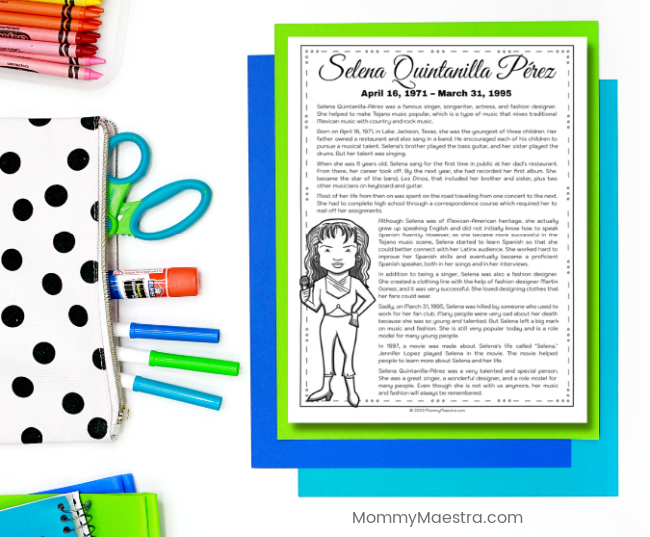
Introduce your children or students to the famous singer, Selena Quintanilla Pérez, with this printable one-page reading passage and comprehension questions.

And if you're looking for more information and ideas to use with your students, check on my post, Resources for Celebrating Selena Day.

Who was Selena?

Selena Quintanilla Pérez was an American singer, songwriter, actress, and fashion designer. 

She was born on April 16, 1971, in Lake Jackson, Texas. Selena came from a family of musicians and she began performing with her family's band, Selena y Los Dinos, when she was only 8 years old. As she grew up, she became the lead vocalist of the group and helped to popularize Tejano music, a genre that blends traditional Mexican folk music with country and rock music.

In the early 1990s, Selena began to achieve mainstream success with the release of her album "Entre a Mi Mundo" and her collaboration with fashion designer, Martin Gomez, on a clothing line. She continued to release successful albums, including "Dreaming of You," which was released after she died.

Sadly, when she was only 23 years old, Selena was shot and killed by her former fan club president, Yolanda Saldívar. Her death was widely mourned, and she remains an icon of Latin music and fashion. 

If you haven't seen it, Selena's life and career were later the subject of a biopic film, "Selena" (1997), starring Jennifer Lopez in the title role.


What is Selena Day?


Back in 1995, while fans all over the US, Mexico, and throughout Latin America were still grieving the death of their beloved star, George W. Bush (who was at the time the governor of Texas) declared that April 16th, Selena’s birthday, would be an official Texas holiday.

One of Selena's greatest achievements was breaking barriers in the music industry. As a Latina woman, she faced many challenges, but she never gave up on her dreams. She showed that with hard work and determination, anything is possible.

In honor of Selena's legacy, many people celebrate her life and music every year on April 16th. This day is known as Selena Day, and it's a time to remember her and all the joy she brought to the world.

Selena One-Page Reading Passage

Selena One-Page Reading Passage


This year, in honor of the rock star, I've put together a one-page reading passage that shares Selena's life story.

Geared for children in 4th grade and up, this file also comes with reading comprehension questions. The 8-question quiz also comes with a separate answer key.

AND it is available in English and Spanish (as always)!


Other Posts You May Enjoy:


Monday, January 30, 2023

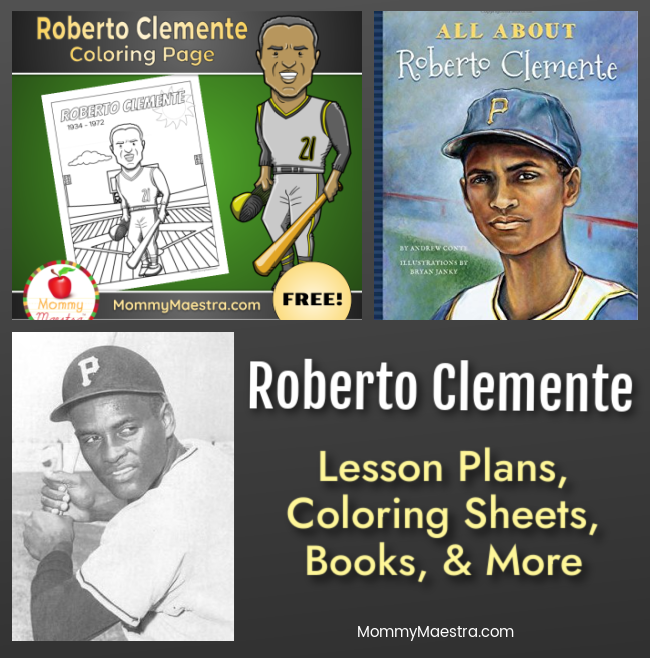
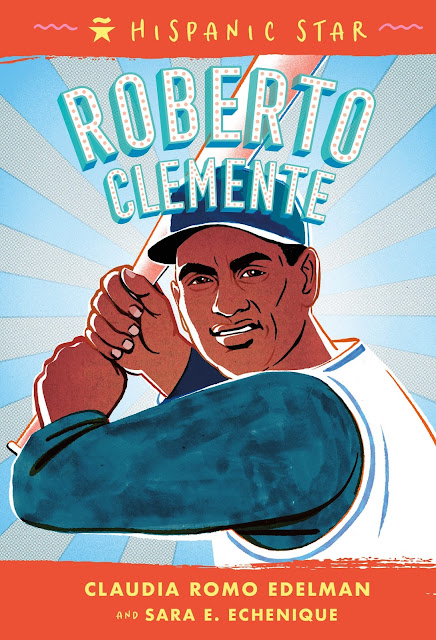
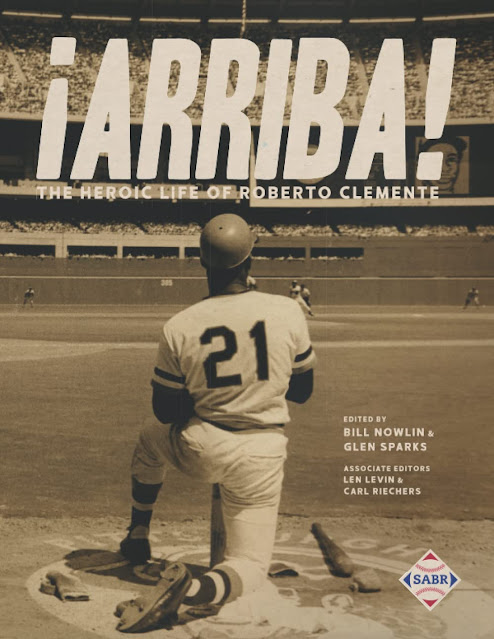
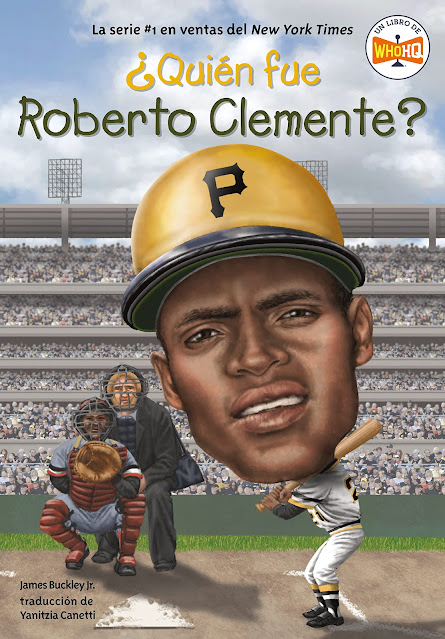
Roberto Clemente Lesson Plans, Activities, Coloring Sheets and More

You may have heard about the baseball legend, Roberto Clemente. But did you know that the Puerto Rican was also a great humanitarian? In fact, he was posthumously awarded a Congressional Gold Medal of Honor in 1973 for his philanthropic work. Roberto Clemente was the first Hispanic to achieve greatness in baseball, such as the first Hispanic to be named league MVP and the first Hispanic elected to the Hall of Fame, among other firsts. I hope you enjoy this collection of resources for learning and teaching about Roberto Clemente. Surprisingly, there are less than I expected. I hope that changes in the future.

Then learn about other important Latinos in history that your children should know!

This post contains affiliate links.


Lesson Plans


TpT Resources:


Printables


Coloring Pages


Videos


Here are some great child-friendly videos about the great baseball player, Clemente.


Friday, December 30, 2022

Latin Americans in History

 
I am SO excited to share that my newest book is now available for pre-order! Latin Americans in History: 15 Inspiring Latinas and Latinos You Should Know (aff link) was wonderful to research and write and I hope that you will all run out (or get online) and buy a copy! This book is a collection of biographies written for children ages 8 to 12 years old. It introduces them to a few well-known (and some not so well-known) figures of Latin American heritage in history.

This post contains affiliate links.


Teaching Children a More Complete History

One of the most frustrating things that I've noticed over the years is how true Latin American history has been ignored - or erased? - from history books. The only mention that Latin America typically gets in any history curriculum is by way of the Mesoamerican civilizations and the Spanish "discovery" and conquest/colonization of America.

How many historical figures of Latin American heritage can you actually think of? Maybe you think of Rigoberta Menchú or Simón Bolívar or maybe Benito Juárez? If you are familiar with their names AND their stories, then you should give yourself a pat on the back because you are in the minority.

Latin Americans in History: Biographies for Children


My book was written to introduce children ages 8 to 12 to some of the remarkable men and women of Latin American heritage who have made a difference in their countries and on world history. These 15 inspiring Latinas and Latinos are:

  • José Gervasio Artigas
  • Simón Bolívar
  • María Piedad Castillo de Levi
  • Guillo Pérez
  • Antônio Carlos Jobim
  • Gabriel García Márquez
  • Violeta Barrios Torres de Chamorro
  • Dolores Huerta
  • Rita Moreno
  • Pope Francis
  • Isabel Allende
  • Franklin Chang-Díaz
  • Gloria Estefan
  • Rigoberta Menchú
  • Cecilia Tait
In no way should these be considered the best or the most important figures to learn about. These 15 extraordinary figures barely touch the surface of the many, many noteworthy people who have loved their culture and fought for their people, countries, or traditions. 

The names chosen for profiles in this book were based on their diversity and representation. You will find an artist, musician, novelist, scientist, athlete, activist, suffragist, actor, and a Pope. They come from the U.S. and throughout Latin America, including Uruguay, Ecuador, the Dominican Republic, Venezuela, Colombia, Nicaragua, Argentina, Guatemala, Costa Rica, and Peru.

Perhaps your children will recognize some of these names - or maybe they won't. And that's why I wrote this book. To help them learn, admire, and find confidence. 


And I'd like to give a huge shout out to Kristina Rodriguez, the talented illustrator whose artwork graces the pages of this book. Her beautiful portraits help children visualize the individuals we've highlighted in this biography.


Lesson Plans for Latin Americans in History


My book is available on Amazon - you can order it now! 

I am also making lesson plans for each individual chapter biography. They'll be available over the next few months. I'll update this post with links as they become available.


A Note About Brazil and Tom Jobim


Tom Jobim was a brilliant Brazilian musician. However, if you ask Brazilians or people of Brazilian heritage if they are Latin Americans, you may get different answers. The question of whether or not Brazil is part of Latin America remains controversial because it was a Portuguese colony, not a Spanish one. Therefore, it has a different history than its neighboring countries. However, in the spirit of inclusivity, Brazil has been included in this book. Just keep this question in mind as you read about Tom Jobim. 


Other Posts You May Enjoy


Don't forget to subscribe to my newsletter!


Sunday, October 2, 2022

Celia Cruz Lesson Plans, Coloring Pages, Crafts, Activities and More


Did you know that the Cuban "Queen of Salsa" Celia Cruz, originally studied to become a literature teacher? But she interrupted her studies to pursue singing opportunities that eventually led to stardom. She has become beloved by generations all over the world for her operatic voice, flamboyant costumes and intimate relation to the music of Salsa. I've listed resources available for educators and parents below. If you want to learn about other important figures, check out my post on Latinos in History Your Children Should Know.

This post contains affiliate links.


Lesson Plans for Celia Cruz


Elementary Lessons


Resources for Middle & High School


Kid-Friendly Videos for Celia Cruz


Here's my favorite biography video for kids of any age from Cultura Colectiva Plus: The History Machine: Celia Cruz


Read Alouds


Here are a couple of video read alouds of two different children's biographies about Celia Cruz.


Activities & Crafts


Books


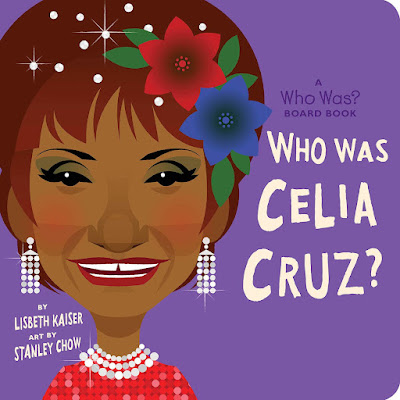
by Lisbeth Kaiser

It's also available in Spanish:
¿Quién fue Celia Cruz?: ¿Quién fue? Un libro de cartón


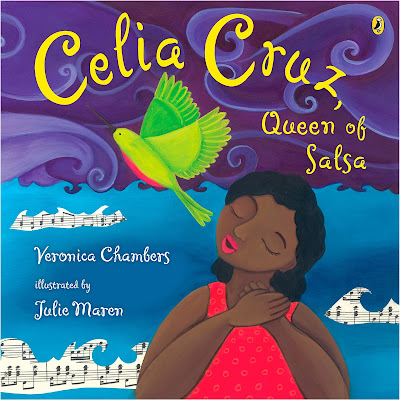
by Veronica Chambers


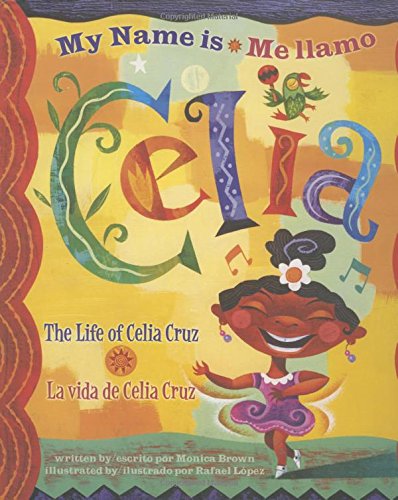
by Monica Brown


Other Posts You May Enjoy


Monday, September 19, 2022

Flashcards on Hispanic Figures & Events in History

Flashcards on Hispanic Figures & Events in History
The following is a sponsored post in collaboration with Chicanx Scholars. All thoughts and opinions are my own.

One of my favorite things about Hispanic Heritage Month is learning about (and sharing!) remarkable resources that help our kids learn about the contributions of Latin Americans in world and U.S. history. This line of flashcards from Chicanx Scholars is a prime example! And what makes them even better is that the company was started by parents who reflected on their own school experiences, recognized something was lacking, and did something to change it for future generations. 

This post contains affiliate links.


Flashcards Featuring Hispanics in History


There is a growing number of children's books that highlight the Hispanic experience. But finding other materials continues to be a challenge. I appreciate it when people realize the value of creating and using other types of learning tools, because not all children learn the same way, nor are they all avid readers. Some kids prefer to learn through activity-based projects. 

These flashcards provide a way to supplement books and worksheets when teaching about Hispanic Heritage Month. And there are three different sets from which you may choose.

Flashcards on Hispanic Figures & Events in History


The History of Mexico Flashcards


While all of the decks that are available are excellent, this is probably the best set, in my opinion. Why? Because it is really hard to find ANY resources in English that are about the history of Mexico...and geared for children.

I've seen several parents asking for materials on Mexican history and historical figures in my Facebook group for Hispanic & Bilingual Homeschoolers. And each time, it has been a real struggle to find resources to recommend. Not anymore! This flashcard set will be at the top of my list. 

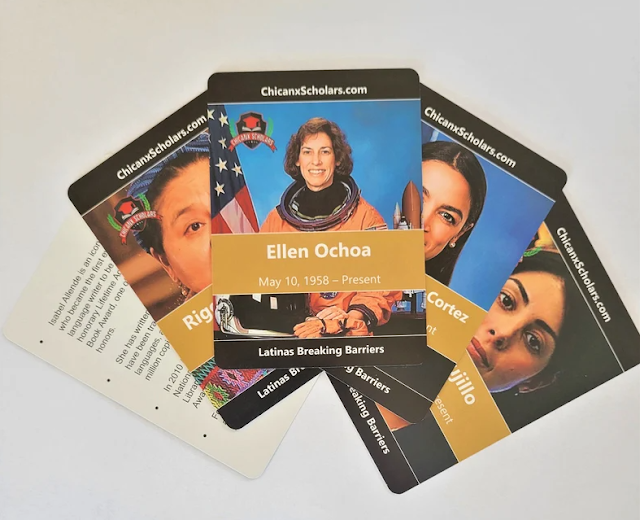
This set of 52 cards covers people and events from the Olmecs to the Mexico City Earthquake, and Benito Juarez to the Battle of Zacatecas. I would use this as a spine for studying Mexican history and select a card, then research the topic of the card more in-depth (or have your student do so). 

Each card comes with an image and the name on the front, and a bullet-point list of key facts on the back. Most of the cards also have a date on the front, but a few don't because dates aren't applicable. It's obvious that a lot of work has gone into researching each cart topic. I give this deck an A++ rating. :)

Flashcards on Hispanic Figures & Events in History


The Chicano Movement Flashcards


These flashcards take an in-depth look at the Chicano Civil Rights Movement. It includes, of course, Cesar Chávez and Dolores Huerta, but it also highlights many little known leaders of the movement, whose work made a national impact. Quieter figures such as Helen Fabela Chávez (Cesar's wife), Jessie de la Cruz, Emma Tenayuca, and Rodolfo Acuña are featured. (Don't know them? Look them up!!)

But there are also a lot of important moments in the Chicano movement that are included. This is especially important because too often historical events are often overlooked by (non-Latino) historians or those creating curricula.

Latinas Breaking Barriers Flashcards


This, of course, is always a popular topic. Latinas love stories or resources that highlight the achievement of other Latinas. We already know how tough we are. But we want the world to know it, too. And when we see these stories being written down and handed down, there's an orgullo that we ALL feel. Because we know these women; they are our mothers, our grandmothers, our tías, and primas. 

I looked through this one curious to see if there would be anyone listed that I didn't recognize and I was happy to see quite a few of them. Many of them are from California - which is where the Chicanx founder, Danny, is from. If you are from California, you may find this to be especially interesting. But either way, what a great way to introduce new Latina faces and their accomplishments. 
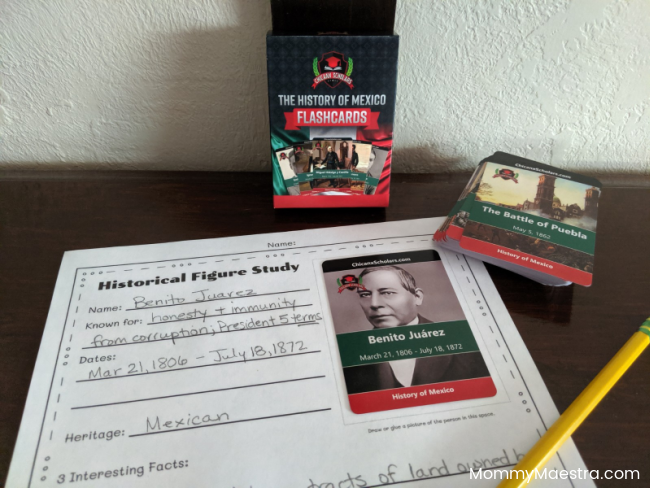

Flashcards on Hispanic Figures & Events in History

How to Use Them


There are a few different ways to use these flashcards. As I mentioned earlier, the main way I would use them is as a spine for a class on Mexican studies, Mexican-American Civil Rights, or Latina studies. 

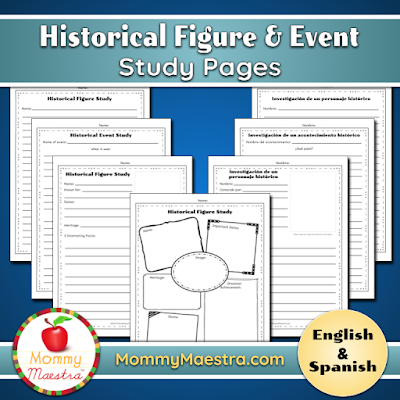
Students can memorize the names and accomplishments of each person, place, or event. They can also choose a card from the deck and do more thorough research or a presentation on the topic. (The picture above is one of the graphic organizers from my Historical Figure & Event Study Pages set.)

The decks may also be used as a trivia game to assess your child's knowledge of the subject. 

Or you can simply use them as conversation starters for your class or family.


What I Like


I find these cards to be a fabulous resource for parents regardless of whether or not they are homeschooling, as well as educators. I could easily create a homeschool course for my teen on any of the three topics covered by these flashcards. The figures and events on each card present the perfect jumping off point for more in-depth study and all together would be a great way for parents to supplement their children's history education. 

It's important to note, however, that the focus is primarily on Mexican/Mexican American figures and events. If that's what you're looking for, then these sets are for you! That said, the Latinas Breaking Barriers set does take a broader look and includes international figures such as Guatemala's Rigoberta Menchu, Chile's Michelle Bachelet, Puertorriqueña Dr. Antonia Novello, and several others.


Buy Them Today!


Visit the Chicanx Scholars shop on Etsy and take a look at their card decks for sale. Or, if you know exactly which one you want, you can click on these links to take you there:

Mexican History Flashcards


Latinas Breaking Barriers

Latinas Breaking Barriers


Want to find this post again? Pin it!

Flashcards on Hispanic Figures & Events in History


Other Posts That You May Enjoy


Thursday, September 1, 2022

Jovita Idár Lesson Plan

image source: U.S. Mint

After more than three quarters of a century, Jovita Idár is in the news again. Only this time, she is the subject, not the writer. Jovita will be one of five women recognized by the U.S. Mint in the 2023 American Women Quarters Program. (Learn about the other four women.) Her image will be found on a U.S. quarter. Maybe you've never heard of Jovita Idár. If not, continue reading to learn about this fierce, intelligent, and compassionate role model we have in our history. Scroll down to find my printable lesson plan. To learn about other remarkable figures, check out my post on Latinos in History Your Children Should Know.

This post contains affiliate links.

Who was Jovita Idár?

Jovita Idár was born in the border town of Laredo, Texas, in 1885. Jovita’s family was one of the few middle class Mexican families. Passionate about education and civil rights, Jovita’s father, Nicasio Idár raised his kids to be highly educated and with a strong sense of social justice. 

The second of eight children, Jovita excelled academically. It’s no surprise that she started off as a teacher. But she became frustrated with the lack of resources available to Mexican students and the one-sided curriculum that omitted or demonized Mexican figures and culture. She understood the lasting damage this did to Mexican children who learned that being white was good and being brown was bad. Before long, she decided that she would be more effective at creating social change as a journalist fighting for equal education and the civil rights of Mexican families. She began working for La Crónica, her family’s newspaper. Nicasio was proud of his daughter’s outspoken character and encouraged her interest and involvement in politics.

In her weekly articles, Jovita protested the racist, anti-Mexican culture that permeated not just her border town, but also throughout Texas and the Southwest. Signs refusing service to “Mexicans and dogs” were often hung in storefronts. Segregation was strong. And voter intimidation - frequently through violent killing and mutilations - was common. 

It’s important to note that Jovita did not restrict her articles to her father’s paper. She frequently wrote for other Spanish-language newspapers throughout her life, oftentimes under pseudonyms, such as “Ave Negra” (Black Bird) and “Astrea” (the Greek goddess of justice).


Jovita Idár and members of Union of Stone Mason and Bricklayers, Laredo, Texas, ca. 1915,
General Photograph Collection, UTSA Special Collections.


The First Mexican Congress

In 1911, Jovita and her family organized the First Mexican Congress - El Primer Congreso Mexicanista - in response to the lynching of a 14-year-old boy. The goal was to find solutions to the inequalities and racism that existed for Mexicans and Mexican Americans. It also strove to unite Mexicans on the issues they faced and create a unified front to fight for their rights and better living conditions. 

The event had a huge turnout with officials and citizens from both Mexico and Texas attending. It is regarded as one of the largest Mexican-American civil rights gatherings of the time.

Unsurprisingly, Jovita ensured that women were central to the event and not only helped to organize it, but were speakers, too.

The League of Mexican Women & the White Cross

Shortly afterward, Jovita also founded La Liga Femenil Mexicanista (the League of Mexican Women), which she modeled after the Mexican Congress. It’s goals were to engage and empower Mexican women, support women’s suffrage, teach adult literacy classes, and champion quality education for Mexican children. She served as its first president and their first project was providing free bilingual education to Mexican children from poor families. Its members were highly educated women and mostly working class who learned about politics so they could improve conditions in their communities.

Jovita saw the fluidity of living in a border town and sought to rally families on both sides of the border. Fully bilingual, she understood that the success of Mexican families required change in both countries. She left her journalism behind and served in the White Cross (founded by her best friend Leonor Villegas de Magnon) when the Mexican Revolution made its way across the Texas border in 1914. 

A couple of years later, Jovita was able to hang up her nurses’ uniform and return to her love of journalism when she began writing for El Progreso newspaper. After the paper ran an editorial criticizing President Woodrow Wilson's order to dispatch U.S military troops to the Mexico–United States border, Texas Rangers showed up at the newspaper, armed and ready to close it down. But Jovita herself barred entry and refused to let them enter while boldly quoting their First Amendment rights to freedom of the press. (They returned the next day when she was gone and smashed the printing press to bits.)

The First Latina Newspaper Owner

Two years later, in 1916, Jovita purchased her own printing press and started her own Spanish-language newspaper called La Evolución in which she continued to expose the discrimination Mexicans experienced. It was probably the first Latina-owned newspaper in the United States.

Wedding portrait of Bartolo Juarez and Jovita Idar, 
General Photograph Collection, UTSA Special Collections.

Five years later, Jovita’s brother, Eduardo, took over the running of the paper when Jovita moved to San Antonio with her husband, Bartolo Juárez. But Jovita didn’t stop her crusade for social justice. Together, they founded the Democrat club. And they quickly became leaders in the community. As such, Jovita embraced civic engagement and gave back to her community by founding a free kindergarten, volunteering as an interpreter at the local hospital, and assisting undocumented workers in getting their naturalization papers.

Jovita Idár Juárez died in San Antonio from tuberculosis on June 3, 1946.

She was fierce and intelligent and compassionate. What a wonderful role model we have in our history. 


Get the Lesson Plan


If you're looking for a lesson plan to share Jovita Idár's story with your older children, consider Lesson 1: Hispanic Activist Jovita Idár from Unit 1 of my curriculum, A More Complete History. 

This 30-page lesson plan is part of my comprehensive Teach for Justice unit that focuses on five important (and often forgotten) historical figures of the 1900s using articles and mini documentaries as our secondary sources. In this packet for high school students, you'll find lesson plans for in-person and virtual learning, as well as:
  • essay questions,
  • project based learning options,
  • and research & present topics.

It includes Google Drive options for worksheets and summative assessments allow for differentiated learning and virtual instruction. Answer keys and essay rubric are included.

Other Resources You May Enjoy


Thursday, August 18, 2022

Latinos in History Your Children Should Know

Latinos in history that your children should know.The contributions of Hispanics to U.S. and world history are numerous. They've impacted every aspect of history, including the arts, music, literature, science, math, politics, athletics, conservation, education, and on and on. I've written a lot about specific figures and shared my research and resources for introducing some of these important people to your students and children. So I decided that I really needed a single post that links back to the posts featuring these remarkable men and women of Hispanic and Latino heritage. 

This is just a beginning. There are many more figures that I'll be adding to this list, and some I've already added that have features in the works. I hope you'll bookmark this page and check back frequently to learn about more notable Hispanics in history.

Where possible, I have linked to student/child-friendly posts or sites. If there is no link, I have not found anything age appropriate yet, and will work to add a page to my site.


Diego and Frida. Archives of American Art, Smithsonian Institution


Hispanic Artists


You will probably recognize most of the names on this current list. But I bet there are one or two you'll learn more about! 

  • Frida Kahlo Lesson Plans, Activities, Coloring Sheets and More 
    Frida was a Mexican artist who is best known for her self portraits. Her fame is worldwide but she has a huge following here in the United States. She was married to Diego Rivera.

  • Diego Rivera Lesson Plans, Books, and More 
    Diego was a Mexican muralist who focused his artwork on highlighting the stories and struggles of the working class. He was married to Frida Kahlo.

  • Joan Miró Activities, Crafts, Lesson Plans and More (Hispanic not Latino)
    Joan was a Spanish painter and sculptor. His unique art is recognizable and makes him a great subject for school art projects.

  • Pablo Picasso Lesson Plans, Activities, Coloring Pages, and More (Hispanic not Latino)
    Picasso's fame is almost universal. And his Cubist style makes him a great subject for students.

  • A Mini-Lesson on Bill Meléndez
    Not many people know that the Peanuts' TV animator was Mexican-American. He was also the voice of Snoopy!

  • José Guadalupe Posada Lesson Plans
    José was a Mexican artist who specialized in lithographs (and engravings). He's best known for his Day of the Dead illustrations that were politically charged.

  • Salvador Dalí (Hispanic not Latino)
    Dalí was a Spanish painter. He is best remembered for his Surrealist paintings that feature dream-like subjects, merging reality and illusion. 

  • José Clemente Orozco
    Orozco was a Mexican painter who led the muralist movement.

  • Carolina Herrera 
    Carolina Herrera is a famous Venezuelan- American fashion designer. Her clothing line has been worn by women all over the world, including several U.S. first ladies, including Michelle Obama.


Jroses, CC BY-SA 3.0, via Wikimedia Commons


Latino Writers


  • Sor Juana Inés de la Cruz: Lesson Plans, Videos, and Books for Kids
    Sor Juana Inés de la Cruz was a 17th-century nun, self-taught scholar, and poet. Her writings make her a major figure of the the Spanish Golden Age.

  • Pablo Neruda: Lesson Plans, Videos, Books, & More
    Neruda was a Chilean poet, diplomat, and politician. He is best remembered for his poetry that reflected his love of his country.

  • Julia de Burgos
    Burgos García was a Puerto Rican poet, and a civil rights activist for women and African/Afro-Caribbean writers. 

  • Isabel Allende
    Allende is a Chilean-American writer and journalist. She's considered Latin America's most successful female novelist and her books have sold more than 56 million copies world wide.

  • Miguel de Cervantes (Hispanic not Latino)
    Miguel de Cervantes was a Spanish novelist, poet, and playwright. His most well known work - “Don Quixote” - was an instant international bestseller and is considered the first Modern Novel.

  • Gabriel García Márquez
    García Márquez was a Colombian novelist, journalist, short-story writer, and screenwriter. He's considered Latin America's most famous author. His stories mastered the style of magical realism and are beloved by most Latin Americans.

  • Gabriela Mistral
    Gabriela Mistral was a poet, educator, and diplomat. She was the first Latin American writer to receive the Nobel Prize for Literature in 1945.

  • José Martí
    Martí was a Cuban poet, essayist, journalist, translator, professor, and publisher. He was also dedicated to Cuba's independence from Spain and is considered a national hero. 

  • Jorge Luis Borges
    Borges was an Argentine writer and poet, who is considered one of the major literary figures of the 20th century.

  • Carlos Fuentes
    Fuentes was, perhaps, Mexico's most famous novelist and essayist.

  • Rudolfo Anaya
    Anaya was a Mexican-American writer and novelist who has been called a Father of Chicano Literature for his groundbreaking works that reflect the American Southwest and especially the Mexican-American culture.

  • Federico García Lorca (Hispanic not Latino)
    García Lorca was a Spanish poet, playwright, and theatre director. He is considered to be one of the most important Spanish poets of the twentieth century.

  • Soledad O’Brien
    O’Brien is a national broadcast journalist and philanthropist. She is best known for anchoring and co-anchoring several news shows for major networks such as NBC, CNN, and HBO. 

  • Sandra Cisneros
    Sandra Cisneros is a Chicana poet and novelist famed for her first novel “The House on Mango Street.” She was the first female Mexican-American writer to be published by a mainstream publisher and has won numerous awards for her work.

  • Juan Felipe Herrera
    Herrera is a poet, performer, writer, cartoonist, teacher, and activist. He was also the 21st United States Poet Laureate from 2015 to 2017.

  • Octavio Paz
    Octavio Paz Lozano was a Mexican poet and diplomat. In 1990, he was awarded the Nobel Prize in Literature “for impassioned writing with wide horizons, characterized by sensuous intelligence and humanistic integrity.”


http://science.in2pic.com, via Wikimedia Commons


Hispanic Scientists


  • Mario José Molina
    Dr. Molina is one of the researchers who discovered the horrifying effects of CFCs on our planet's protective ozone layer. His research led to world-wide change.

  • Franklin Ramón Chang Díaz 
    Franklin Díaz is a Costa Rican-American physicist, mechanical engineer, and former NASA astronaut. He has flown on seven space shuttle missions making him the record holder for the most spaceflights. He now runs a company that makes high-speed rocket systems.

  • Ellen Ochoa
    The first Latina in space, Dr. Ochoa, was also the first Latina director of the Johnson Space Center. She has spent nearly 1,000 hours in space aboard four different missions.
  • Carlos Juan Finlay
    Dr. Finlay was a Cuban epidemiologist who discovered that yellow fever is transmitted through mosquitoes.

  • Lydia Aguilar-Bryan (a good read for educators/adults)
    Together with her husband, Lydia discovered how the body regulates the secretion of insulin, a hormone that controls the amount of sugar in our blood. 

  • Guillermo González Camarena
    Camarena was a Mexican electrical engineer who was the inventor of a color-wheel type of color television.

  • Manuel “Manny” Villafaña
    Villafaña is an entrepreneur of medical devices. His businesses have mainly concentrated on heart health devices such as pacemakers and heart valves. His work has saved hundreds of thousands of lives.

  • Helen Rodríguez Trías
    Dr. Trías was a pediatrician, educator and women rights activist. She was the first Latina president of the American Public Health Association. Dr. Trías received the Presidential Citizen's Medal for her work on behalf of minorities and the poor.

Trikosko, Marion S., photographer, Public domain, via Wikimedia Commons


Latino Activists & Teachers


  • Arturo Alfonso Schomburg Resources
    Schomburg was an Afro-Latino from Puerto Rico whose foresight and diligence helped create and establish the largest collection dedicated to Africans and the African diaspora.

  • Cesar Chavez Lesson Plans, Activities, Coloring Sheets and More
    Chavez was a Mexican-American labor leader and civil rights activist, who fought for better working conditions for farm workers. Together with Dolores Huerta, he co-founded the National Farm Workers Association.

  • Dolores Huerta Lesson Plans, Activities, Coloring Sheets and More 
    Dolores Huerta is a Mexican-American civil rights activist, who has fought for better working conditions for farm workers and other hard- working families. Together with Cesar Chavez, she co-founded the National Farm Workers Association.

  • Las Adelitas for Kids & Young Adults 
    Las Adelitas were the women in the military - many of whom bravely joined their male family members and sweethearts to fight - in the Mexican Revolution.

  • Sylvia Mendez
    Sylvia Mendez is a civil rights activist whose family played a crucial role in the Mendez v. Westminster case in 1946. It was the first case for the integration of schools won in California, and paved the way for the desegregation of schools in the United States.

  • Ralph Lazo
    Lazo was the only known non-spouse, non-Japanese American who voluntarily relocated to a World War II Japanese American internment camp in support of his friends. He later helped raise funds for a class-action lawsuit to win reparations for the Japanese Americans interned.

  • Willie Velásquez
    Willie Velasquez was a grassroots activist and vote organizer. Perhaps no one has had a greater impact on American politics by empowering Hispanic citizens to run for office.

  • Jovita Idár
    Jovita Idár was a journalist and civil rights activist who fought for the rights of Mexican American families and Mexican immigrants, as well as for equal education for Mexican American children and women’s suffrage.

  • Jaime Escalante
    Escalante was a Bolivian immigrant who taught math at an L.A. high school. His teaching style and methods helped students believed to be "unteachable" to master calculus and many pursued higher education.


Ibrahim Arce (Narcy Studios photographer), most likely, Public domain, via Wikimedia Commons


Hispanic Musicians


  • Vicente Fernández Reading Passage
    Vicente Fernández was a Mexican singer, actor, and film producer. He is best known for his ranchera songs. Fernández is considered one of the best-selling artists from Mexico of all time.

  • Tito Puente Lesson Plans, Coloring Pages, Crafts, Activities and More 
    Tito was an American musician and Latin jazz composer. Dubbed the King of Mambo, Puente was famous for his ability to play the timbales, a type of drum set. He was awarded the National Medal of Arts.

  • Selena Quintanilla Perez
    Tejano music’s most cherished icon, known simply as Selena, broke many records before her unexpected death at the age of 23.

  • Celia Cruz
    Best known as the “Queen of Salsa,” Celia Cruz was a Cuban singer who introduced the world to vibrant music with her amazing voice and flamboyant costumes. 

  • Carlos Santana
    Carlos Santana is a guitarist, composer, and singer. He is known for his unique musical style blending rock music with Latin American rhythms. Listed as one of the 100 Greatest Guitarists of All Time, he has won 10 Grammy Awards and 3 Latin Grammy Awards.
     
  • Linda Ronstadt 
    Ronstadt is a famous American singer and one of the bestselling artists of all time. She was the first female singer to sell out concerts. Ronstadt has made more than 120 albums that have sold  more than 100 million records. 

  • Gloria Estefan
    Estefan is a Cuban-American singer, actress, and businesswoman. She's best known as the lead singer of the Latin Pop group Miami Sound Machine. 

  • Placido Domingo (Hispanic not Latino)
    Plácido Domingo is a Spanish tenor opera singer. He has recorded over 100 complete operas and has performed in Italian, French, German, Spanish, English, and Russian in the most prestigious opera houses in the world.

  • Martina Arroyo
    Arroyo is an American opera singer. Martina’s father was from Puerto Rico and her mother was from Charleston, South Carolina. She is one of the first African Americans to have a successful international career in opera.

Latinx Athletes


  • Dara Torres
    Dara Torres is a five-time Olympic swimmer and former world record-holder in three events. The only swimmer to compete in five different Olympic games, she was also the oldest swimmer to ever earn a place on the Olympic swimming team when she was 41 years old.

  • Roberto Clemente  
    Roberto Clemente was a famous Puerto Rican baseball player and philanthropist. He played for the Pittsburgh Pirates, where he became a player of exceptional skill. He set several records and made baseball history.

  • Rafael Nadal 
    Nadal is a Spanish tennis player and record title holder. Nicknamed “The King of Clay,” he is considered to be the greatest clay court player of all time. Nadal’s incredible success has established him as one of the greatest tennis players in history.
     

Sonia Sotomayor, U.S. Supreme Court justice

Other Notable Hispanics


  • Sonia Sotomayor
    Sotomayor is the first Latina to become a Supreme Court Justice in the United States. She has been appointed to be a judge in three courts by three different presidents, and was also the first Hispanic federal judge in New York State. 

  • Rita Moreno
    Moreno is a famous Puerto Rican dancer, singer, and actress best known for playing the role of Anita in the movie “West Side Story.” She is the only Hispanic to ever win all 4 major American entertainment awards: an Oscar, a Grammy, a Tony, and an Emmy.

  • Pura Belpré
    Belpré was the first Puerto Rican librarian in New York City. She pioneered the library’s outreach program in the Latino community. Belpré was also a writer, collector of folktales, and a puppeteer.

  • Sonia Manzano
    Manzano is an actress and writer best known for her role as “María” on Sesame Street. She’s won 15 Emmy Awards as part of the show’s writing team and has helped millions of American children develop the skills they need to start school.

  • Sammy Davis, Jr. 
    Sammy Davis Jr. was a famous Afro-Cuban-American entertainer. He was a member of the famous “Rat Pack,” a group of actors that appeared together in films and on stage. The group included actors Frank Sinatra and Dean Martin.

  • Bernardo de Gálvez
    Gálvez was a Spanish military leader who helped the 13 original colonies gain independence. He led Spanish forces against Britain in the Revolutionary War and defeated the British at the Siege of Pensacola. Galveston, Texas, was named after Gálvez.


Why it is important for Hispanic children to learn about their culture and history


So many studies have shown that Hispanic children who grow up knowledgeable and proud of their culture have lower drop out rates, better academic achievements, higher graduation rates, less substance abuse problems, and are less likely to be incarcerated. 

It doesn't take a rocket scientist to figure out that being proud of who you are and where you came from gives you confidence and the motivation to make your ancestors proud and leave your own mark on history.

In fact, a 2016 study conducted by scholars at Stanford Graduate School of Education found that ethnic studies classes dramatically helped struggling students - of all backgrounds.

A high school ethnic studies course examining the roles of race, nationality and culture on identity and experience boosted attendance and academic performance of students at risk of dropping out... 

So this is why I focus on sharing the stories of  Hispanics with you through books, articles, and printable activities. I know it makes a difference in your children's lives.

You can find most of my resources here in my shop or in my TpT store.

Have Your Kids Do Their Own Research 


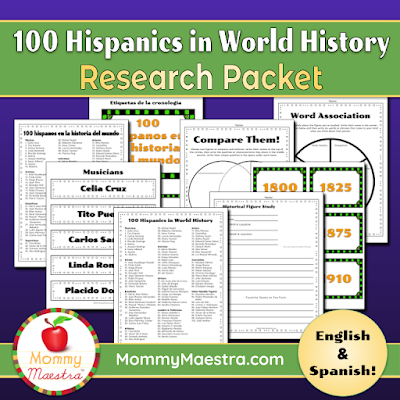
My 100 Hispanics in World History Research Packet is a 79-page unit that allows students to choose from a list of 100 Hispanics in world history to research and share. The list is available in two formats:

  • The historical figures are arranged by century starting with the 1400s to the present
  • The historical figures are arranged by field of influence, including musicians, artists, activists, scientists, athletes, writers, journalists, actors, leaders & politicians, and other notable figures.
Pages for note-taking, research, and one-page presentations are included, as are additional pages for comparing/contrasting historical figures, word association, and listing new vocabulary. In addition, it contains printable date cards and information labels for creating a timeline display on a wall. Instructions are included.

And as always, this entire packet is available in both English and Spanish. Simply select the version that best suits your needs.

Historical Figure & Event Study Pages


Or you may prefer to simply assign a historical figure or event to your student(s) and have them do the research. These study pages help guide the student in what information to look for and record. Can be used for ANY historical figure or event. 


You May Also Like Learning About...


Here are some of my other posts and reading passages that you may enjoy.


LinkWithin

Related Posts Plugin for WordPress, Blogger...