Showing posts with label world cultures. Show all posts

Thursday, April 30, 2026

Homeschool Geography Curriculum: Around the World Stories

Around the World Stories: A geography curriculum for kids ages 5 - 11.


The following post is a collaboration between Around the World Stories and MommyMaestra. All thoughts and opinions are my own.

Homeschool parents! If you're raising a world citizen and are searching for a geography curriculum that supports your efforts, then Around the World Stories may be just what you're looking for!

As a mom, one of the most important things I want to pass on to my children is an appreciation for world cultures and travel. I’ve been traveling ever since I was a kid, and my husband and I have tried hard to continue traveling with our kids while they are growing up. So when I was given the opportunity to review Around the World Stories, a program created to make learning about countries around the world, I enthusiastically agreed. Here's what I think about it...

Geography & Social Studies Curriculum

I love it when I can knock out more than one subject at a time. And I especially love it when a company recognizes that geography is more than just memorizing maps and names. It’s about the people and the traditions and the culture. And this curriculum - Around the World Stories - does exactly that. It combines both geography and social studies to help make countries around the world come alive for kids using audiobook stories, printable activities, and cultural information. My 8 year old is the perfect age for this program, and I will be able to use it for several more years, so this is a winner, winner, chicken dinner in my book. Overall, the program is best suited for kids ages 4 or 5 to 11-years-old.

If I wasn't a homeschooler, I would still be intrigued by this program. Especially since many schools no longer teach geography. If that was the case, I think I would use this program over the summer with my kids, or as a weekend activity once a month.

Around the World Stories offers printables for each country, including recipes like these from Italy.

Printable Learning Activities

Around the World Studies is like a digital library. Parents (or students) can login to the website and select a country that they want to learn about. The country’s home page pops up with 5 tabs to choose from:

  • Stories (more about that in a minute)

  • Exploring [Country]

  • Arts & Culture

  • Food

  • Printables

The Exploring tab gives you a broad overview of the country with little sections that highlight important aspects of the country. For example, when I select the country Spain and click on the Exploring Spain tab, I learn a lot of fun facts about the country, such as their New Year’s tradition of eating 12 grapes at midnight, or that Spain has more than 3,000 miles of coastline, or what Spanish tapas are. The topics selected for this page typically relate back to the stories that are shared for each country. 

In Art & Culture, they talk about Flamenco, Cubism, and the master painter, Picasso. I like that it included an art project with video tutorials for creating your own Cubist painting. And in the Food tab, they highlight iconic foods and even include printable recipes!

It seemed to me that most of the tabs included at least one printable activity, but you can easily find them all in one place under the Printables tab. This just makes it easier to find them once you’ve finished listening to the stories and going through the tabs.


The Stories


The real highlight of this curriculum, though, are the stories. Around the World Stories has written original stories that they have then uploaded as audiobooks. Each country has several to choose from. They typically run about 30 minutes.


My 8yo finds the stories engaging for two reasons: 

  1. Different characters are often portrayed by different voice actors, including kids.

  2. The stories themselves are unique and fun to listen to.


I like that I can play the stories anytime and anywhere. We can listen in long car rides, during our school lessons, or even at bed time. The first night we listened to one before bed, we thought it was a fun change from our traditional bedtime reading routine. In fact, my son asked if we could listen to another the next night. For now, I have agreed to listen to one once a week instead of reading a bedtime story.


And since I know that audiobooks play such a valuable role in my son’s reading development, I can take extra joy in listening.


Around the World Studies works great with individual children and in classroom settings.


Great for Individuals or Groups


This semester, I have the pleasure of helping out our local homeschool co-op by teaching Global Cultures & Travel Studies to middle schoolers. I have found this program to be such a great way to supplement my lessons. Each week, I choose a different country to teach about. While designing my lesson, I use Around the World Stories as a reference for topics and printable resources. Time doesn’t really allow for me to use the stories, and my students may be a little old for them anyway, but the printable activities were a great addition.


Right now, Around the World Stories offers content for 21 countries:

  • Austria 

  • China

  • Czech Republic

  • England

  • France

  • Germany

  • Greece

  • India

  • Ireland

  • Italy

  • Japan

  • Nepal

  • Netherland

  • Poland

  • Portugal

  • Russia

  • South Korea

  • Spain

  • Thailand

  • Turkey

  • Vietnam


Want to see them add a particular country? Follow them on Facebook or Instagram and let them know!


How it Works


Around the World Stories is a subscription-based program. For $29.95 a month, you get a ticket each month to use in the digital library. Just login to the website and click on Stories to see the list of countries. Click on the one you want to learn about that month and get immediate access. Or you can choose the yearly option and get 12 tickets all at once. And if you use up all 12 before the year is out? No worries, you can buy extra tickets at any time. 


If your kids are still too young (or are grown up), but it would be perfect for nieces, nephews, or grandchildren, then you'll be happy to know that they also offer Gift Certificates!


The hardest part of it all is figuring out which country to start with!


If this program sounds like a good fit for your child, visit their website today to learn more.


Want to find this post again? Pin it!


Other Posts for Elementary Resources that You May Enjoy:


Thursday, September 15, 2022

Under the Mambo Moon


You can't celebrate Hispanic Heritage Month and Hispanic culture without talking about music. The Spanish and Latin beats are embedded in the foundations of Spain and Latin America. One of my favorite books to recommend when it comes to introducing children to the music of Latin America is Under the Mambo Moon. We got a copy of it years ago and it still has a special place in my heart. It is such an original way to talk about music that it engages young readers. Here's a review I wrote a few years ago for the Latin Baby Book Club.

This post contains affiliate links.

A chapter book highlighting Latin American music


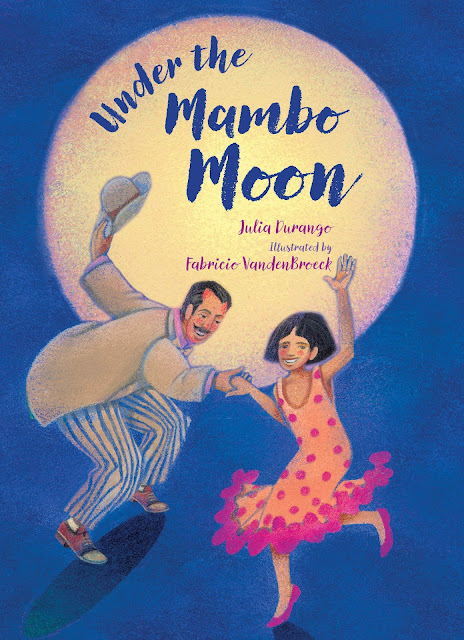
Under the Mambo Moon
by Julia Durango
illustrated by Fabricio VandenBroeck

My familia loves music - especially anything with a Latin rhythm. So I was overjoyed to find the new book, Under the Mambo Moon. Inside the pages of this unique story, readers can explore various types of Latin American music - from Colombia’s cumbia to the Dominican merengue to the candombé of Uruguay.

The story line itself is a little unusual. The first thought that came to my mind was that this book would be perfect for a play. Young Marisol is the narrator. She helps out her Papi at his music store where people come in to buy their favorite songs. Papi says, “You can read people’s souls by the music they listen to.” (Looking at my CD and record collection, I wonder what my soul is saying? I’ve got everything from Sergio Mendes & Brasil ’66 to SpyroGyra to Yiddish-American Klezmer music. Oy.)

Interspersed throughout the book, are brief poems told by each customer who enters the store to buy the music of their homeland. João is a fan of bossa nova, while Professor Soto prefers Andean tunes that he has heard played on a zampoña player. Mr. and Mrs. Mayer are tango dancers, but young Gabriel loves the vallenatos of Colombia.

VandenBroeck cleverly uses color to help the reader distinguish between the main story line and the individual poems for each character. I appreciate the careful attention that he gave to depict each dance accurately with special attention to costumes and musical instruments.

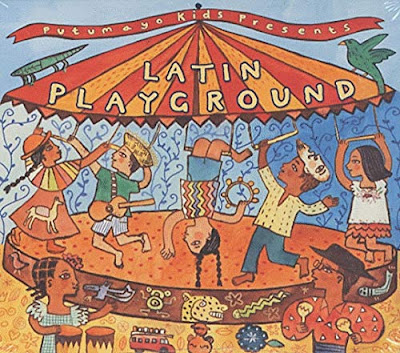
The only thing that would make this book better would be an actual CD to accompany it and provide examples of each musical style. However, Putumayo has some great albums that would complement this book nicely. Or you can visit All Around This World's website and listen to music from different countries.

I also like how at the back of the book, the author includes a brief history of the amazingly diverse Latin American music and dance. Durango talks about the influence of indigenous, European, and African cultures on the rhythms and even the musical instruments used to create the various styles of music. She also includes a short description of each music style mentioned in the story.

Under the Mambo Moon is written in English with some embedded Spanish text. This book is best suited for children ages 4 and up.

Parents and teachers: This book is an awesome resource if you are studying music, Latin America, culture, traditions, multiculturalism, the colonization of the Americas, etc.

Buy your own copy of Under the Mambo Moon!


Here's my affiliate link for Amazon. Using this link to purchase Under the Mambo Moon helps keep MommyMaestra going!


Albums that complement this book


Rumba, Mambo, Cha Cha Cha


Samba Bossa Nova


Latin Playground


Happy reading!

Other Posts You May Enjoy


Monday, December 6, 2021

Holiday Gifting: Picture Book of World Celebrations


This is one of the books on my list to buy this year! 

Celebrations Around the World

Let's Celebrate! Special Days Around the World features 13 holidays found in different cultures. What a fabulous resource for those of us raising global citizens. 

You'll read about holidays like Kodomo no Hi (Children's Day) in Japan, Matariki in New Zealand, Diwali in India, New Yam Festival in Nigeria, and many more. It even includes Día de los Muertos! :)

The book includes a timeline so that you can see on what day of the year each holiday is celebrated. There's also a section of fun facts for each holiday that includes words in different languages as they relate to each celebration.


And the illustrations are fantastic. This is a vibrant picture book with just enough information so as not to overwhelm young readers. Instead they are left engaged and wanting to learn more.

Online Theatrical Story Time

And if you'd like to extend the learning, the Fort Worth Kimbell Art Museum is hosting a BILINGUAL theatrical story time for FREE and ONLINE, tomorrow, Tuesday, December 7th at 11 am CT. You read that right - it's in English AND SPANISH.

The name of the event is Pictures and Pages/Fotos y Libros. You can either RSVP to their FB event page or subscribe to their YouTube channel to get notified so that you don't forget.

Get It!

Be sure to visit your local library to ask for this title. 

And if you'd like to purchase this book, you can find it on Amazon or Bookshop:

Thursday, June 10, 2021

Homeschool High School World Literature Curriculum

Learning Language Arts Through Literature

The following is a sponsored post in collaboration with Common Sense Press. All thoughts and opinions are my own. 

I'm continuing today with my homeschooling high school series. Today's post focuses on Language Arts. This was really a huge struggle for me, but I am ecstatic that I have finally settled on the Learning Language Arts Through Literature (LLATL) curriculum from Common Sense Press that delves deep and provides us with exactly what we need to study language arts in high school.  

Quick Overview

Program: Learning Language Arts Through Literature: The Gold Book - World Literature
Subject(s): literacy, literature, world cultures, ELA
Religious Perspective: Explores World Religions through their literature
Format: Books
Grades: 9th - 12th
Language: English 
Price: $14.00 - $27.00


Homeschool Literature Curriculum


Finding a language arts curriculum that meets my expectations has always been a struggle. And once my middle kid started 9th grade, my stress level about this subject skyrocketed. UNTIL I learned about LLATL. I just wish that I had learned about it before we started 9th grade instead of a few months ago. 

This program is simple and easy to implement. Easy to teach AND easy for my student to get done on his own. I don't necessarily have to teach this subject. But I do because I love it.

LLATL - World Lit sample


Open-and-Go Curriculum


The program uses two main books: the text book which contains all the lessons, and A World Literature Anthology, with excerpts of (yep!) world literature. To complete the course, I ran up to my local Half-Price Book Store and purchased copies of The Odyssey by Homer, The Little Prince by Antoine de Saint-Exupéry, and Cry, the Beloved Country by Alan Paton. I had to order No Fear Shakespeare, Romeo and Juliet by William Shakespeare off of Amazon.

That's it. The textbook and anthology are the main materials my son needs. It's set up for a 5 daily lessons each week, but honestly, you can do as many as you want in a sitting. Sometimes we do one lesson in a day, and sometimes we push and do all five. I LOVE the versatility of it!

But what I love even more, is that this program explores literature from all over the world and throughout history. I've loved learning and exploring right alongside my kid. And when I'm excited about it, he enjoys it more and we have great discussions.

This course isn't designed to read just a few books in their entirety. Instead, it is like a smörgÃ¥sbord that presents amazing literary works from all over the globe. 

The text itself is divided up into 5 sections:
  1. Early Literature,
  2. Epic Poetry,
  3. Medieval - Renaissance,
  4. Enlightenment - Romanticism, and
  5. 20th Century.
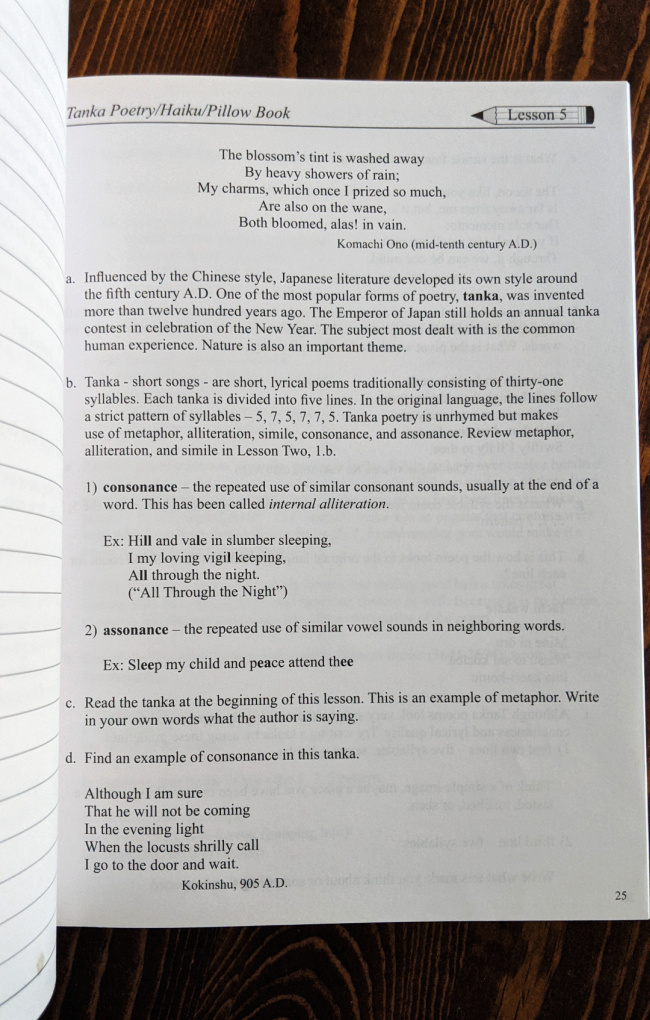
Right now, we are in Epic Poetry, partially because we've so enjoyed exploring some of the new stuff. For example, we've all heard of haiku poetry, but neither one of us had ever heard of tanka poems. We spent some extra time with that. 

I am SO grateful that we homeschool because I don't feel pressured into getting it all done as quickly as possible. We can enjoy this and while we may go ahead and push the learning through the summer, if we don't finish until a few months into the new school year, we're okay with that.

What I Like BEST


I love the diversity and thoroughness of this curriculum. So far, we've read excerpts of Hindu hymns from the Rig Veda, the Epic of Gilgamesh (of course!), African proverbs, Japanese folktales, Aesop's fables, Zen parables, portions of the Bible, the Analects of Confucius, and even suras from the Koran.

Seriously, you can see why I like it and highly recommend it. Last week, I told you about the world cultures curriculum I'm planning for my elementary kid. Now, I'm sharing one for my high schooler!! Yay!

I just cannot stress enough how important it is to me for my kids to travel the world. And if we can't do it physically because of a pandemic, then we'll do it virtually through online programs and books. And curricula like this one from Common Sense Press is excellent. I recommend 100%!!

I also love that my 15yo kid actually LIKES it. This is not always the case with him. He struggles so much with dysgraphia that he automatically complains about any subject with written assignments (Hello? All of them?!). But he does enjoy these lessons.

Based on this experience, I do plan on using their other curricula for high school literature with my kid. Next year, we'll probably dive into British Literature as my kid loves all things British (including the accent).  

If your kids aren't old enough for high school, yet. Check out their other LLATL textbooks. They start with 1st grade.

So if you are homeschooling a high schooler (or preparing to do so in the fall), go and check out this curriculum.

The Discount 


If you're already convinced and off to buy it yourself, then here's a discount code for you! Get 15% off when you enter the code: Summer2021

It's valid through July 31st.

The Giveaway!


The winner gets to choose 1 Teacher/Student set from Learning Language Arts Through Literature or 1 Great Science Adventures!


Want to find this post again? Pin it!

Learning Language Arts Through Literature


Tuesday, June 1, 2021

Igniting Wonder for World Cultures with Picture Books

Beautiful Feet Books

The following is a sponsored post in collaboration with Beautiful Feet Books. All thoughts and opinions are my own. 

I'm a planner. And when it comes to homeschooling, few things excite me as much as discovering new curricula that I think will delight my kids while teaching them valuable lessons. So while I currently have a preschooler, I'm already looking forward to Kindergarten curricula. And my most exciting discovery at the moment, is the Around the World with Picture Books literature pack from Beautiful Feet Books.

(Psst! Don't miss the GREAT giveaway and freebie at the end of this post!)

Quick Overview

Program: Around the World with Picture Books Part 1 from Beautiful Feet Books
Subject(s): literacy, literature, world cultures, geography
Religious Perspective: Christian
Format: Books
Grades: K - 3rd
Language: English 
Price: $27.95 for the Teacher Guide up to $205.95 for all the materials (books included)


Charlotte Mason's Good Books


Beautiful Feet Books is a Charlotte Mason-inspired history and literature curriculum for homeschool families. (If you are new to homeschooling and don't know about the Charlotte Mason method, here's a post I wrote for a quick overview.)

I consider us to be an eclectic homeschool family drawing from various methods those aspects that inspire and engage us the most. What I love best about the Charlotte Mason approach is the use of living books instead of text books. Living books are those written by authors who are knowledgeable and passionate about a particular subject. They make history come alive for the reader and capture their imagination. I used these extensively with my older children and am now looking forward to using them with my youngest.

I also am striving to raise global citizens who can interact with any person of any background from anywhere in the world. So when I discovered that Beautiful Feet Books has several literature packs that explore world cultures, I was ecstatic! 

A look at the Around the World with Picture Books literature pack from Beautiful Feet Books


A Literature Approach


My favorite way to teach young children is through reading, reading, and reading more great books. And that's exactly what Beautiful Feet Books provides. 

I chose to receive Around the World with Picture Books Part 1, which covers Asia, Africa, Australia, and Antarctica. The Asian books dive into China, Japan, Thailand, and India. And the African books explore Morocco, Egypt, Kenya, Tanzania, and Ghana.

The complete set comes with 17 books, a teacher's guide, and a composition book. Included in the 17 books is an atlas that I've been dying to buy for years, but my big kids were just too old for it. I'm so excited to have my hands on it. More about it below...

BUT if you are on a budget, you can also purchase JUST the teacher's guide ($27.95) and then request all the books from your local library. They probably already have most of them, and if not, would surely be happy to order them for you.

The teacher's guide for the Around the World with Picture Books literature pack from Beautiful Feet Books

The Teacher's Guide


Oh. My. 

That's exactly what I thought when I saw the teacher's guide. Seriously, it's remarkable. It's beautifully done. The full-color guide walks you through each of the 70 lessons and provides lots of extra activities and resources to explore, including artworks, nature connections, recipes, and more.

The guide goes from one country to the next until all 11 countries have been explored. As your student completes the art assignments, they should cut and paste them into the notebook (which, by the way, is imported from Japan and specifically designed for beginning writers). Many of these will be the reproducible maps and drawings found in the back of the guide that your child will color in with colored pencils or watercolors. So the pages of the notebook will mostly contain these pieces of art, with minimal writing. Instead, the lesson encourage oral presentations and dialogue with your children to foster a deep connection both with the subject matter and between parent and child.

The Books


And the picture books have been carefully curated to best represent each country. I love the authenticity of each one and the glimpses of culture that they contain. Some have no words, such as Anno's China, which has only illustrations (the back of the book has descriptions of each scene). Each page is full of activity, a collection of snapshots of daily life in China.

Personally, I love that someone has done all the legwork for me and that I don't have to take time to go and search for books for each country and then try to find them in my library, bookstore, or online. Having it all put together saves me time, which I simply don't have to spare. And the guide makes it possible for me to simply open and teach. I can grab it, look it over, then sit down with my youngest and the book(s) of the day.

A peek inside the teacher's guide from the Around the World with Picture Books literature pack from Beautiful Feet Books


What You'll Need


As I mentioned above, this is a literature-based program. The box that arrives supplies almost everything, but you'll also need the following:
  • colored pencils
  • set of watercolors
  • paintbrushes
  • watercolor paper
You may have all of these already. But I really appreciate that there's not a ton of stuff I have to buy to use this program. 

There's also ingredients for the recipes, but that's certainly up to you if you want to make your own, buy it (if you live near restaurants that serve the dishes), or decide to skip some all together. 

One of the great things about this program is that it very flexible and the guide simply provides you with ways to explore and build on the books being read.

My youngest was there for the unboxing and immediately grabbed the book Maps by Aleksandra Mizielinska and Daniel Mizielinski. He was enthralled (to my delight!) by all the illustrations. And we've even read some of the books already at his insistence. Totally okay. We read the same books over and over again. So it'll be fun when we add the activities from the guide - that will give the books a fresh slant. 

If this sounds like type of program you're interested in using with your elementary student, go take a look at their product page for more information!


The Freebie


Beautiful Feet Books is giving away the free eBook, 5 Ways to Know If A Book Is Worth Sharing With Your Kids by Josh Berg. To get your copy, sign up here.

Want to find this post again? Pin it!
Friday, May 7, 2021

Makanaka's World: Adventure in Morocco

This is a sponsored book post with Global Kidz House. All thoughts and opinions are my own. This post uses affiliate links.

If you are like me, you are always on the lookout for diverse books to read and share with your children. Raising a global citizen, a person who is able to communicate and appreciate people from all across the world, is an empowering action. Doing so helps us enact change in our world. And part of that journey to global citizenship is deeply rooted in diverse literature. Which is why today, I'm so very pleased to share Global Kidz House with you!

This new publishing company highlights the stories of Africa and the African diaspora through their publication of children's books. Their first book has recently been released and I have had the opportunity to get my hands on a copy of it. 

Makanaka's World is a series following a young girl named Makanaka and her pet parrot, Fari. Makanaka has friends ALL over the world, of course, and loves to visit them with the help of Fari. He isn't just your average pet parrot. Her little feathered friend has the special ability to transform into an airplane that can fly anywhere in the world. 

In this first book, Adventure in Morocco (aff), the two fly to the North African country to visit Makanaka's friend, Nadia. Upon their arrival, there is trouble to be found, and Makanaka and her friends set out to help. Along the way, they explore the city of Casablanca and its rich culture.

The illustrations are lovely; they are colorful and engaging without being too busy for little readers. 

There is also a glossary and a world map in the back of the book, as well as a couple of pages with photographs that give a mini tour of Morocco. 

This book is recommended for children in K - 3rd or 5 - 8 years old, but my 3yo loves it. 

The really fun thing is that there is also a 7-page curriculum guide for the book. It comes with discussion questions, recipes, and activity ideas to go along with the story. 

This story is a good addition for lesson plans on world cultures, travel, geography, global citizens, family, friends, Africa, Morocco, Casablanca, soccer, languages, Arabic, and more.

You can click the links above to purchase this book, or find it here on Amazon:

Thursday, March 25, 2021

National Spanish Paella Day

Paella. © Can Stock Photo / Alex9500

Did you know that this Saturday - March 27th - is National Spanish Paella Day?

I have a profound love of paella. It comes from my dad's side of the family. As a child, when I would visit Spain, paella became one of my favorite dishes. I associate the flavor with beautiful memories. 

So in honor of National Spanish Paella Day, I wanted to share a little bit of the history of this iconic dish.

Paella is a Spanish rice dish. Together with gazpacho, it is probably considered the national dish by many outside of the country. But this meal finds its roots in eastern Spain, and Spaniards all recognize it as being the official dish of Valencia. This city is of great importance to Spain due to its economic impact on the country. The Port of Valencia is the fifth busiest seaport in Europe and the busiest port in the Mediterranean. It employs 15,000 people who service more than 7,500 ships annually. All of this is important because of the trade goods that are imported (and exported) through this port. And one of those is saffron (more about that below).

Valencia is also Spain's leading rice producer. It was introduced to Spain by the Moors in 711. In fact, rice in Spanish is called "arroz" a word that finds its roots in Arabic ('arz), rather than Latin.

Paella cooking over an open fire. Jan Harenburg, CC BY 4.0, via Wikimedia Commons

Originally, paella was a laborer's dish. Those who worked the rice fields cooked it in a wide pan over an open fire. These farmers would add whatever meats and vegetables they had available. The true original paella recipe used chicken or rabbit meat. Today, however, paella sprinkled with seafood - especially shrimp, octopus, and clams - is popular throughout the country.

The name paella itself is believed to come from the Valencian word for the unique shallow pan in which it is cooked. But there are many other lovely legends about where the dish got its name. (Challenge your kids to research it!)

Recipes are plentiful throughout Spain, but there are two main ingredients that identify it as being paella: the rice (of course) and saffron, the spice that gives it that unique yellow/golden appearance. In addition to chicken, rabbit, and seafood, other meats include sausage, and even duck. The chef may even go to great lengths to artfully arrange the dish before serving. Check out this example: 

Seafood paella. Image by Manuel Martín Vicente, CC BY 2.0, via Wikimedia Commons

Since its beginning, however, this dish has been traditionally cooked and served outside, especially for large (family) gatherings. 

Such a fantastic dish. Here are links to some fabulous recipes online:

And if you'd like to use this mini lesson with your own students or children, check out my one-page reading passage! You can find it here in my TpT store.


Are you going to try one of the recipes linked to above? You may want to get this equipment, too!


You may also like:

LinkWithin

Related Posts Plugin for WordPress, Blogger...