Showing posts with label preliteracy. Show all posts

Monday, November 14, 2022

7 Alphabet Learning Toys


It's the time of year when I shift my attention to gift buying in preparation for the upcoming holiday season. I start thinking about what my kids want and what they need. And where they're concerned, I'm always thinking about fun educational products that will help them learn and grow. Over the past year, I have focused on alphabet toys for preschoolers and kindergartners to help my youngest. And I wanted to share some of the ones that we've used, and a few others that I think would be great tools in a child's pre-literacy journey.

Educational Insights and Learning Resources are my two go-to brands for this type of resource. They have so many excellent educational toys to help teach and reinforce basic skills. But there are a few other smaller, but wonderful companies creating learning magic. I've tried to list the resources below in order of complexity, beginning with uppercase letter recognition and ending with beginning sounds.

The following post contains affiliate links.

Peaceable Kingdom Alphabet Bingo!


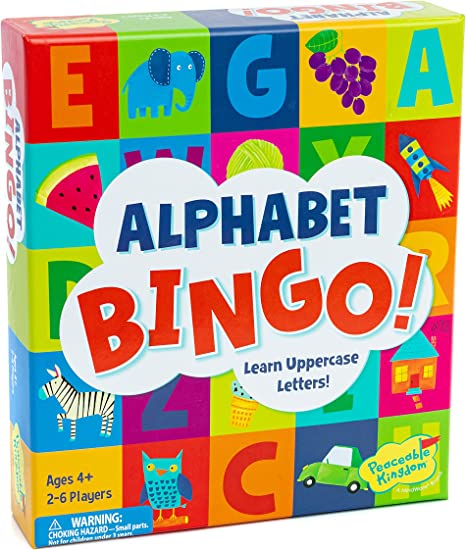
Alphabet Bingo


We began with this game and still play it today, even though my son knows his alphabet letters. This bingo game comes with six double-sided game boards, a bunch of counters, and 26 letter tokens with the capital on one side and an image on the other. Each image begins with the letter on the other side of the token. 

When we first started playing this game, my son always wanted to look for the picture which was easier, but I would always say the letter out loud instead of the name of the image. Or I would say, "R for rocket," emphasizing the r sound at the beginning of the word. This is a great first game for alphabet recognition.

This game is from Peaceable Kingdom.


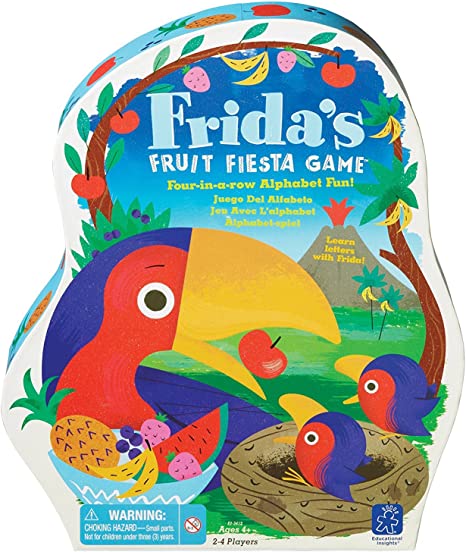
Frida's Fruit Fiesta Alphabet Game


Frida's Fruit Fiesta Alphabet Game


This is, hands down, my favorite alphabet toy. Technically, it's a 2- (or more) player game. But it's one that even I don't mind playing regularly with my 5 year old. He's old enough now to recognize all the letters, but we still play the game because it's fun and a good way to reinforce his letter recognition.

This game comes with four player boards, three (connected) spinners, 26 game pieces (fruit bowls with a letter), and Frida (a toucan-shaped tweezer tool). Instructions are also included, of course. 

The objective of the game is to get four in a row on your player board in a manner similar to bingo (left-right, up-down, or diagonally). You spin all three spinners and choose the letter of the alphabet you want to place on your player board. Then your child uses Frida to "collect" the fruit bowl that has the letter in question.

It's super fun for littles and great for helping them identify upper case letters. The only thing I would change about this game would be to add lowercase letters as well.

This game is by Educational Insights.

Alphabet Learning Locks

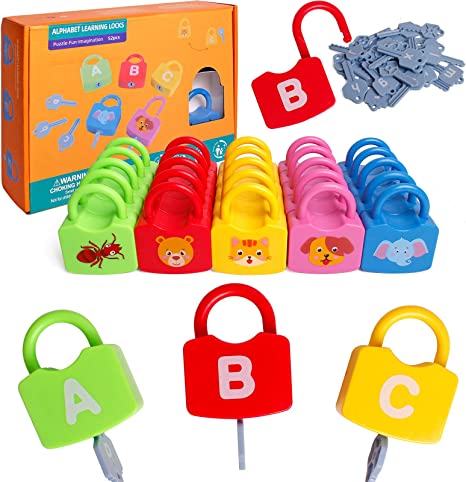
Alphabet Learning Locks


This is another great toy that we have. I noticed a long time ago that my son was fascinated by keys and locks. So whoever invented this was pretty brilliant. Kids have to find the right key to unlock the padlock - and the "key" is that they have to match the upper- and lowercase letters! 

This is a really fun toy set by Dinhon.


Alphabet Acorns Activity Se


Alphabet Acorns Activity Set


I bought this set a few years ago for my son and he still plays with them. Alphabet Acorns comes with 78 pieces: 26 acorn bases, 26 acorn "caps" and 26 color-coded counters/figures. 

Each acorn has a capital letter displayed on the front, it's lowercase partner on the inside of the lid, and a surprise hidden inside that begins with the letter on the acorn. What a great way to help teach the alphabet! I really highly recommend this set. 

But parents be warned: It can be a challenge to keep up with the small figures inside the acorns if you don't keep an eye on your child while they are playing with the set.

This set is by Learning Resources.


ABC Cookies


ABC Cookies


This set is also on my list to purchase because it is the next level up. ABC Cookies comes with four different games that you can play to learn different concepts: 

  • letter recognition
  • upper and lowercase matching
  • letter sequencing
  • beginning sounds
Letter sequencing is, I think, often overlooked especially in homeschooling. So I really like this set from Learning Resources.


Learning Resources Smart Snacks Alpha Pops


Alpha Pops


The focus of this set is to learn upper and lowercase letters. It comes with 26 double-sided pops, that are also color coded to help children learn which letters go together. All the popsicles will connect with each other, so they may also be used to build simple two-letter words, such as "go," "at," "me," etc.

This set is also by Learning Resources.


Alphabet Island


I haven't actually bought Alphabet Island, but it is on my list of games to get this year. It caught my eye because players are required to match upper and lowercase letters or beginning sounds with the corresponding pictures. My 5 yo definitely loves playing games, so this is high on my list this year for Christmas. And it's a treasure hunt theme, which I know he will enjoy. 

This game is by Learning Resources.


Other Posts You May Enjoy


Wednesday, March 25, 2020

Free Download: Bilingual Alphabet Pages


Many parents are opting to preschool their children at home. So much has happened in recent years -- maybe too much for some of us. They/we are taking the extra time to spend with their little ones and keep them safe while learning those important skills and concepts that preschoolers need to master. One thing I had started working on before Covid-19 burst upon the scene and took over our lives was this set of bilingual alphabet pages for my toddler. He's still young, so it is an introduction for him. And hopefully, a way to keep him engaged while I am helping his older brother with school.

Printable Bilingual Alphabet Worksheets


This set of alphabet pages is unique because I chose images of items that all start with the same letter in both English and Spanish. So you can choose whichever language you prefer to use with your child. Just print the letter you are looking for and share it with your child. 

Ways to Use Them


These pages are versatile and may be used any way you want. But if you are looking for some suggestions, here's what I recommend:

  • Choose the language you want to use (English or Spanish).
  • Give your child the page and let them color the images.
  • Ask them if they know what letter is on the page.
  • Point to the letter and say its name, then say the sound it makes. Start with the capital letter and then repeat with the lowercase letter.
  • Point to the images at the top of the page and say their names. Be sure to emphasize the beginning sound of each one (ex., ah-ah-aguacate or ah-ah-avocado).
  • Have them practice writing the letters on the lines at the bottom of the page.

How to Add Variety


Some children love repetition. They enjoy the security of knowing what to expect. In this instance, following the same routine with these alphabet pages is important. 

But some children (like my youngest) love the unexpected. I change things up for him this way: Depending on the letter, we decorate it a totally different way each time. Here are some different ways to "color" a letter:

  • use crayons
  • use markers
  • use colored pencils
  • use play-dough to fill in the letters 
  • use dot markers
  • use Q-tips dipped in washable paint
  • use fingerpaints (washable!!!)
  • use watercolors
  • use chalk
  • use stickers to fill the letters
  • use stamps to fill
  • dip a pencil eraser into paint or stamp ink and fill the letters with dots
  • glue yarn inside the letters
  • glue pasta to them
  • glue buttons in them
  • glue pompoms in them
  • fill the letters with beans
  • fill the letters with rice
  • fill the letters with Cheerios
  • fill with water bottle caps
  • place miniature figures (dinosaurs, horses, etc.) inside the letters
  • use Legos to fill them
  • cover the letter shape with sticky notes

There is no limit. Use your imagination!


Great Activity to Keep Younger Children Busy


It's been hard to keep my oldest son focused on his school work. And my preschooler is getting into everything and demanding our attention when I'm trying to help his older brother. So these pages are one activity that makes him feel like he's also doing school with his brother. And they also keep him occupied while I teach my older child.

If you are also in the same boat with little ones underfoot making school time difficult, I hope these  help you as much as they help me! 


Wednesday, November 14, 2018

Thanksgiving Activity Pack for Preschoolers in English & Spanish


I've been on a creative roll the last couple of weeks. Thanksgiving is possibly my favorite holiday, so I've been digging out all of my Thanksgiving decorations for the house. And although I can't stand to be cold (and, oh, has the wind been so bitterly cold!), I love autumn: the colors, the scents, the images!

My thoughts have been on that early Thanksgiving between the Native Americans and the English settlers. I think about how dreary life might have been for the English without reliable heat, with the loss of loved ones, with illness and starvation. I think about the wives and mothers who braved the long trip at sea to come to this unknown (to them) land and how much courage that must have taken...and how much fear probably accompanied it. Starting over is hard. I've done it several times now. Most recently a year ago when we moved, I hope for the final time, back to Texas.

I think about the generosity of Squanto and his tribe toward these new immigrants who were so very, very different. Even though the relationship between settlers and the indigenous people swiftly deteriorated and led to a complete conquering of several Indian nations, for this brief moment, things were peaceable and life was good between the two. This is the thought that I cling to these days: that people can be good if they choose to be. People can let go of fear and embrace love for themselves and others. Greed can be vanquished, because really, what good is it? We can't take anything with us when we die, except our soul. And, I sure hope that mine is good and reflects love.

Anyway, these thoughts and my creativity have spilled forth into new printables. The first is this Thanksgiving Activity Pack for Pre-K and Kindergarten. It focuses, of course, on those basic skills that our little ones must learn: counting, beginning sounds, letter recognition, new vocabulary, writing skills, and more. But it also quietly reflects friendship, working together, and generosity. I wish my baby boy was old enough to enjoy it now, but he still has a few years to go.

I know that there are quite a few of these available online, but how many are available in both English and Spanish?

I'll tell you about my other fun activity next time. For now, you can find this print-and-go download in my TpT store and MommyMaestra shop.

Enjoy!

Friday, August 3, 2018

Mrs. Wordsmith: The Social Journey

Preschool is such a critical time in your child's development. Study after study indicates that a good preschool can have a longlasting impact on your child's future academic success, as well as their adult lives.

I receive a steady stream of emails and messages asking me about how to preschool at home. So, of course, you can find many posts here on MommyMaestra about the importance of preschool and how to give your child a quality preschool education at home. I'm ALWAYS happy to discover new, EFFECTIVE products that help parents and caregivers who are homeschooling their preschoolers.

And today's resource is just that!

When Mrs. Wordsmith reached out to me to ask if I would review their new reading tool for students, I immediately said, "YES!" And I'm so glad I did because I love the program.

Mrs. Wordsmith is designed to improve your child's learning and memory through various programs. It's based out of the UK, but they launched here in the U.S. at the beginning of the summer.

I received their Social Journey vocabulary program, and love both the concept and the application of this learning tool. It is designed for kids 3 - 6 years old and the focus is social-emotional skills, which are extremely valuable to your child's growth and success in life. Teaching your child these skills ensures that they are "school ready" by the time they start kindergarten.

And the program is two-fold as it not only teaches kids these important skills, but also does it through literacy-boosting activities. Here's something that struck me when reading the instruction booklet inside the box I received. It said:
When children learn vocabulary to accurately identify their feelings, they are better able to manage them. Likewise, labeling and discussing concepts like "community" empowers children to more ably engage with their world (Elias 2014).

Makes sense, no?

And it is apparent that a lot of time and energy has gone into this product. Here's a look at what you will receive:

Each month, a new box will arrive at your door and the activities will focus on a different aspect of the social-emotional skill set. For example, learning growth-words such as push, try and effort, helps children understand their actions and feelings.


I love how the inside of the box is carefully organized to make sense for the parent/caregiver. There is no guesswork here. You'll find an instruction booklet immediately upon opening the box - but really, the process is quite simple.


You start with the picture book and read at your own pace. Each story introduces the new words your child will focus on learning.


Then you set up your activity book stand and place the activity book on it and open to the first word. You've probably read on MommyMaestra more than once about how creating a print-rich environment for children is crucial for developing their literacy skills. Well, here's an example of how to create a print-rich environment: place words on display in your home! Put your stand in an accessible place where your child can see it throughout the day and look at it at his or her leisure.


Each month has around 20 words for you to teach your little one. You can just take your time, letting the new word hang on the book stand for a while before tearing it off and completing the activity on the back. Give it time to soak in.


And, finally, there are the word cards which you can use to play games with your child in order to reinforce their meaning.

What a great product!! I can't wait to use it with my youngest child as soon as he is old enough.

THE GIVEAWAY

Mrs. Wordsmith has graciously offered a 12-month subscription to their Social Journey product to one (1) MommyMaestra reader! If you are caring for a preschooler this school year, this would be a must-have for your lesson plans.

To enter, simply use the Rafflecopter below.

¡Buena suerte!


a Rafflecopter giveaway


Disclosure: I received a sample box for review purposes. All thought and opinions are my own.

Thursday, July 6, 2017

8 Skills Every Literate Child Must Master


Although defined as the ability to read and write, literacy itself is a complex combination of skills. It goes far beyond simply reading and writing. In reality, literacy is the root of all human communication. It requires an ability to identify and interpret messages - spoken or written -  and the ability to effectively formulate and communicate a response.

For children, part of becoming literate requires learning - and mastering - the following skills:

  • print awareness
  • letter identification
  • phonemic awareness
  • phonics
  • reading fluency
  • vocabulary
  • comprehension
  • writing
  • spelling & punctuation

The first step for children is to learn print awareness. This is simply their ability to understand and use print as a communication tool. Kids learn that books are for reading; the words relay information and tell a story. Signs in our environment provide directions, information, or warnings.

Letter identification comes next. Teaching letter identification should begin in preschool at the latest. Really, parents should be reading to their babies and toddlers daily, pointing at words and letters, and creating a print-rich environment for their children through toys, books, artwork, posters, puzzles, alphabet blocks, and more. There are also countless activities dedicated to developing a child's ability to identify the letters of the alphabet. You can find many fabulous ideas on my Pinterest Letter Identification Board.

Phonemic awareness is a subset of phonological awareness in which listeners are able to hear, identify and manipulate phonemes, the smallest units of sound that can differentiate meaning. Separating the spoken word "cat" into three distinct phonemes, /k/, /æ/, and /t/, requires phonemic awareness. In simple terms, it is associating specific sounds, called phonemes, with specific letters. English is a bit crazy since it often associates multiple sounds to single letters. We have 26 letters in our alphabet, but we have more than 44 phonemes. For example, the letter Y makes four sounds, as seen in the following words: sky, gym, yoyo, baby. And once you begin combining letters, the number of sounds explodes!

Phonics is the ability to put those phonemes, or letter sounds, together to create words. Teachers always say, "sound it out" to children learning to read. It is a system for learning to read written language. Phonics is closely linked to decoding, the skill associated with interpreting symbols - in this case: letters and words.

Fluency is the ability to read a text accurately, quickly, and with expression. Fluency, in my opinion, takes more time and practice to master. Children who read fluently don't focus on one word read it out loud, and then move on to the next in a choppy manner. For example:

"Maya. The. Cat. Is. Black. And. Traps. Birds. In. The. Yard. And. Eats. Them."

By the time the child has gotten to the end of the sentence, they don't remember what color Maya was because they were focused on decoding one word at a time. Fluency is much smoother and develops after decoding has been mastered so that the child is already looking ahead to the next word and/or thinking about what they just read.

It is important because it provides a bridge between word recognition and comprehension. Over time and with practice, fluent readers automatically recognize words and quickly group them together to gain an understanding of the information being relayed.

Other elements of fluency include rhythm and emotion. When fluent readers read aloud, they sound like they are having a conversation. There's no hesitation and they emphasize certain words. Their voice rises and falls. Listening to audiobooks is an excellent way to help a child learn inflection and rhythm. Reading poetry is another great way to develop these skills.

Developing vocabulary is the next step. If children have a limited vocabulary, it can be hard to communicate effectively. Vocabulary goes beyond decoding to the actual meaning of words. The more words you know and whose meaning you understand, the greater your vocabulary, the better you are at communicating.

Reading comprehension is the ability to read text, process it, and understand its meaning. How well a child is able to comprehend text is influenced by their traits and skills, one of which is the ability to make inferences. An inference is basically an educated guess. You come to a conclusion based on something you read.

"María drove her car to the panadería to stock up on pan dulce."

From this sentence, I would infer that María is not a child and that she has a sweet tooth. Why? Because she must be old enough to drive her car and she is buying a bunch of sweet bread. (Of course, she might be buying it for another reason, but I would need more information.)

Developing a child's reading comprehension skills requires the parent/teacher to stop and ask the child questions about what they've read.

  • Why do you think he did that? 
  • What do you think will happen next? 
  • How did he feel about what just happened? Why?

The questions need to require more than yes or no answers. They should require the child to think about what they've just learned and recall important events or information.

Equally important to reading is the ability to write well. Literate children not only know how to read, but also how to respond and express their own thoughts or relay valuable information in written form. Children should be able to transfer their thoughts to paper in an organized and sequential manner.

And finally, we have spelling and punctuation. These go hand in hand with writing because a misspelled word can either distract the intended reader, or worse, relay the wrong information. Remember María? What if she walked into the panadería and saw this sign:

"Don't touch the pan dulce with your hands - please use tongue"

While María might actually enjoy tasting all of the pan dulce first, the abuelita waiting in line behind her might object and prefer that María use the TONGS instead.

Correct punctuation also provides the reader with guidance for decoding the information being presented. We've all seen the following meme on why grammar matters:

Carlos loves cooking his dog and his family.

No, Carlos is not a cannibal. He actually enjoys cooking, and he enjoys his dog, and he enjoys his family. But punctuation can change the meaning of a sentence dramatically.


Wednesday, March 29, 2017

Bilingual Easter-Themed Activity Pages for Preschool


I've got several new projects in the works, one of which I can't wait to share with you. But it's not quite done yet. So in the meantime, I'm happy to announce that I have a new more comprehensive Easter-themed activity pack available for your little preschoolers!

I felt like I needed to replace the older Easter worksheets I'd made a few years ago. And since lots of MM readers are always writing me asking about preschool resources, I decided to expand the file with additional activities that help develop those skills your children should be learning in preschool to prepare for Kindergarten.


I really wanted to incorporate Latino culture in the packet, so in addition to the Easter Bunny and Easter chicks, you'll also find activities that feature one of my favorite Hispanic traditions: cascarones!

This packet is heavy on developing number recognition through fun counting activities. You'll also find pages that help your child recognize patterns and shapes.


And I didn't forget those vocabulary and pre-writing skills! Strengthen pencil grip and beginning letter recognition with tracing activities.

There are 10 pages of different activities and they are available in both English and Spanish so you can choose the ones that best suit your needs.

You can find this new packet both in my TpT store .

Enjoy!

Thursday, August 18, 2016

WordWorld's It's Time for School on DVD


One of the best concepts for an educational TV show, in my opinion, is WordWorld. It really was a genius idea for helping children grow up in a print-rich environment. But did you know that you can buy the show on DVD? I didn't until PBS KIDS sent me a copy. And I thought that it would be great to share it with you since with school starting, this particular WordWorld DVD is especially timely.

WordWorld's "It's Time for School" collection features eight different stories, starting with Shark's First Day of School. It's a sweet episode that helps prepare children for their first day in a school setting. Like many kids, Shark is afraid to go, but with the help of his good friend, Duck, he finds the courage he needs. Cat, the teacher, is encouraging and fun and by the end of the day, he's had a great time.

I love that this DVD set also comes with a learning and activity book featuring the WordWorld characters. Inside are coloring pages and activities that help children learn to associate the characters with their written name.

You can also visit the WordWorld website where you'll find interactive books, apps, and games to extend the learning your child gets from each episode. There's even a section for parents and educators with links to pages that describe the show's educational approach and tips for teaching at home or in the classroom.


If you'd like to buy your copy of this awesome little DVD to share with your preschooler, visit the PBS Educational Media shop.

Enjoy!

Wednesday, April 8, 2015

Free Spanish Game to Build Letter Naming Fluency


This post contains affiliate links.

April's freebie from our sponsor, Lectura para niños is "Fluidez de letras," a simple game to strengthen your child's letter naming fluency in Spanish.

Leah says that in kindergarten, there is a fluency benchmark that the students must meet for the IDEL - Dibels assessment. To help her students develop this skill, Lectura para niños has created an easy game for kids.

Letter recognition is a critical pre-literacy skill that all children need in order to begin reading. Unfortunately, many Latino children begin kindergaren without this skill, causing them to fall behind their peers. Learning to recognize letters is a skill that should begin (and mastered) in preschool. If your child is not enrolled in a preschool program, that's okay, so long as you are actively working with them at home. Resources like this game from Lectura para niños are invaluable tools for professional educators and parents.


There is a wonderful little series of abecedarios, or alphabet books in Spanish (aff link) by Lectorum that I recently discovered. I think it would be a great little supplement for this activity. The ones shown above are just an example of some of the titles included in the series.

But you can also check out Mi abecedario by Maria Parrish, and ¡Marimba! Animales from A to Z by Pat Mora.

For more awesome Spanish materials, especially those that teach children to read in Spanish, check out Lectura para niños on Facebook, Teachers Pay Teachers, Blog, and Pinterest.

Thursday, April 2, 2015

App Review: WordWorld Tales


Do your kids love the PBS KIDS TV show, WordWorld? Did you know that PBS KIDS' first “appisodes” app called WordWorld Tales is now available? It's based on their hit Emmy Award-winning program for preschoolers!


Subject(s): language arts
Brief Description: An interactive story tales app that focuses on early literacy.
Price: FREE
Language: English
Ages: 2 - 5 years
Device: iOS

WordWorld Tales includes a library of exclusive, touchable story tales that focus on early literacy skills. As children explore, discover, collect and create different parts of each appisode, they create their own learning adventures. The app is geared to develop vocabulary and helps children build words. Preschoolers can even sing along to some of their favorite WordWorld songs. 

This app comes with two free appisodes:

Happy Birthday, Dog!: It’s Dog’s birthday and all his friends in WordWorld are planning a surprise party. Help the WordFriends collect all the supplies for Dog’s party while focusing on print awareness, letter recognition and word building.

A Christmas Present for Dog: Something is wrong with Dog’s present from Santa! Discover the giving spirit and help save Dog’s Christmas while focusing on writing letters, letter recognition, and word building.

NOTE: Additional appisodes are available for in-app purchase. 

Thursday, September 18, 2014

5 Activities to Practice Uppercase and Lowercase Vowels in Spanish {Printable}


This month's freebie from our sponsor Monarca Language is a wonderful set of activities to practice lowercase and uppercase vowels in Spanish. Perfect for preschoolers and kindergartners, these five pages develop letter recognition.

If you are not familiar with Monarca Language, it is a most fabulous resource for families with preschoolers at home and who are raising them bilingually. If you have chosen to homeschooler your preschooler, Monarca Language has a complete curriculum that you can access online. You can read my review of the program here, and try out lots of free printables from them here on my site.

If you have a 3 or 4 year old at home, it is very important to be working with him (or her!) to prepare him for kindergarten so that he does not start school already behind. Teaching your child is simple, and even more so when you use Monarca Language!


Enjoy!

Friday, August 22, 2014

Spanish Classroom Poster Set from Monarca Language {GIVEAWAY}


One of the best things you can do to raise literate children, is to create a print-rich environment for them. By now, you know how much emphasis we place on pre-literacy and literacy skills for our children. So you can imagine our delight when one of our blog sponsors - Monarca Language - agreed to giveaway a set of their Spanish classroom posters to one MommyMaestra reader!

We know a lot of Spanish & bilingual education teachers follow along, but this giveaway is also for parents who are eager to nurture their child's biliteracy skills. Are you teaching your child to speak or read in Spanish? These wonderful posters are a great tool for both Spanish learners and beginning readers. They are a lovely way to decorate your child's bedroom, the refrigerator, your home library or classroom (ahem - homeschoolers!), or any spot in your home.

You can use the posters in conjunction with your Monarca Language subscription, or to supplement any curriculum.

Teachers, wouldn't these posters be a wonderful addition to your classroom decor? The set comes with more than two dozen posters - 29 to be exact - covering a range of topics, including the seasons, numbers, shapes, and classroom rules & activities.

I love how they are colorful and adorable, perfect for attracting your child's attention. Parents, in addition to hanging them up around the house, be sure to take the time to point them out and talk about what they represent.

The winner will receive a downloadable file from Monarca Language so that you can print up however many you need. You might prefer to print just a few at a time and switch them out over the course of the year. This helps to keep your child engaged and learning.

To enter the giveaway, just use the Rafflecopter below.

¡Buena suerte!


a Rafflecopter giveaway

Friday, June 28, 2013

Mi Abecedario: Spanish Edition

This post contains affiliate links. 

If you have followed me over at the Latin Baby Book Club, then you'll know that I'm a bit of a nut about abecedarios. I don't know why. But I just love alphabet books in any language, really.  

So I wanted to share with you Mi abecedario (aff link) by Maria Parrish. The illustrations are insanely cute and I love the simple, but engaging layout of the book. It is currently only available as an eBook, so make sure your have a Kindle or Kindle for PC (it's free!) or Kindle for iPad or Android before you purchase it. 

This beautiful book is a great introduction to the Spanish alphabet for both Spanish-language learners and native speakers. Remember that if you have a child under 5 years old, you should be working with them at home to prepare them for entering kindergarten and starting school. ESPECIALLY if they are not enrolled in a preschool. Letter identification is a critical skill that they need to master before they can start reading. So why not teach them in a fun way with abecedarios?

You can find Maria's beautiful eBook here (aff) on Amazon.

And here is a sneak peek at some of the images in this beautiful book for children: 


Disclosure: I was not compensated for this post. I did receive a free digital copy of the book for review purposes. All opinions are my own. 

Sunday, June 9, 2013

Spanish Preschool Curriculum Review: Monarca Language & {PRINTABLE}

If you have a 3- or 4-year-old child at home, then this summer is the perfect time to start preparing them for entering school and kindergarten. I want to emphasize once again, how important it is for children this age to either attend a preschool or be worked with at home to develop the skills they'll need when they enter kindergarten. I am reminded of a 2000 study by the department of education that showed that half of the Latino children starting kindergarten could not recognize all the letters of the alphabet, no surprise given that Latino kids are less likely to be enrolled in a preschool program than any other group.

I have 
written extensively about the importance of parents working with their children at home to teach them basic concepts such as letter and number recognition, shapes, colors, and more. You can find tons of bilingual resources here on MommyMaestra simply by searching for "preschool" in my sidebar.

And now I have a new one to add to the list! I recently had the opportunity to explore Monarca Language, an website with high-quality materials in Spanish for 3 and 4 year olds. The subscription-based site covers math logic and pre-literacy skills, as well as fine-motor coordination, reasoning and attention span.


With a subscription you can get access to the following themed printables and activities: Seasonal Materials, Reading & Writing Corner, Math Circle, and Coloring Activities. (The coloring pages are actually free to everyone.) And you don't have to worry that your kids will get bored with the same old worksheets because they are adding new materials every month. They even include phonetics instruction, in addition to letter recognition. I was impressed to read that 85% of the participating children finish the program reading and writing efficiently.

I really do like the easy and age-appropriate printables. They use many of the concepts my own children used when learning to recognize numbers and letters. Best of all, you can choose the level of difficulty and proceed at your child's own pace. All of them are in Spanish, with easy to understand directions in both English and Spanish for teachers and parents.


The fact that they include math is especially exciting as so often program focus on pre-literacy skills and forget or ignore early math skills. Really and truly, as I looked throughout this program I was very pleased to see that it covers all of the basic skills and concepts a child would learn in preschool.

I also love that there is no long-term commitment and you can cancel your subscription at any time. This makes me feel like Monarca Language is so confident in their materialsprintables, activities, and newsletter. You can even test it out with a one-month free trial.


FREE PRINTABLE

The kind people at Monarca Language have allowed me to share the following printable with MommyMaestra readers. It is part of their Seasonal Materials and features La Primavera: Animales de la Granja. Best suited for 3-year-olds. For more free printables from Monarca Language, click on the words "Monarca Language" in the section below this article.

If you already subscribe to Monarca, leave some feedback in the comments to help other readers decide if this is a program for them.

-------
Disclaimer: I was not compensated for this post, however, I did receive a one-month access to the site for review purposes. All thoughts and opinions are my own.

Thursday, May 23, 2013

Cricket Magazine Launches Babybug...en español!


Looking for an educational magazine in Spanish for your toddler? Well, I finally have one for you!

When my kids were little, we would get Babybug and other little magazines like it. At the time, I scoured the internet looking for the same type of magazine but in Spanish, and lamented over the fact that there weren't any. I even went so far as to play with the idea of doing it myself, but with a full plate, that idea never panned out.

Well, I am so pleased to share that Cricket Magazine, the leader in quality children's magazines, has embraced the idea and in a progressive move launched Babybug en español. Babybug is a boardbook style magazine made with nontoxic ink, rounded corners, and no staples. It is put together by the very talented Christianne Meneses Jacobs, creator of Iguana magazine, the only Spanish language magazine for kids ages 7 - 12. (Cricket Magazine now offers Iguana magazine as well.) Full of the highest quality content available from the world’s best children’s writers and artists, Babybug is available in a print or digital edition for your iPad!


With early learning a critical issue for Latino families that has a significant impact on academic performance, it is important for us to find the resources that we need to prepare our children for school. Babybug helps parents develop their children's pre-literacy and pre-math skills with fun but simple illustrations and activities. Inside you'll find stories and activities that teach them about the seasons, colors, number & letter recognition, ways to develop your child's vocabulary, and ones that teach them about the world around them and their own bodies. Poems and short stories prevail and make learning a lot of fun for you nenes.

I especially love how they incorporate cultural folklore and fingerplays that allow us to pass down the traditional stories of our heritage. So many of them are not only fun, but educational, too.


Check out this introductory video to the app...


Learn more about Cricket's Spanish Magazines for children here.

Disclosure: I received a digital copy of Babybug en español for review purposes.

LinkWithin

Related Posts Plugin for WordPress, Blogger...