Showing posts with label Día de los niños. Show all posts

Monday, April 24, 2023

Día de los Niños PowerPoint Presentations

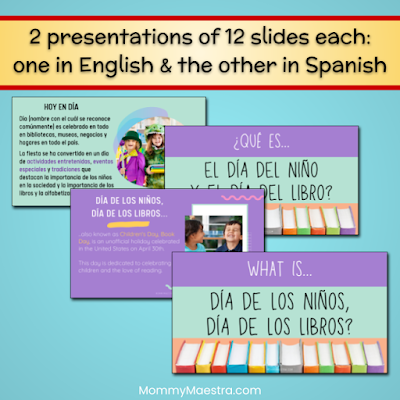
Día de los Niños presentations in PowerPoint and Google Slides in English and Spanish.

Are you teaching about Día de los Niños, Día de los Libros this week? If so, be sure to download my Día presentation for PowerPoint and Google Slides!

What is Día de los Niños


Día de los Niños y Día de los Libros, also known as Children's Day and Book Day, is a holiday celebrated here in the U.S. on April 30th. 

This day is dedicated to celebrating children, their unique qualities, promoting their well-being and happiness, and the love of reading. Children's Day was brought to the U.S. in the 1990s and combined with a love of books by the children's author, Pat Mora, who was inspired by the Mexican holiday.

In Mexico, El Día del Niño's roots lie in ancient Mesoamerican cultures, and the holiday has evolved into a day of fun activities, special events, and traditions that highlight the importance of children in society.

Today, Día de los Niños y Día de los Libros is a time for families and communities to come together to celebrate and cherish the children in their lives and the joy of reading.


Día de los Niños presentations in PowerPoint and Google Slides in English and Spanish.

Día de los Niños Presentations for PowerPoint & Google Slides


The best way to introduce a new topic, in my opinion, is when you can start with a visual presentation that explains the key points. Because my Día Activity Packet is so popular, I thought it would be great to put together a slide show to help kick off a lesson. 

This 12-slide presentation introduces children to the holiday in a fun way. The slides talk about what exactly the holiday is about, and even gives a brief history of how it came to be here in the United States.

I've also included a slide on the symbols and traditions associated with Día and ended with a list of 10 ways that anyone can celebrate the holiday.

This product comes with four files:
  • English-only PowerPoint
  • Spanish-only PowerPoint
  • English-only Google Slides
  • Spanish-only Google Slides
You pick the format that best suits your home or classroom.


To Use with In-Person or Distance Learning

The best part is that this presentation can be displayed on your classroom whiteboard, or assigned through Google Classroom, and soon it will be available on TpT's Easel, too. 

Online classes can use the file in their lessons by directly sharing their screen with their students.


Día de los Niños literacy activity packet in English and Spanish.

How to Use it in a Lesson


Use this presentation at the beginning of the lesson to introduce the holiday.  Follow up with one or more of the literacy activities available in my Día Activity Pack.

Or you may want to have your students do a literacy craft instead. Here are a few that I recommend:

Día de los Niños book list in full-color or black-and-white.

The Día Book List


You can end your lesson by handing out a copy of my free Día de los Niños book list that's been newly updated for 2023. This list features books mostly written by Latinx authors and that highlight stories and folklore that children will love. 

You might also prefer to print the list ahead of time and select a few books from it to read to your class before or after the presentation.


Want to find this post again? Pin it!


Tuesday, April 27, 2021

Celebrating Día de los Niños 2021


This Friday is Día de los Niños, Día de los Libros.

It'll be the first year that I don't have my oldest two children with me to celebrate, which makes me a little sad. BUT it will be the first year that my youngest can actually appreciate what's happening. 

My plan is to focus on a day of books, starting with a trip to the library and followed by opening and reading all the great new books we've received from Beautiful Feet Books. I selected AROUND THE WORLD WITH PICTURE BOOKS PART I. 

I can't wait to dive into these diverse books and the amazing lesson plan book that accompanies them. Part I covers Asia, Africa, Australia, and Antarctica. (Stay tuned for an in-depth review.)

If you're looking for ideas on ways to celebrate the day, check out my post: 10 Ways to Celebrate Día at Home.

And don't forget about my printable Día Activity Pack! You can find it in my TpT store. 


Wednesday, April 29, 2015

PBS KIDS Celebrates Día de los Niños with New Spanish-Learning Games, Videos {FREE PRINTABLE}


I am so thrilled to announce that PBS KIDS is celebrating Día de los niños, Día de los libros this year! How wonderful is it to have the holiday recognized on national television? Bilingual families and those with young Spanish learners will find this of special interest.

Starting tomorrow, in honor of the holiday, the PBS KIDS series OH NOAH! is launching new animated videos and games that introduce kids to Spanish in a fun way. (Have you been to their website yet? I so LOVE the horse in the cowboys & librarians video!!!)

The program is aimed at children ages 4-7 and features the funny misadventures of Noah, a little boy not unlike my own, who stays with his grandmother in a community where almost everyone speaks only Spanish. As he learns the language, Noah frequently gets into a predicament but always manages to find his way out and learns with a smile. Here's a teaser:


The show's bilingual education consultant, Mariana Swick, provides guidance on vocabulary and phrases appropriate to teach the show's target audience. She reviews script drafts, animation rough cuts, iterations of games, and drafts of offline activities to ensure that the use of Spanish is correct.

According to Swick, the inspiration behind the show stems from the changing demographics in the US. In response, the NY public television station WNET wanted to add a series to the PBS lineup that introduced Spanish to English-dominant children, including Latino children whose parents are interested in preserving their heritage language.

Swick says that they use a “360-degree” approach to developing Oh Noah! materials. "Stories and interactive games for children," she says, "are connected to bilingual family activities, plans for parents, resources for teachers, and community event kits for out-of-school partners like libraries."


I'm delighted to be able share with all of you MommyMaestra readers one of those materials: the OH NOAH! Family Activity Guide. 


Happy Día de los niños, Día de los libros!

Disclosure: I'm a PBS KIDS VIP which allows me to find out first about news and resources that are of special interest to my readers. I was not compensated for this post and all thoughts and opinions are my own.  

Wednesday, April 30, 2014

Celebrate Día de los Niños with Free eBooks and Live Author Readings!

L4LL's 2014 Dia eBook


Happy Día de los Niños, Día de los Libros! Are you celebrating today?? We are! First off, don't forget to head over to Latinas4LatinoLit.org to download your free eBook! If you didn't have a chance to follow along the Día Blog Hop featuring 24 Latino authors and illustrators (such as Amy Costales who I was so honored to host here on MommyMaestra), you can still go back and read all of the fabulous essays. You'll find the schedule here.


THEN, after you do that, don't forget to head over to Qlovi to listen to some of your favorite Latino authors and illustrators reading aloud one or two of their own books LIVE online. Best part? It's FREE! Just register and then follow along. You can even submit questions during the livestreams.

And finally? Grab your chil and a book and READ! Grab two books! THREE! Take turns reading aloud to each other.

And enjoy your day.

¡A leer!

Abrazo......


Sunday, April 27, 2014

Celebrate Día with ¡Uno, Dos, Tres con Andrés!


Time for another music review! If you follow me on Facebook, you might remember me posting an adorable music video featuring bilingual music for kids by Uno, Dos, Tres con Andrés. (I've posted it below in case you missed it.)

Well, just in time for Día de los Niños, musician Andrés Salguero has released his debut album and it is such a delight for Latino families! ¡Uno, Dos, Tres con Andrés! is a bilingual feast of Latin rhythms and introduces us to salsa, bolero, mariachi, and so many more! Andrés' bilingual songs are fun for children and parents alike, covering topics like colors, friendship, and parents. You and your child will be jumping and counting to ¡Salta, Salta!, then dancing to the bachata rhythm in Los Colores. I really love the variety of music styles that Andrés presents in this album. It celebrates the diversity of the Latin culture, and the unifying - rather than separating - force of bilingualism.

Parents will love this album for their early elementary children, as well as for their Spanish/English learners. It is a great way to develop vocabulary and basic concepts. But really, the songs are just plain fun for kids of any age.

The CD comes with an illustrated booklet with the lyrics to each song making it a great tool for bilingual children learning to read. The super cute illustrations were created by award-winning Colombian artist Carlos Diaz Consuegra.


But you don't have to take my word for it. Listen to Los Colores yourself and enjoy the music video. It will steal your heart!


If you'd like to get your own copy of ¡Uno, Dos, Tres con Andrés!, just visit their fantastic site. You can even listen to a sample of each song - after which you won't be able to help but buy the album!

Disclosure: I was sent a copy of this album for review. All thoughts and opinions are strictly my own.

Friday, April 25, 2014

Latino Authors Read Aloud for Día de los Niños


Opportunity alert! As a co-founder of Latinas for Latino Lit (L4LL), I'm super proud to share with you this great opportunity for families and educators. Over at L4LL, we've partnered with Qlovi to bring you live readings by Latino authors during an all-day virtual event. 

Next Wednesday on Día de los Niños, from 9 am to 5 pm ET, eight magnificent Latino authors will go online to read aloud one or two of their own titles. And YOU can sign up to watch for FREE! In addition, you'll have the opportunity to submit questions during the event.

Go here to see the schedule and sign up for one, two, or ALL EIGHT read alouds. We hope to see you there!


Monday, April 7, 2014

Amy Costales for the L4LL Día Blog Hop

Yesterday, Día founder Pat Mora kicked off the Día Blog Hop with a post on Latinas4LatinoLit.org. As a co-founder of Latinas for Latino Lit, the blog hop is one of the events that makes me proud to be Latina and a champion of literacy for our children. Back for the second year in a row, the blog hop features a different Latino author or illustrator on a different blog every day this month starting on the 6th. You can find the full schedule here.

All of the guest writers were asked to write on the topic "Reflection." Today on MommyMaestra, author Amy Costales reflects on her reason for picking up a pen to write for Latino children. I hope that you are as moved by her article as I am.


© il-fede - Fotolia.com

The issue of reflection, or rather the lack of it, for my daughter, her friends, her cousins and my students is what lead me to write. I knew a group of children who were caramel-skinned, spoke Spanish and shared housing with extended family members. I watched them use the word American to mean white, draw themselves blond, hesitate to enter parks where everyone else was white and looked at us weird when we spoke Spanish. It was the 90's and Proposition 187 had just passed in California. There was an animosity in the part of Orange County where we lived that you could see, feel and hear in the schools, in the store, if you went to the wrong beach. I started writing.

I wanted to portray the Mexican immigrant community that most the children I knew, including my daughter, were growing up in. I wrote about shared housing, a relative coming from Mexico, families working together, a loved used car, uncles who live in the garage to keep their rent cheap, undocumented immigration, children who sleep on pulled out mattresses in the living room, fathers who work two jobs, single mothers and, most importantly, love. Children coming from those backgrounds deserve to have their lives portrayed as normal. I wanted to write those books for those kids.

The daughter that once inspired me to write is older than I was when I first grabbed a pencil and a notebook and started my first attempt at picture books. Her cousins and friends that also inspired me grew up and went to college in places like Cal State Fullerton, Brown, UC Santa Barbara and (due to deportation) Tamaulipas, México. I got busy with an M.A. program and then with the efforts to start a Spanish for Heritage Speakers program at the University of Oregon where I work. Twenty years have slipped by. And yet the lack of reflection has not been resolved. This trimester I asked 60 young Latino college students if they learned about the Bracero Program in their K-12 education. Only two said yes. Half of these kids were participating in a UO high school equivalency program for students whose families did agricultural work. Of the other half, most of their families had done agricultural work. More importantly, when I asked them to look into their families pasts, most of them had Bracero grandparents and sometimes also great-grandparents. Their family stories included two, three or four generations of crossing the U.S. border to work in los files (the fields), mostly starting with the Bracero Program. When we studied the program and listened to the family stories, one young woman said, "Me siento robada de mi historia." She should feel robbed of her history , or her story, because in Spanish they are beautifully the same word. The Bracero Program brought 4.5 million people across the border and created transnational Mexican communities. It is a vital piece of history in understanding immigration and the growing Latino population today. How is it possible that year after year most of my students say they have never heard of it? I am using the Bracero Program as an example of a greater problem, which is a lack of representation of Latinos in history and literature in our K-12 programs.

And yet it is not just Latino students who are robbed of this history. It is a nation. It is not just Latino students who are robbed of their reflection in literature. It is a nation. 25% school-age children in the U.S. are Latino. By 2050, that number is predicted to be closer to 50%. To ignore Latino history and literature is to ignore la historia of a very significant segment of our population. It is equivalent to a nation not seeing its true self. As we go through this significant demographic shift being brought on by an aging white population and a young Latino population, an accurate reflection of nation would facilitate the change. I am no longer just concerned about how Latino children see themselves. I am concerned about how a nation sees itself. Latinos are part of the "we" that make this nation, as are all ethnic groups.

Personally, I am feeling the need to pick up my pencil again. I feel sad that I still have Latino students who use the word "American" to mean white. And if my daughter has grown, I now have a bilingual son who deserves a book about his life with his part Latina mother and his Mexican stepfather, as well as his Italian-American stepmother, and his Scandinavian-American father. He is as complex as this nation. This time I am going to think about the complexity of the Latino population itself, for as we write (or read) about Latino children, there is a diversity in regards to family, ethnicity, generations in the U.S., region, language, and social class that needs to be portrayed. It is a mosaic.


Amy Costales is an award-winning bilingual children's author. Her picture books include Hello Night~Hola noche, Abuelita Full of Life~Abuelita llena de vida, Lupe Vargas and Her Super Best Friend ~Lupe Vargas y su super mejor amiga, Sundays on Fourth Street ~Los domingos en la calle Cuatro and Grandpa Used to Live Alone~Abuelo vivía solo. She teaches Spanish for Heritage Speakers at the University of Oregon. Learn more about Amy and her books on her website, AmyCostales.com.

Tuesday, April 1, 2014

L4LL Announces 2nd Annual Día Blog Hop


I have been very slow to post on MommyMaestra lately. And here is just one of the reasons: Today, Latinas for Latino Lit (of which I am a co-founder with my partner Viviana Hurtado) is announcing our 2nd annual Día Blog Hop!

Two dozen (24!!!) Latino authors and/or illustrators have been paired with 24 Latina bloggers, and all of them have enthusiastically agreed once again to support Latino children's literacy. Each day, beginning April 6th, a different blog will host a different author/illustrator on their site. The article they've submitted are moving and passionate, sharing with all of us a glimpse into their lives and what motivates them to write for children.

You can find the complete schedule here on the L4LL website. I hope you'll follow along. Here on MommyMaestra, I'll be hosting author Amy Costales next Monday, April 7th.

The Día Blog Hop will end on April 30th (Día de los Niños, Día de los Libros) with a special announcement.

Gracias to all the authors, illustrators, and bloggers for supporting Latino children's literacy!

Tuesday, April 30, 2013

Happy Día de los Niños, Día de los Libros!


Wishing you all a happy Día today!

But remember - EVERYDAY is Día de los Niños, Día de los Libros!

We'll be celebrating today with lots of fun and lots of books. How about you?

Before I go, I want to share with you some of the events happening online today:

FIRST, don't miss the announcement of the Día Blog Hop Grand Prize Giveaway winner over on www.Latinas4LatinoLit.org. Felicidades to the winning library!

Second, "Vecinitos: Lots of Little Neighbors, One Big City" is an exciting new Spanish program for children. This summer they'll be running a seven-week long Spanish immersion summer program for children 5-9 years-old at La Casa Azul Bookstore at 143 E 103rd St, NY, NY 10029. Children will learn Spanish through original songs (available with lyrics in Spanish and English on CD Baby at http://www.vecinitos.org/music-and-songs), traditional Latin American rhythms, games and their own works of art - all in Spanish. In honor of El Dia de los Niños, they have a special offer: Anyone who signs up TODAY ONLY gets a very special one-time discount of 15% off the camp! That's 20 hours of camp for just $255. (Normally the camp is $300 per week, so with the 15% off, it would be $255 per week.) You can register here.

Sunday, April 14, 2013

Day #5 of the Día Blog Hop: Joe Cepeda On Illustrating and Writing

I am so pleased to share with you today, illustrator and author, Joe Cepeda's, personal article that talks about his own childhood and how he feels about what he does. Reading all of the articles in the #L4LL Día Blog Hop is a moving experience and I hope that you, too, will find joy in reading what these authors have to say. Please feel free to leave a comment for Mr. Cepeda, or to enter your school library (or local library!) in the giveaway by leaving a comment on this, and every other blog in the blog hop.


As someone who makes his living illustrating books (even having written one), I’d like to tell you that I was raised in a home where the thirst for reading was rich and vibrant and that we were so hungry for the written word that we’d read anything that we could get our hands on.  It would certainly be nice to tell you that my family spent hours and hours at the East Los Angeles Public Library foraging for books, laughing and chatting it up with our good friend, the nice gentle librarian, then strolled happily down the cracked and crooked sidewalks all the way home with piles of books lovingly wrapped in our arms. At dinnertime we all sat at the table telling stories. That, under the warm light of our simple kitchen, we listening eagerly and patiently to one another, quoting passages and sharing the excitement and drama that lied within the pages of our wonderful books.  It would be delicious to say how the legacy of books and their hidden treasures was a sweet dessert we filled ourselves with on a daily basis.

As you might be guessing, such was not truly the case. The only bookcase in our home was small, with three shelves...and held as many knick-knacks as it did books and unintentionally, perhaps symbolically though, was a little removed, away in the far corner of my parent’s bedroom.

We were by no means a family of scholars.  We came from simple roots, (although my mom’s stepfather was a self-taught engineer toy-maker carpenter public-attorney Marxist in Durango, Mexico... but he was the exception).  My brother, sister, and I went to school and did our homework... or didn’t.  We played baseball, stayed out ‘til dark and were not much different from our neighbors.  Each day was met with largely simple and clear struggles.  We were sometimes yellers and screamers like a lot of families on our block and like in my fathers case, whose education went as far as the third grade and didn’t have a lot of book knowledge to draw upon, we sometimes never said a thing.

We weren’t a well-read bunch.  It wasn’t a horrible place to grow up, it just wasn’t the most literary household.  Then, almost by happenstance (at least it seemed that way from my point of view) there was a change, small and incidental... yet momentous like the shifting of tectonic plates.

A door-to-door salesman came to our home one day.   He must have been a great salesperson because my mom was not one easily swayed. Yet, he convinced her, a woman working as a teacher’s aide, to let go of some of her hard-earned money. It wasn’t vacuum cleaners or Fuller brushes he was vending.  Soon after his visit, the curios and the few dust-covered books on our little bookcase made way for the 1969 edition of the World Book encyclopedia.  Brand-spanking new! Not a lot of brand new things made it into our home.  It was green and white with shiny gold-edged pages on each pebbly-textured volume.

Like an unknown siren calling hypnotically from a cliff, the next thing I knew I was sprawled across my parent’s bed slowly opening that first leathery cover, listening to it crack as I took in that smell that wafts up from a new book.

I started one day at volume A and sometime later... days, maybe weeks, I’m not really sure how long it took me, eventually I paged through the whole set, A to Z.  I make no claim, of course, to have read an entire encyclopedia from front to back like some super-genius, but glimpses and flashes of the outside world poured into my head with every turn of the page like a slow steady rain.  I never knew what a mallard duck looked like, but there it was. That funny looking building, the Taj Mahal, had no place in my brain before then... nor did the flags of the world, some answers to the mysteries of the human body, and the principle and workings of a simple lever.  The contents of those heavy books were not exactly poetry or elegant prose or fantastic storytelling, but it got me started reading in a whole different way.

Our house never really filled up with books, and the joy of reading wasn’t exactly a new thing to me, but, maybe at that tender age it freed me just a bit.  Like the first time I rode around the block on my bike by myself, zooming over new and different sidewalks, waving at fresh new faces.  The outside world and its discovery was just that much more in my control, letter by letter, page by page, volume by volume.  What I found in books took me to places that I’d never before imagined and has done that all my life.

Illustrating and writing stories has done something else.  I’ve illustrated city stories, farm stories, stories from Africa, a book about heaven and even a story that takes place in a bathtub. One day, I look forward to illustrating some epic saga.... perhaps a Viking story or one set in the future.  Yet, inevitably, and not necessarily by design... a life making books and picture-making comes round to making pictures that feel like home, not necessarily in a literal sense, but in the sense that is the most human thing to share a story.  Not so much about what you’re sharing as much as how you share it.  It all comes back home.  It all comes back to what I tell the young people I meet at school visits... wherever you come from, whether your place is small and humble, or grand and fanciful, if chaos runs rampant, or you live in utter doldrums... your story is worth telling.  The challenge lies in the beauty and poetry of it.  When I started speaking publicly I was anxious and eager to share what I did. I talked about painting, composition, visual storytelling skills and creative prowess and all that. Yet, eventually, after doing this for a while it became apparent to me that working as an illustrator is about who I am... something that all along was much harder for me to share.  Stories and books started me on that path, as did a set of encyclopedias.


Joe Cepeda received his BFA in Illustration from California State University, Long Beach in 1992 and also studied Engineering at Cornell University.  He is the illustrator of award-winning picture books such as What a Truly Cool World (Scholastic), Nappy Hair (Knopf), Mice and Beans (Scholastic) including The Swing (Arthur A. Levine Books), which he wrote as well as illustrated.  Mr. Cepeda has illustrated books written by numerous notable authors including Gary Soto, Pam Muñoz Ryan, Arnold Adoff, Monica Brown, Julius Lester and most recently, Toni Morrison.  He has also illustrated book jackets for many titles, including Esperanza Rising.  He was selected to illustrate the cover of Shaquille O’Neal and Reading is Fundamental’s Biggest Book in the World.  Mr. Cepeda received an ALA 2002 Pura Belpre’ Honor Award and the Recognition of Merit Award for 2000 from the George G. Stone Center for Children’s Books.  His work has been accepted to the Society of Illustrators shows in New York and Los Angeles. In addition to his illustrative work, Mr. Cepeda is sought after as a public speaker to schools and other groups. He is the current president of the Society of Illustrators of Los Angeles.  He lives in Southern California with his wife and son.


The Giveaway

L4LL has put together a wonderful collection of Latino children’s literature to be given to a school or public library. Many of the books were donated by the authors and illustrators participating in this blog hop. You can read a complete list of titles (as well as the blog hop SCHEDULE) here on the L4LL website.

To enter your school library or local library in the giveaway, simply leave a comment below. Don't forget that you can enter it every day on a different blog! That's 20 chances to win!

The deadline to enter is 11:59 EST, Monday, April 29th. The winner will be chosen using Random.org and announced on the L4LL website on April 30th, Día de los Niños, Día de los Libros, and will be contacted via email - so be sure to leave a valid email address in your comment! (If we have no way to contact you, we'll have to choose someone else!)

By entering this giveaway, you agree to the Official Sweepstakes Rules. No purchase required. Void where prohibited.

¡Buena suerte!

Wednesday, April 10, 2013

The #L4LL Día Blog Hop Starts TODAY


Joy of joys! Today marks the first day of the (Latinas4LatinoLiterature) #L4LL Día Blog Hop! 20 amazing Latino children's authors and illustrators paired with 20 Latina bloggers (yes, MommyMaestra is on the schedule!) for 20 days of celebrating Latino children's literature and literacy. There are two posts up over on the #L4LL site, so head on over to read them.

I've neglected MommyMaestra a bit the last week, mainly because I was so busy trying to make sure all the articles were in and to their bloguera partners. Phew! It was well worth the effort because you will NOT want to miss a single one! The articles are moving, inspiring, and joyful. I can't tell you how many times I started crying while reading one. Okay, a bit much, but it is really just so FANTASTIC to see such collaboration among people and the sincere love that these authors have for our children. If I could bottle all that up and give it to every single Latino child in this country, not a single one of them would struggle with literacy. Not one.


And for all you parents and teachers, there is an extra bonus. In addition to the amazing articles, there's also a major giveaway that you don't want to miss. 


Seriously, get over there and enter your school or local library.


Wepa!

Monday, April 8, 2013

The First Ever Día de los Niños, Día de los Libros Blog Hop

Just in case you missed the big announcement this weekend, I'm happy to share the news with you about the first Día Blog Hop. I am so excited to be a part of this extraordinary event! I hope you'll follow along every day, starting this Wednesday on the Latinas for Latino Literature website.


Día de los Niños Blog Hop


Monday, April 30, 2012

Happy Día de los Niños, Día de los Libros!


Happiest of days! Today is one of my favorite holidays! Are you celebrating Día de los niños, Día de los libros at your home or school? Would love to see pictures. (Hint, hint. You can share them on my FB page!)

Don't forget that in honor of the holiday, MommyMaestra has two great giveaways going on: a United States Activity Atlas, and THREE sets of the complete Hagamos Caminos Spanish Reading Curriculum. The giveaways end TONIGHT, at 11:59 p.m. Monday, April 30th, 2012.

And finally, because I love this holiday so, I have put all the bilingual/bicultural/Spanish children's books over at Latin Baby on sale, including the new Spanish versions of my favorite Who Was...? series. Get them while they are cheap!!

May you all enjoy your children and a few good books today.

Un abrazo...

Friday, April 27, 2012

Will Latino Stories Sell?

It is with extreme pleasure that I publish this article by author, Laura Lacámara. Laura has chosen to share her thoughts on the current Latino children's literature market, and within her words I find an important message for all of us as we head into Día de los niños, Día de los libros. As parents, let's make some noise and show the publishing companies what we think about the market.

Will Latino Stories Sell?
by Laura Lacámara

Lately, big New York publishers have been saying NO to making children’s books with Latino-oriented stories or themes. The sales numbers aren’t big enough to justify the investment, they say. It costs a lot to produce picture books, after all. 

Well, in the not-so-distant past, before the phrase: “It’s the economy,” was rolling off our tongues a hundred times a day, there was a much more Latino-friendly atmosphere at these large publishing houses.

What a happy time! The mangos were ripe and salsa music was in the air! This Cuban chica was in demand! My new agent was circulating my first picture book manuscript, Floating on Mama’s Song/Flotando en la canción de mamá. And publishers weren’t dancing around the issue, they were obviously hungry for Latino stories!

I know this because all eight of the “non-acceptance” letters my agent got from the editors of these big publishers (before my manuscript was acquired) ended more or less the same way:  “Please keep me in mind for future Latino-themed submissions. We are actively seeking to expand our multicultural line.” It was clear that something big was happening. Not just for me, but also for my fellow Latino authors and illustrators.

An agent I met at the time told me even better news. She said: Now that we have opened a lot of doors for Latino authors to share their unique stories with the world, we are ready to take it to the next level. We are ready to hear stories of all kinds from authors of color.  In addition to culturally-inspired themes such as the Latino immigrant experience, the doors are now swinging open to include other themes from authors who happen to be Latino and have a story to tell.

That appealed to me. I knew my Latina-ness would still come through, no matter what I wrote. And what I wanted most was the freedom to let my imagination soar and make stuff up that appealed to the child inside of me. It looked like I would get to have my flan and eat it, too!

So how did we lose so much ground? Back then I really believed there were no limits. That the road to cultural diversity in children’s literature was opening up in front of me. But now, years later, I’m literally being told by my editor not to write Latino stories at all (no Latino themes, main characters, etc.) because they are such a hard sell.

I wanted to be free to let my spirit soar, but I never wanted to exclude my cultural identity! Is my only choice now to cut off part of myself in order to appeal to the mainstream?

Not that there isn’t something seductive about finally, after a lifetime of feeling like an outsider, being invited to join the mainstream!

Growing up Latina in white suburbia I felt ashamed of being different and longed to be like everyone else.

And don’t get me started on the never feeling normal because I’m an artist thing...

It’s taken me years, heck a lifetime, to accept that I will always feel like an outsider to some degree. So naturally, it’s with a certain level of ambivalence that I consider joining into the mainstream...

But, wait a minute here!  What is this so-called mainstream we're talking about?  Are publishers afraid that white Americans are under-represented in children's publishing today?

Well, let's see.  In 2010, according to US Census data, 63% of the US population was Caucasian. Yet, according to the University of Wisconsin, nearly 95% of children’s books published that year were by white authors and illustrators. Also in 2010, Latinos comprised about 16% of the U.S. population. However, less than 2% of the books published that year were by and/or about Latinos! Talk about under-representation!

The fact is that nearly 40% of U.S. children come from diverse backgrounds. How can we deny a considerable slice of our population the validating experience of seeing themselves in the pages of their books?

True, when I was growing up, I don’t remember ever seeing a reflection of myself or my culture in the books I read. But folks, that was like a thousand years ago! In the late 60’s and early 70’s, I was a minority in my San Fernando Valley classroom. But today, in the L.A. Unified classroom of 2012, my blonde, blue-eyed daughter is the oddball. Today’s Los Angeles Unified School District is almost 75% Latino.

So what are publishers afraid of? That there is no audience for Latino books? Whenever schools in the Los Angeles area and beyond hear that I have bilingual books to share, they go crazy trying to book me for a presentation! They know what their kids are missing.

And I can see it in the kid’s faces when I get there. Like the girl who was beaming when she announced, "Anita in your book looks like me!"

And kids love it when I share my background and tell them about becoming an author and illustrator. One second grader named Araceli tapped me on the arm as I was packing up to leave. "When I grow up, I'm going to be an artist, like you," she whispered. Maybe she sees it as an option for the first time.

So, I'm left wondering if the enthusiasm for Latino stories was just a passing fad? Or, when the economy turns around, will Latino and multicultural imprints spring up at the big publishers like never before and take their rightful place representing a proportional amount of American culture?

Is there something we as authors, illustrators and/or parents should do to help our voices be heard in the publishing world?

I don’t have any magic answers.  But I do want to create magical stories and pictures. And, while I know the deepest part of me supersedes culture and identity, I still seek the freedom to express myself in the fullest way possible which naturally includes my Cuban-American background.

Meanwhile, I'll go make a flan, and I hope someday soon we can all have a slice! 

---------------------------------


Laura Lacámara is the award-winning author of Floating on Mama’s Song / Flotando en la canción de mamá, which was chosen as a Junior Library Guild Selection for Fall 2010 and is a Tejas Star Book Award Finalist for 2011 - 2012.

To learn more about Laura Lacámara, visit her website: LauraLacamara.com

Thursday, April 26, 2012

Tintin and the Reluctant Reader

The following article is written by our regular contributor, Marta Darby, a homeschooling mami of 10 years for our "In Your Words" Literacy Series as we celebrate Día de los Niños, Día de los Libros this month on MommyMaestra.

My son, Jonathan, was a reluctant reader. He had some struggles with spatial relationships when he was very young, and is still very much a kinesthetic learner. We addressed his difficulty with the crossover of brain information by getting a trampoline. (Read about that here.)

He loved being read to, but he didn’t like to pick up books on his own and just read for pleasure. My older son, Adam had had that same problem. I wondered if it was a gender thing? Or maybe it was just my own boys?

When Adam was young, I was introduced to a series of comic-type books by the Belgian author, Hergé. They were written in the 1930’s and the hero was called Tintin, a young Belgian reporter who is aided in his adventures by his faithful dog, Snowy.

I was advised by none other than Jim Trelease, the author of the Read Aloud Handbook, to get some of the Tintin books and put them in a basket in the *ahem* bathroom. Really? That’s the sage reading advice from the reading expert?

This was back in the stone age. Before the internet and cement. When research was actually done in libraries. I decided I had nothing to lose.

So I headed out to the bookstore to special order some Tintin books. Did I mention they were from the 1930’s? I filled a basket full of these and set it in the *ahem* smallest room in the house.


What happened next, was glorious. I would start finding the Tintin books in other places. By Adam’s bed. On the coffee table. Next to the couch. Someone was picking up the books and moving them around the house. Which meant someone was reading them.

Then someone started asking for more. And sharing what he had read. And asking for more. The stories were well-researched, engaging and had a variety of plot lines in various genres. Swashbuckling adventures, science fiction, mysteries, fantasy, political thrillers. The illustrations were clean and easy to follow. Tintin had it all.

Ten years later, when Jonathan was “reluctant” to read, I remembered how The Adventures of Tintin had helped his big brother and again, I brought out the *ahem* bathroom basket and the Tintin books.

And the magic happened again. This time, Jonathan wanted all of us to read them so we could discuss them at the dinner table. That’s when we all started getting attached to Tintin.

Eventually, Jonathan went on to read other, different kinds of literature. He was not as reluctant to pick up other kinds of books and was able to follow other plot lines.


But I still credit Hergé and the Adventures of Tintin for introducing both of my boys to real honest-to-goodness storytelling. And giving them a love and passion for reading and learning.


----------------------------------------

Marta Darby is an avid blogger, business owner, Cuban cook, graphic designer, scrapbooker, photographer and homemaker. She was born in Havana and left Cuba with her family when she was 5 years old. She likes to tell anecdotes and stories about her family (all 40 of them!), her passions (dulce de leche and red lipstick), and especially being Cuban. She is happily married to her fabulous gringo husband, Eric, and lives with him and their four children in a tiny house with a white picket fence.

Wednesday, April 25, 2012

Hagamos Caminos Review

Spanish reading curriculum

The following is a product review by homeschooling mami, Carla Molina, for our "In Your Words" Literacy Series as we celebrate Día de los Niños, Día de los Libros this month on MommyMaestra.


The only fear I have about homeschooling my daughters is that I won't be able to teach them to read in Spanish. I was never taught to read in Spanish. Actually, I wasn't taught any school subjects in Spanish, but the concepts of math and geography and science and all the other subjects translate easily when you're doing hands-on learning. Reading, however, leaves me completely dumbfounded. I searched far and wide for a curriculum to get my girls (and me) off on the right foot. It was a relief to discover Alma Flor Ada's Hagamos Caminos, a creative reading literacy program.

When it comes to reading, I want my daughter to learn to read independently but also, if not more importantly, love to read. Hagamos Caminos is a literature based program which focuses on nurturing a true affection for reading. The books contain a variety of genres including legends, oral folklore, poetry, riddles and rhymes, even plays from all over the Hispanic world. There are stories based on reality, which my daughter easily identifies with, and tales based on fantasy which engage her imagination. Everyone in our house has fallen in love with the literature in this series. We not only work on the educational exercises, but you'll often find one of the books next to our bed for a quick story before getting tucked in for the night.


Curriculum_for_reading_in_SpanishI adore the illustrations. They are fun and whimsical and really make the content pop. When we go through the texts just looking at the pictures, deducing what we think is taking place, I appreciate how someone thought to make it beautiful. The same way I love to hold a gorgeous book in my hands, so do my daughters. If my daughter doesn't like the artwork, then a book has a slim chance of making it past page one. So, five points on a five-point scale for visual appeal!

The program comes with eight books, four of which are reading texts and four accompanying workbooks. There are 4 stages to the series: Partimos (pre-K - 1st), Andamos (K - 2nd), Corremos (1st - 3rd) and Volamos (2nd - 5th). Despite the wide span of grade level content, we were able to work with each of the books. We started with Partimos and I was surprised, having had zero experience with a formal reading program, how engaged and excited my daughter was. She enjoyed the variety of activities and I appreciated how much was covered. Not only did she make connections to the stories but she also got to practice math concepts, fine motor skills, pattern identification, and early writing skills. 
Spanish_literacy_workbooksAll of the books are equally rich in educational content covering a range of skills. We're almost done with Partimos and are making our way through Andamos. With these two books, my daughter has felt easily empowered to work independently and ask for assistance when needed, which is sparingly. It was beautiful to watch her feel so proud of herself as she went through the exercises. The last two books of the series are geared towards older children (1st - 5th grade) so we work on them together. I've thought about putting these away for later but she loves them so much I can't really get them away from her.

The only negative I found with the program is the included DVD. It's a bit dated and not the very best quality. You do, however, get a clear sense of Ada's passion for educating children and her enthusiasm for the program. She shares the principles behind the program which gave me a better perspective on her approach. There are also a few songs which my daughter enjoyed. The video is helpful in getting background on the program but, honestly, I would have felt fine just diving right into the materials.

If you can't tell, I'm really impressed with this program. My daughter is confidently putting the pieces together to learn to read and is genuinely excited for "school" time as we've come to call it. She even applies the methodology for analyzing and thinking about a story to books we read for fun. Hagamos Caminos has made me feel confident in teaching my children to read.

My family has long been a fan of Alma Flor Ada's work and this just solidifies a place in our hearts for her. She is really committed to educating children with respect and love. I highly recommend the Hagamos Caminos program. This set is available for purchase through Del Sol Books. I've already got other books from Del Sol Books, the publishers of Hagamos Caminos, on my daughter's wish list!


---------------------------------------

Carla Molina is a weaver of words and creative collaborator. A Jersey girl at heart with lots of love for Boston, she spends most of her time raising two bilingual little ladies and brainstorming more ways to write her heart out. She blogs about being a woman and a creative creature at All of Me Now. And plays cheerleader to the local businesses serving families in her current home state at Petit Rhody.

LinkWithin

Related Posts Plugin for WordPress, Blogger...