Monday, January 11, 2021

New Virtual Language Camp in Spanish


This is a sponsored post in collaboration with Cultural Bytes and MommyMaestra. All opinions are my own.

So many families are homeschooling their children for the first time this year, and many of those had children in dual-language/immersion programs. And many more are find this as an opportunity to nurture and develop their children's bilingualism.  

Therefore a LOT of families are looking for classes and other opportunities that teach kids Spanish, or allow interaction for practicing their Spanish-speaking skills. But that can be hard when places are closed and/or your stuck at home. I've seen a lot of requests like these in our Hispanic & Bilingual Homeschool group on Facebook.

Virtual Language Camp (ViLaCa)

So I was delighted with Cultural Bytes emailed me to tell me about their newest virtual language camp for native, bilingual, and intermediate speakers ages 5 to 12! ViLaCa will meet for 60 minutes four days a week - Monday through Friday - and each day has a different theme:

  • Mondays: Food
  • Tuesdays: Animals
  • Wednesdays: Places
  • Thursdays: Games
They have morning and afternoon sessions. Each class is limited to 7 children max. 

You can attend all four days, or just one. The camp is VERY affordable in my opinion. You can sign up for a whole month (16 sessions) for $60 or just one session for $10. And they accept PayPal or Venmo.

THIS WEEK ONLY!  Classes are FREE if you use the discount code “FREEVilaca”

Don't wait! Go sign up today and get your child talking in Spanish.


Friday, January 8, 2021

PRIDE Reading Program Review

PRIDE Reading Program for students with dyslexia

The following post is a collaboration between PRIDE Reading Program and MommyMaestra. All thoughts and opinions are the personal ones of guest writer, Stacie Farias. This post contains affiliate links.


The Orton-Gillingham Method


As a self-titled “Orton-Gillingham (OG) fangirl,” I was absolutely delighted at the prospect of getting my hands on a level of the PRIDE Reading Program to review. At the very least, my two oldest children are dyslexic and kiddos #3 and #4 present with similar traits; therefore, no reading program is welcome in our house unless it can claim OG status. For those unfamiliar with the characteristics of an OG program here is some helpful information on what OG means and why it is so effective for dyslexics.

It's important to note here, that this reading program is a wonderful resource for ALL children, not just those with dyslexia. However, those children with dyslexia who struggle with other reading programs will find this one to be easier and effective.

So it was with a hopeful heart and a discerning eye that I began to look through the Pride Reading level titled “Beginning Consonants” and started watching the Pride Reading Training Program videos. What I found, made a deep and lasting impression on me. 

PRIDE Reading Program

PRIDE Reading Program


A Homeschool Reading Curriculum for Children with Dyslexia


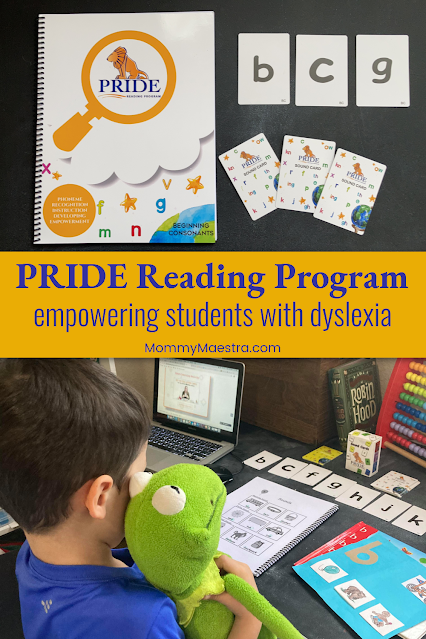
For this review of the Beginning Consonants level, I received the online Teacher’s Guide, the Student Workbook, and a set of the PRIDE Sound cards. I found the cards to be surprisingly sturdy, which is perfect for rough little hands. To the untrained eye, the Student Workbook looks plain and boring, but what a parent needs to understand is that kids with dyslexia often get overwhelmed when there is too much visual stimulation on the page. Cutesy pictures and lots of color may end up hindering a student’s progress. 

The PRIDE Reading Program is scripted like other OG programs such as Barton Reading and Spelling and All About Reading, but what I found to be unique about PRIDE’s online Teacher Guide is the layout of the scripts and procedures is so simple that it’s genius. Each step is boxed in bright orange so you don’t lose your place. The directions are written in black and dialogue is written in blue. It could not be any simpler to follow, which I appreciate as a busy homeschool mama of 5. I cannot tell you the amount of times I’ve taken my eye off a teacher’s manual, even for a moment, and lost my place. It sounds like a small complaint, but in a scripted curriculum, losing your place is frustrating and cumbersome. Using a Teacher’s Guide that is as user-friendly and open-and-go as this one encourages a parent to continue a program with fidelity. This is key to remediating for dyslexia.

Empowering Parents


E-v-e-r-y homeschool parent, on fire with determination and willingness, knows we will stop at nothing to learn the technique, pedagogy, program, style, etc. that is most suitable for our children. If a homeschool parent determines that being their child’s own dyslexia tutor is the best fit for their family, PRIDE Reading is an excellent choice for the parent new to OG programs. 

The most helpful feature of PRIDE Reading is the online PRIDE Reading training videos you receive access to with each level. Before you begin using this program with your kids, watch the training videos on the PRIDE Reading website. Unless you are experienced with OG programs, you NEED to see these videos to understand how particular OG procedures work such as sky writing and arm tapping. In fact, even if you have previous experience with an OG program like I do, watch the videos anyway. 

After years of using Barton Reading and Spelling (you can find my review of Barton here), I still learned a few tricks watching these training videos. I imagine the name PRIDE, which stands for Phonemic Recognition Instruction Delivering Empowerment, was meant to be directed at the student who is empowered with the skills to read. But these training videos empower the parent to be confident about the remediation they are giving their child. It’s incredibly moving to experience this as a homeschool parent who’s likely been told that they are not qualified to teach their own children let alone a child with a learning issue. Many thanks to PRIDE for creating such a wonderful resource for parents!

PRIDE Reading Program

PRIDE In My Home


I decided to try PRIDE with my 4th kiddo because he is 5 years old, is not already using an OG program, and demonstrates similar dyslexic traits like his older siblings. He already knew some of his letter sounds but not all of them, which made the Beginning Consonants level a perfect fit for him. 

Take the placement check to find the best level for your child.

Overall, the lessons have gone better than I expected. Kiddo #4 is a very active child and these lessons are easily done while he wiggled in his chair or stood next to me. His maximum amount of concentration on ANY lesson homeschool subject is about 10-15 minutes and with PRIDE Reading, it is easy enough to complete a couple of units in that time. 

In Beginning Consonants, there are 20 modules and 3 units in each module making for a simple and organized level. It took several modules for Kiddo #4 to understand all the procedures, but once they are mastered, it’s pretty smooth sailing (I may have also promised gummy bears in exchange for a good attitude during lessons because whatever works, LOL). 

Some children will likely need more repetition and other children will likely blast through this level in a semester. As a parent, you will have to discern how fast or slow to pace the work. I also loved the additional links to past PRIDE articles that enhance learning at the end of each module. For example, at the end of the first module, there is a link to DIY Tactile Tile Letter Cards.

I was delighted for the excuse to break out my sandpaper letters and use them with this program. Like most OG-based programs, the student probably needs to finish a couple of levels before the effectiveness is revealed. I would caution the parent new to PRIDE that Beginning Consonants may not be the game changer, but it lays a solid foundation for the rest of the levels and is a gentle introduction to the ways of OG. 

PRIDE Reading Program

How to Personalize and Supplement the Program


I have just a couple of tweaks I’d recommend to families so that they could get the most out of PRIDE Reading Beginning Consonants. I would recommend that you include picture books at the end of the modules which emphasize the specific sound in the module. For example, I happened to have a set of Jane Belk Moncure’s First Steps to Reading A-Z series and read My “b” Book, following the first module and the other books following each of the letter sounds we were learning. The picture book choices are endless! Blueberries For Sal by Robert McClosky for the letter ‘b’ and Caps For Sale by Esphyr Slobodkina for the letter ‘c’ are a couple of other examples. 

There are many picture book titles that would compliment this level AND celebrate Hispanic culture as well. M is For Mexico by Flor de Maria Cordero comes to mind, as well as ¡Todos Al Celebrar! A Hispanic Customs and Traditions Alphabet Book by Dr. Ma. Alma Gonzalez Perez. If you’d like to pick a picture book to focus on 1 letter at a time, that is more than possible too! Imagine the laughs you will share if you read a book like Too Many Tamales by Gary Soto, while learning about the letter, ‘T’. 

Because I’ve homeschooled for almost 10 years now and have used Handwriting Without Tears with all my school-aged children during those years, it was strange for me to attempt handwriting using the line spacing in the PRIDE student workbook. Although I do not see anything particularly wrong with the handwriting portions of PRIDE, it looks like any standard handwriting program on the market, I appreciate PRIDE including it in their program.

Bottom Line


PRIDE Reading deserves a place at the same table with all the best homeschool reading programs. The ease of use of the Teacher’s Manual paired with the effectiveness of Orton-Gillingham methodology makes PRIDE Reading an ideal program for homeschooling families. 

Visit the PRIDE website to learn more about their program, to find your child's level, or to sign up for their free introduction course!


Want to find this review again? Pin it!

PRIDE Reading Program for children with dyslexia


Disclaimer: I received a copy of level one for review purposes. All thoughts and opinions are my own. ~Stacie

----------------
Bio:

Stacie Servantes Farias is an Army wife and mom of 6 with a “very healthy” obsession for Snoopy, Disney movies, Audrey Hepburn, Dr. Pepper, Whataburger, books, and homeschooling. Originally from Mission, Texas, Stacie and her high-school sweetheart hubby live with their kids and dog in a different home every few years, because that is the military life. She has big plans to write a book exploring her theory that La Llorona drowned her children because they would take their socks off all over the house and then would complain that they never had clean socks!

Wednesday, January 6, 2021

Free January 6 2021 Writing Pages


As I type this, the news has been on in our home most of the afternoon and evening. Today has been historic, and not in a good way. And it has been a teachable moment of gigantic proportions.

My teenagers have been asking all sorts of questions. My oldest is taking AP US history and my middle kid is taking civics. So what happened at the Capitol today held their attention. 

Today, we talked about the Constitution and ethics. We talked about peaceful transfer of power. We talked about the right to protest...and the federal offence of entering the Capitol by force. 

I think this is a really important opportunity for kids to think critically and deeply about government and power and laws. So I created some writing pages for my son to use tomorrow during our civics lesson. 

And I thought, well, maybe some of you would like to use them in your classrooms, too. They are FREE and very versatile. 

You can use them to have your students write down their thoughts about what happened today. They can write about how they felt or how the attack on Congress relates to what they have learned about how our government works. Or they can write about the events leading up to it. Or the events they witnessed on the television. 

The file comes in English and Spanish. And it has several formats for a variety of ages and skill levels. 

Click here to download these writing pages

Wishing for peace for our country.

Evaluating Your First Semester of Homeschooling

Evaluating Your First Semester of Homeschooling
© Can Stock Photo / iqoncept

If your homeschool year started last fall, then you are getting ready to start your second semester of lessons. Before you do, I want to encourage you to stop, grab a pen and paper, and take 10 or 15 minutes to think critically of your homeschool. 

All well-running machines need routine assessments and tweaks. Now is the time to take a moment to sit and think carefully about how the first part of your year went. What are you going to keep? What are you going to change?

Start by writing out the subjects in your homeschool. Leave space to make comments under each one, like this:

Evaluating Your First Semester of Homeschooling

Then start with the first subject. Ask yourself these questions:

  • Is my child loving it? Why or why not?
  • Is my child learning and growing? Why or why not?
  • Am I having trouble teaching the material because of the way it is presented?
  • Is the problem (if any) one that can be easily resolved by making simple changes?
    i.e. - changing the order of subjects, changing the way in which they answer, etc.
  • Does the curriculum we're using teach the concepts in the way my child learns best? (If not, you may need a different curriculum.)
Write your thoughts down in the space below each subject. Do the same with each subject. Your final page should look like this:

Evaluating Your First Semester of Homeschooling

And then stop and think about your homeschool day. Most homeschool families I know are super busy. Flexibility is key to success. But if you have a set routine, then maybe look at it critically and see if it is working. 

For example, I put the subjects that we need to move more quickly through on Monday, Wednesday, and Friday. Right now our schedule looks like this:

Monday - Wednesday - Friday: 
  • MATH
  • Science
  • History
  • ELA
Tuesday - Thursday:
  • MATH
  • Civics
  • Geography
  • Grammar
  • Spanish
  • Art
Notice that math is the only subject done 5 days a week. That works best for us. Grammar and civics don't take very long, so although he does more subjects on Tues-Thurs, it doesn't necessarily take up more time.

I'm sure YOUR homeschool days look much different. Maybe you homeschool in the evenings or on weekends. Maybe mornings are reserved for play and time outside. Perhaps you are early birds who like to knock out the lessons as soon as you wake up, or you only do a 4-day school week.

Don't be worried about moving subjects to different days or doing one or two every single day. Time may make a difference, too. My son likes to do math last, but I always make sure that it is after lunch so he's had some fuel after the other lessons for him to tackle the algebra equations.

Remember, don't try to force your family into a mold that doesn't fit right. Make homeschooling work for YOUR family. 

Tuesday, January 5, 2021

Free Download: Winter Words Daily Activity in Spanish


MommyMaestra sponsor, Spanish for You!, is kicking off the year with another (free!) fun download for Spanish learners. Seriously, if you are looking for a new Spanish curriculum to engage your middle schooler, check out Spanish for You! In fact, you can click here to look through all the amazing samples that they've shared here over the years. If you enjoy them, then go buy one of their themed lessons that are available for immediate download on their website.

This month's freebie focuses on winter words. The 2-page download includes a word search and instructions for daily activities to help your young Spanish learner master the new vocabulary. It comes with an audio file which is great for those of you who may not speak Spanish yourself, but are raising bilingual children.

Click here to download this file

Remember! Spanish for You!'s program is geared for middle schoolers and is the perfect choice for homeschoolers and afterschoolers alike because their concepts are carefully divided up into manageable bundles that are available for immediate download from their website.

If this is your first time here, you can find other free samples from Spanish for You! here. There are some fantastic downloads of games and activities for you and your family to enjoy. If you enjoy this activity, be sure to visit the Spanish for You! website where you'll find tons of additional resources for you to help your young Spanish learner!

Monday, January 4, 2021

MommyMaestra Dia de los Reyes Resources


Día de los Reyes is only a few days away. Does your family celebrate this tradition? If so, how? 

If you aren't familiar with it, Día de los Reyes Magos (or Day of the Magi) takes place every year on January 6th. It celebrates that long ago day when the Three Wise Men arrived in Bethlehem to visit the newborn Jesus. 

In Latin America and Spain, Día de los Reyes is an integral part of the holiday season. For many, this is the day that children receive presents. It is the Magi who bring gifts rather than Santa.

Different countries celebrate the day in different ways. In some, children leave their shoes at the end of their beds or outside their bedroom doors for the Reyes to fill with gifts. Others assemble a box of hay for the Kings' camels to eat - and then the boxes are refilled with regalos. 

MommyMaestra has compiled a lot of resources over the years that are dedicated to this holiday. Take a look below at all the different ones.

Lesson Plans and More!

Music


Videos


Printables


Reading Passage (for 4th - 6th)

This is a one-page history on the Día de los Reyes Magos, or the Epiphany that is celebrated in Latin America and Spain. Your students will learn about this holiday tradition. Available in full color or black-and-white, this informational text is written for students in 4th - 8th grade. Includes an 8-question comprehension quiz plus answer key.


This minibook is an introduction to the Day of the Magi. This book includes coloring pages of items most closely associated with the holiday, as well as brief descriptions in English and Spanish that are easy for young children to understand.

NOW UPDATED!
This file now contains THREE books:
• a bilingual book (English & Spanish)
• an English only (for ESL)
• a Spanish only (for Spanish learners)


This is my favorite printable for Día de los Reyes! Your students will enjoy it, too. This packet comes with:
• a festive banner to print and hang,
• photo booth props,
• a writing activity where your kids write a letter and stick it into a printed shoe,
• and shoebox decorating sheets for those who put out a box of grass for the camels. Each sheet contains a different scene and the sheets are available for small and large boxes.

FREE Letter Templates to the Magi

This stationery set comes with two designs and both are available in English and Spanish.


Books

In English:

  • The Story of the Three Wise Kings by Tomie dePaola  -  on Amazon | on Bookshop
  • The Three Wise Men: A Christmas Story by Loek Koopmans  -  on Amazon | on Bookshop
  • Home by Another Way: A Christmas Story by Barbara Brown Taylor  -  on Amazon | on Bookshop


And in Spanish:

  • Los Reyes Magos by Lourdes M. Alvarez   -   on Amazon | on Bookshop
  • Ya llegan los Reyes Magos! by Georgina Lazaro - on Amazon | on Bookshop
  • Las Estrellas de Los Reyes Magos by Tere Rodriguez-Nora  -  on Amazon | on Bookshop
  • La Leyenda de Los Reyes Magos by Nora Girón-Dolce  -  on Amazon | on Bookshop
  • Si los Reyes Magos no tuvieran sus camellos by Gilberto Mariscal  -  on Amazon | on Bookshop

Other Posts You May Enjoy


Don't forget to subscribe to my newsletter!


Friday, January 1, 2021

Printable Bilingual 2021 Resolution Worksheet for Kids


GOODBYE, 2020!!


Hello, 2021!

I am struggling to find just one word for 2021 because there are just so many that come to my mind. And they all seem to be vying for first place this year.

Rebirth. Truth. Compassion. Kindness. Service. Perseverance.

I want to focus on them all! 

Every year, I publish these free "resolution" worksheets for parents and teachers to give their students. But this year, I've added another page in case you'd rather focus on a single word for the year. Sometimes setting goals or resolutions makes kids moan. But focusing on a word is a little more intriguing...and challenging!

Anyway, I want you and your students to have choices. Whether you're homeschooling or teaching in a classroom, I hope these goal-setting activity sheets are helpful. 

Click here to download your free copy

I'm also excited about this year because I have a LOT of great new homeschool resources to share with you. My editorial calendar is quickly filling up, so be sure to check back often. Or, if you prefer, you can just subscribe to my monthly newsletter and get a quick summary with links to all the posts of the past month...plus lots of free downloads! Click here to subscribe.

Wishing you all a very GOOD and PRODUCTIVE new year!

Monday, December 28, 2020

Thank You from MommyMaestra

© Can Stock Photo / yarruta

Dear Friends and Familia,

2020 is almost over. I am SO glad! While many great things have happened this year, it has still had pretty awful moments and I know a lot of you are looking forward to leaving this year behind.

I don't like to end any day without being thankful for something, much less an entire year. So I want to quickly list a few things that I'm thankful for here on MommyMaestra.

First, so many wonderful guest contributors were featured on the blog and they all shared remarkable reviews, tips, resources and information. I must thank each and every one of the guest contributors to this site, who share such wonderful content.

Second, so many families chose to homeschool for the first time this fall. After the schools shut down last spring, I realized we needed a group where families felt comfortable asking questions on how to get started and to share advice or resources. So the Hispanic & Bilingual Homeschoolers Facebook Group was established. It has more than 2,000 members and everyone is super supportive. Come join us, if you haven't already.

And lastly, I had the pleasure of working with a lot of new clients with remarkable products over the last 6 months or more. Thank you! A few have become MommyMaestra sponsors, and I thank them for finding my site a good fit for their business, as well as their support. Sponsors like Spanish for You! who shares fantastic freebies every month to help MM readers teach their children a new language or new skills and concepts. As well as Risas y Sonrisas who has continued to push forward each year improving and adding to their Spanish curriculum for elementary students. And I welcome Whistlefritz this year for becoming a monthly sponsor and sharing excellent products for teaching children Spanish or French. 

I want to encourage each of you to visit their sites where you'll discover wonderful products to help you raise multilingual kids. And if you are a parent or educator who has downloaded their free content from MommyMaestra, please take a moment to just say thank you to them so they'll be inspired to continue to provide you with such great materials.

Please remember: MommyMaestra is always looking for guest contributors. Maybe this is the year when you will sit down at your computer and type up your first article sharing your experience. We want to hear and share your stories to inspire other Latino families to get involved in their children's education. We want you to be excited about the things your child is learning and to take an active role in their journey of discovery. 

When I first started MommyMaestra 10 years ago, I only knew of a handful of Latino homeschoolers and there were NO blogs dedicated to education for Latino families. Today, it is rare that a week goes by when I don't get an email or message from a mother (sometimes a father!) who is looking for curricula, has questions about how to start homeschooling, or needs resources for helping their child improve in specific subjects at school.

A giant abrazo to you all. May 2021 be a wonderful year for your familia.

Friday, December 18, 2020

The Best of MommyMaestra 2020

The year is coming to a close, and today is my penultimate post on MommyMaestra. I'll be taking the final two weeks of this year off to spend with my family. (Though you may see one or two more scheduled posts.)

I'm closing with a roundup of my favorite or most popular posts from each month this year. If you've missed any, go and check them out!

Wishing you a peaceful end to 2020.


January

Biblioburro: Lesson Plans, Videos, Books & More

"Do you know about Luis Soriano? Are you looking for resources to teach about this remarkable man who travels far and wide the mountains of Colombia on his little burro to deliver books to children in remote villages?

His story came across my desk... and I started thinking that I should share some resources for his inspirational story. So here you go!"

This was January's most popular post!


February

"Arturo Schomburg: 1-Page Reading Passage is a brief history of the life of the remarkable historian and activist, Arturo Alfonso Schomburg. Learn who he was and the amazing contribution he made to our country's national library system AND nation's history."

Celebrate Black History Month with this printable reading passage in English and Spanish featuring Arturo Alfonso Schomburg.


March


15 Children's Biographies Celebrating Women


"I want to focus on books that celebrate women...because it is Women's History Month! Many of these will be about Latinas. Your kids can use these books when researching the remarkable accomplishments and contributions that women have had in world history. Then they can use these free writing pages to write down what they've learned."


April

Skills Learned During the Pandemic

"I think the only time my kids have picked up an iron has been to press their Perler beads. So I decided that's it. It's time for them to start learning self-sufficiency. And I started putting together this list. I asked my friends on Facebook their opinions and they had a ton. So before long, my little list had become four pages long."

This was by far, one of the most popular posts on my site this year.


May

How I Talk to My Teen about What is Happening in our Country

"At first, I hugged her and told her, "It's okay." I was on automatic pilot trying to soothe her. She immediately said, "No! It's NOT okay!" And she was right."


June

Homeschooling vs. Distance Learning: What's the Difference?

"I can't tell you how many times I saw people complaining on Facebook toward the end of the school year about how much they hated homeschooling. But upon further reading, they talked about how stressful the zoom meetings were or how they didn't understand what the teacher was expecting or couldn't figure out the assignments.

This isn't homeschooling. It's distance learning. And the two are VERY different."


July

Free Download: El Parque y Colores


"This month's freebie is all about learning the colors... and trips to the park! The four-page file includes an instruction page and vocabulary list, picture and color cards, a speaking activity page, and a Speak, Listen, Do activity (with a discount code for any Spanish for You! purchases!). There's also an audio file to help with pronunciation."


August


Risas y Sonrisas Homeschool Elementary Program


"We're kicking off the MommyMaestra Back-to-School Fiesta with a great program for homeschool parents wanting to teach their child a second language! I reviewed this program six years ago and it has done nothing but get better, year by year."


September


Barton Reading and Spelling: Expensive, Boring, and Effective


Barton Reading Spelling is an Orton-Gillingham based reading and spelling program created by Susan Barton. According to the Barton website, the Barton system “is a great tutoring system for children, teenagers, and adults who struggle with reading, spelling, and writing due to dyslexia or a learning disability.”


October


Beautiful Mundo: Secular Spanish Curriculum


"What I love the most is that it is entirely literature based. When I was looking through the booklist, I discovered that I recognized most of the titles because they are considered Latino children's lit. (Most of them are by Hispanic authors, anyway, with a few translations scattered in.) In fact, I have most of them on my bookshelves. Some of the authors I spied in the list are Alma Flor Ada, Monica Brown, José-Luis Orozco, Lulu Delacre, and many others."

November

Holiday Gifting Series


My most popular posts in November were my recommendations for holiday gifting, such as this gift set from Whistlefritz!


December


Winter Solstice & Mesoamerica for Kids


And finally, in December I've had quite a few great posts, so I'm going to select this one with information and resources for learning about the Winter Solstice and its importance in Mesoamerican cultures.


Thursday, December 17, 2020

Giveaway: New Nacho Books

New Titles from Nacho Books!

This is a sponsored post.

Friends, Nacho Books reached out wanting to offer books to the MommyMaestra community for the holidays. So I agreed to one last giveaway before I sign off for the year. 

Many of you have talked about how much you love Nacho Books for teaching your children to read. In fact, the books are so popular, that Nacho Books has expanded and is now offering books in other subjects! 

Check out these three new books:

Color Forma y Tamaño

A workbook (78 pages)  for little ones to paste little papers, toothpicks, rice, leaves or anything recycled that they can find to finish the drawing! This is a very interactive way to learn shapes, colors and the form of objects. 

Aula Creativa 6

This is a really cool workbook (155 pages) for older kids.   This is a workbook totally in Spanish to learn how to DRAW! It promotes cultural and artistic development. Students will learn about art terms like: what is perspective? They will learn art history as well as how to create their own drawings using those concepts. This is book #6 of 9! 

Nacho Recortables

This has been the favorite workbook (78 pages)  in school districts for dual immersion. These cutouts or recortables are great to guide students through social interactions, what feelings, safety rules, community guidelines, all in Spanish! This is the first book of 3! 

The Giveaway

Nacho Books is kindly offering these books for a giveaway. Three MommyMaestra readers will each win one of the books above. 

To enter, simply use the Rafflecopter below

¡Buena suerte!

a Rafflecopter giveaway

Wednesday, December 16, 2020

Winter Solstice & Mesoamerica for Kids

© Can Stock Photo / Kandella

What is the Winter Solstice?

Solstices mark the shortest and longest days of the year. There are two solstices annually: the Winter Solstice and the Summer Solstice.

The Winter Solstice is the shortest day of the year and longest night of the year. This event is due to the Earth's tilt on its axis and its orbit around the sun. It's caused when one of the Earth's poles has its maximum tilt away from the Sun. (From this day onward, the days will continue get longer until they reach the longest day of the year on the Summer Solstice.)

It also officially marks the beginning of winter. 

**It's important to note that while here in the United States (in the Northern Hemisphere) our WINTER Solstice falls on or around December 21st, the Southern Hemisphere is celebrating the SUMMER Solstice on exactly the same day. Why? Because at that time, the opposite pole on Earth has reached its maximum tilt toward the Sun.  

The word "solstice" itself is Latin and literally means to sun stilled - sol ("sun") and sistere ("to stand still"). It was created, one would assume, because on this day, the sun reaches its highest point in the sky and appears to stop its celestial journey across the sky.

This year, the Winter Solstice will coincide with another remarkable phenomenon: The Christmas Star. On Dec. 21, the planets Jupiter and Saturn will appear so close together that they will almost look like one point of light to the unaided eye. Here's how you can see it.

This post contains affiliate links.


Aztec Calendar

The Winter Solstice in Mesoamerica

The solstices have a significant history in Mesoamerican cultures. Both the Aztec and Maya considered the day sacred and it influenced their inventions and art. 

The Maya

The day itself is the most important point in the Maya calendar, which was created by the talented astronomers and mathematicians who carefully studied the heavens over centuries. The calendar is one of the most accurate to be invented, and the solstice is the most important point of the calendar.

They also built solar complexes with pyramids created specifically to celebrate significant dates, such as the summer and winter solstices. On these days, the sun illuminates exactly half of the pyramid leaving the other half in darkness. This phenomenon may be seen at Chichen Itza when El Castillo (the pyramid of Kukulkan) becomes divided perfectly in two.

The Aztecs

The Aztecs celebrated Huitzilopochtli's birthday on the Winter Solstice. He was the Aztec's sun god. And they celebrated his rebirth every year on this day in a festive ritual called, Panquetzaliztli. This new sun was symbolic of the light found within each person and represented. 

The Inca

The Inca also celebrated the solstice with Inti Raymi, or the Festival of the Sun. But remember, that the Inca are located in the Southern Hemisphere, so it was celebrated around June 21st. Inti Raymi is still celebrated in certain areas and many of the traditions have been handed down. Here's a beautiful video about the modern Inti Raymi celebration.


Crafts & Activities for Kids


Solstice Books

Read more about the Winter Solstice with these children's books. (affiliate links)


The Shortest Day
by Susan Cooper

on Amazon | on Bookshop


The Return of the Light: Twelve Tales from Around the World for the Winter Solstice
by Carolyn McVickar Edwards 

on Amazon | on Bookshop


The Solstice Badger
by Robin McFadden

on Amazon | on Bookshop


The Winter Solstice
by Ellen Jackson

on Amazon | on Bookshop


Other Posts You May Enjoy

Tuesday, December 15, 2020

A Short List of Virtual Las Posadas Celebrations for 2020


Tomorrow night, Las Posadas begins. For many, it's hard to imagine the holiday season without getting together for the 9-day celebration. But I want to encourage you all to forego them in person this year. It breaks my heart to write that. But to help you with the struggle, here is a list of virtual posada programs happening around the country, that you can watch/participate in from the warm comfort of your own home!

OR you can organize one yourself among friends and family using Zoom. (I LOVE this idea!)

Enjoy!

Free Virtual Events (most require registration)

  • The Museums at Union Station (Ogden, UT) will be hosting an online event activity that will happen via Youtube and be posted on Facebook. It includes:
    -@11am make luminarias and piñata ornaments
    - @6 pm Music, Stories and Folk Dances from España, Mexico, Salvador, Guatemala, Venezuela, Colombia, Peru, Brazil, Chile and Argentina!
    REGISTER HERE

  • Girl Scouts Virtual Piñata Making & Posada Celebration:: LET'S MAKE a Piñata!! Your whole family and friends are invited to make a piñata while learning how a Mexican Posada is celebrated!
    REGISTER HERE   and in SPANISH HERE

  • Aurora Museum Foundation (Aurora, CO):: Online Lecture: Las Posadas. The Christmastime tradition of Las Posadas begins on December 16th. Maye Agama has celebrated Las Posadas with Las Fraternas at the Fort for many years. She will share her photos and experiences. The lecture is free, but you must register to receive the link to the online meeting. Space is limited, please only register if you plan to attend. There is no cancellation fee. REGISTER HERE

  • Join Ignatian Solidarity Network December 16-24 in a daily virtual experience of music, art, prayer, reflection, and action as they journey with the Holy Family and migrants at the U.S.-Mexico border in search of shelter and protection. Read more here.
     
  • Mission San Jose (Fremont, CA) is hosting FREE nightly Posada entertainment December 15th through 23rd at 7pm. See the schedule and register here.

  • La Posada Sin Fronteras /// Posada Without Borders  This year's Posada Sin Fronteras event will take place virtually on Saturday, December 19 from 4 PM to 5:30 PM. Follow them on Facebook for more information.

LinkWithin

Related Posts Plugin for WordPress, Blogger...