Showing posts with label special needs. Show all posts

Monday, September 14, 2020

Barton Reading and Spelling: Expensive, Boring, and Effective


The following is a guest post by Stacie Farias, a Mexican-American mom of 6 who does not blog because she is too busy reading other blogs to write one of her own.

Have you been struggling to find the right reading and spelling program for your children? Do you have a child with a learning difference who needs the right program to guide them on their path to reading fluency? Today's reading program might be for you! Barton Reading and Spelling is a powerful program that works with all children.

This post contains affiliate links.

The Basics


Barton Reading & Spelling is an Orton-Gillingham based reading and spelling program created by Susan Barton. According to the Barton website, the Barton system “is a great tutoring system for children, teenagers, and adults who struggle with reading, spelling, and writing due to dyslexia or a learning disability.”

Barton Reading and Spelling has 10 levels that range in price from $300 - $350 per level. All students must pass the free Barton Student Screener in order to be able to use the program and all tutors, or parents who “tutor” their own children, must pass the free Barton Tutor Screener. There are several other requirements to be a Barton student (or at least be able to benefit from the Barton program) that are listed here.

The Real Review


Now that I have explained all the basic information, let me give y’all the real deal from a homeschool mom who has tutored her kids through 7 of the 10 Barton levels. 

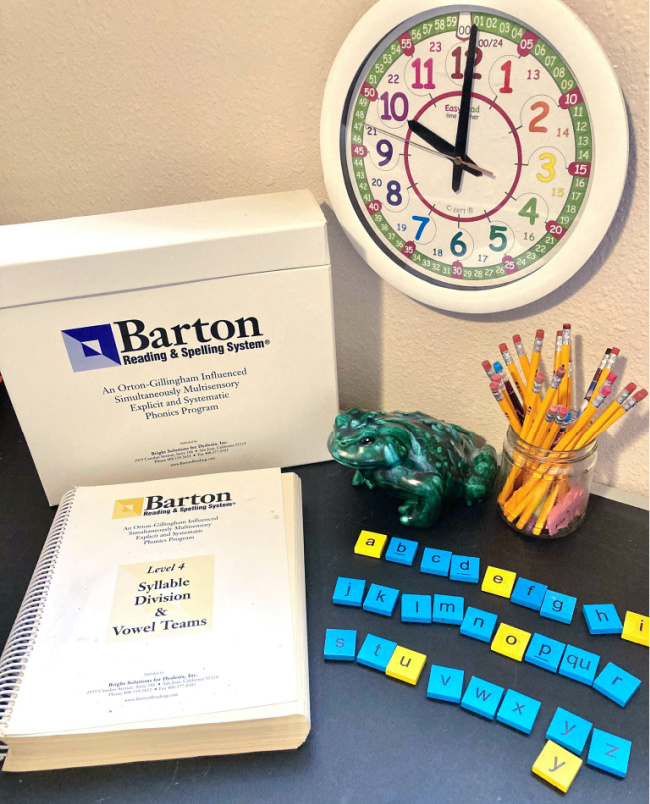
Barton Reading and Spelling is VERY expensive, as far as homeschool curriculum is concerned. We have paid $350 for just one level?!?!? And all you get is a large spiral-bound manual, some colored tiles, and a set of DVDs!!! 

Yup. A lucky set of circumstances helped us to cover some of these costs, but yes. We paid $300 to $350 per level for a box with a giant manual, some colored tiles (although the tile app is better) and a set of DVDs. The plus side of Barton is that it has a very high resale value. Most families buy one level at a time and list that level “for sale” on eBay or various Facebook groups and easily get back $250-$300 back. That money goes into buying the next level their kiddo needs. Another plus is that many Barton parents later invest in becoming certified Barton tutors and begin to tutor other children. Overall, tutoring your own children is still astonishingly cheaper than paying a tutor to do it for you. 

Barton Reading and Spelling is VERY boring. LOL! This does not sound like an endorsement but it most definitely is, after an explanation. Barton was originally written for adults and so there are no cutesy pictures or anything of ANY visual interest in the student pages. The practice stories are drab. The procedures of Barton are so repetitive that you may require a caffeine boost to get you through them. But the repetition is key! The formulaic, systematic, and yes boring, procedures are exactly what a dyslexic student needs to recall and retain the many skills that are needed to read and spell. This is the secret of an Orton-Gillingham based program and why it works. And by the way, Barton is scripted. Moms, you CAN teach your child using this system by watching the DVDs, then doing the lessons from the script. That’s all you need. 

Barton Reading and Spelling is VERY effective. I have seen it in my own children. Their spelling is not perfect 100% of the time but they now have tools to help them. My children can break apart syllables. My children know what schwa is. My children are helping their younger siblings learn how to read using Barton techniques. Wha?!?!? Yes! I caught my dyslexic 12-year-old explaining to my 7-year-old why “y” makes different sounds at the end of a word. It’s called the Cry Baby Rule, thank you Barton!! 

With regards to my children’s reading skills, Barton has been effective in 2 ways. First, my children have stopped guessing at words (at least in front of me) and my children can read words that they have never encountered before by breaking apart syllables. Many people think this is the same as “sound it out,” but it is not the quite the same. There is a system for breaking apart syllables to determine what sounds the letters make and my kids understand this because of Barton. If you are more convinced by numbers, take a look at these studies about Barton’s effectiveness. 

Disclaimer! I could not possibly say everything there is to say about the Barton experience. Some days it just clicks and some days we have to close the manual and take a break. And what can I say about Susan Barton herself? She is a queen, A QUEEN!! If you watch this video of Susan Barton explaining signs and symptoms of dyslexia, you can see how much she cares and how much she knows. When you hear the story about her nephew, grab a tissue. 

Please! If you suspect dyslexia in your child or children, I highly recommend checking up Susan Barton’s two websites:
Do NOT be put off by the early 2000s look of the websites. LOL! The information is up-to-date.


Supplies to Help You Teach


These are some of the extra supplies I find helpful in teaching my kids to read with this program. 


And these guided reading strips are also extremely helpful.


Keep learning!


Click on these links to additional information about dyslexia resources or other reading program reviews.

-----------


Stacie Servantes Farias is an Army wife and mom of 6 with a “very healthy” obsession for Snoopy, Disney movies, Audrey Hepburn, Dr. Pepper, Whataburger, books, and homeschooling. Originally from Mission, Texas, Stacie and her high-school sweetheart hubby live with their kids and dog in a different home every few years, because that is the military life. She has big plans to write a book exploring her theory that La Llorona drowned her children because they would take their socks off all over the house and then would complain that they never had clean socks! Stacie also thinks she is really funny, but she is mostly lame. 


Wednesday, April 19, 2017

Lion’s Story: To Homeschool a Special Needs Child


As we continue to support Autism Awareness Month, I'm happy to publish this exceptional article by Suzanne Mahoney, a Spanish-American mother of two in a multilingual household. She's homeschooling her special needs child and shares helpful advice and resources for parents who are considering homeschooling as an option for their own family.


Lion’s Story: To Homeschool a Special Needs Child


Homeschooling a special needs child can be challenging, but it is rewarding not only for your child’s accomplishments but your own. In Lion’s case, we have seen both sides of the education fence; public school and now for the last year, homeschool. Lion, now 15 years old, has a variety of obstacles to overcome. Some of his diagnoses include cerebral palsy and autism. He is also non-verbal and (until a couple of months ago) a non-walker. Homeschooling challenges can be especially complicated when there are multiple spoken languages in the home. Since birth, Lion had been immersed in a household where three or four languages were being spoken continually. He grew up understanding three of them well. More recently, he has mainly been in a bilingual environment (English-Spanish) and because he was attending public school, his education was solely in English. Now that we are homeschooling, Spanish has been incorporated as part of his communications program.

When the homeschooling of a special needs child, in any language(s), is being considered, you must ask yourself, “Why do I want to do it?” It will be a lot of work, the time commitment may be huge, and not all expenses that you think are necessary will have external funding. But...

Homeschooling empowers both the child and the parent so that what you thought would be an impossible task, is made possible with patience, insistence, and persistence. The attained goals become your reward and your family’s quality of life also improves.

Choices and Sources
Once you have your “why” then what are your choices and sources? Visiting your state’s Department of Education website will be the place to start. It not only outlines the steps to take, but it should also have a wealth of supportive educational materials to guide and assist you. Most importantly, it should contain the legalese and statutes pertaining to Special Education and the available homeschooling programs within your state. This will better prepare you for knowing the what, when, where, why, and how of the homeschooling mission. I cannot stress how important it is to know your legal rights when it comes to children with disabilities, so though it is often time consuming to sit down: just do it. Understand it. It helps to invite a friend over for coffee to assist you in comprehending the lingo involved. Ask a community outreach program or find a local homeschool support group for feedback and ideas. The better informed you are, the better planning, services, and funding you will be able to obtain for your child. Yes! You can homeschool your child and get a few “perks.” It is a matter of knowing what is available in your area and what your child really needs. Check out this page on HSLDA for information about Special Education Provisions in the 50 States and Territories.

To our surprise, our state offers flexibility in providing “perks” that I had not anticipated. For example, you can homeschool and still have the district provide speech, occupational, physical and behavior modification therapies. You can also have your child participate in the school’s extracurricular activities (such as sports, theater, band, etc.) and have transportation provided. The caveat? An IEP (Individualized Education Program) and associated goals would then be required to be written by the IEP team.

Virtual School enrollment may be another alternative worth considering depending upon what your State offers. Florida does require that homeschooling be logged, documented, and be available for review upon request.

For now, we wanted as much detachment and freedom as possible from school districts to allow Lion to catch-up in as many of his academics and life skills as possible. Well, we are proceeding with our own carefully crafted goals and we are experiencing fabulous results!

Considerations and Goals:
Each child is unique. His interaction with others is unique. His current school environment is also unique. So, you must create your goals and be realistic in doing so.

Years ago, I remember setting a goal for my child to learn to use his “AAC communications device (his voice)” to say “hello” independently. This seemed to be a logical, realistic, and very valuable skill; a first step towards communicating with us. This basic goal is successfully taught to special needs children similar to Lion.

At that time, he was attending public school. The frustration that we had was in working with the school to design appropriate goals that would benefit Lion. Unfortunately, the school told us that they knew our child better than we did and that we must follow their lead. They stated that they were the educators and we were not. We were overruled many times in the IEP meetings and elsewhere. It turned out that the school’s main driving force was not in benefiting Lion but in limiting the amount of time that they were willing to spend on him. They even stated that the time dedicated to his individualized academics was “15 to 20 minutes a day.” We were informed that there were “other students in the classroom to take care of.” Nor could we get a dedicated aide assigned to him within the IEP. Their methods were not well thought out, were not stressed at school, and were ineffective. For us to do something else at home was too confusing to Lion. We helped as we could but knew that the situation was not what it should be. As a result, Lion lost years. Such is life. But it was very frustrating!

At the same time, while attending school, Lion attained a simpler goal. He learned to feed himself. All I heard from school was that he either needed yet another adaptive spoon or that he had refused to feed himself and thus needed to be fed by someone at school. My solution? I took it upon myself to ignore the school’s methodology and applied my own methods during dinner time. My goal was to accomplish his training in six months. To my surprise, with hand-over-hand methods and a bit of insistence, in less than a month he was eating with minimal assistance. A month after that, he was independently feeding himself. He would still come home from school with the same notes of nonattainment and insist on being spoon fed by me because he had been spoon fed at school. He really had them fooled and they did not take the time needed to listen to me, so they could understand, insist, and change Lion’s behavior. It took us an hour to dine then. But today, he can eat as quickly or as slowly as need be. He has mastered the fork, too! I thought I would never see the day when I would finally sit and enjoy eating without having to feed him.

Be as Creative as You Want
Homeschooling for Lion is not the traditional paper, pencil, and book program. Just as technology has enabled “normal” homeschoolers to explore a vast wealth of global encyclopedic information, so has technology blessed our “special needs” children with the ability to access programs and communication platforms. This is especially evident for those children for whom talking and/or writing was not possible in the past due to physical or mental impediments. Now, many of these challenges have been alleviated by technical solutions that, while not perfect, are certainly helpful.

Lion’s first two years of homeschooling include three global goals:

1) Lion will communicate with minimal assistance using an AAC communication device (we use ProLoquo2go software) with family and friends,

2) Lion will walk independently (using a walker) on both even and some uneven surfaces (trails, the playground, etc.),

3) Lion will learn a variety of self-living skills; undressing and dressing with minimal assistance, toileting skills, transitioning in/out of a chair and the car from his walker or wheelchair, etc.

Just like any human being has good and bad days, so do our kids. The exception is that our children’s behavior tends to be more pronounced than children who don’t have special needs. When Lion wakes up with a cute half sneer in his mouth and the attitude of, “Oh, I’m broken and I can’t get up…” that’s when I know I need to forget what I had planned for that day and revisit what actually is possible to accomplish together. Math? Well, in our house, bread needs to be made. So, counting while measuring ingredients and integrating this activity into the use of his communication device may be the only types of things that can be accomplished… that day.

When his attitude is good, he does much more and it thrills me that he enjoys most of it. Quite a change from his public school days.

We have found that teaching methodologies and best practices may be obtained and learned from surmountable sources of data. Usually, they are available at our fingertips via the internet or a visit/phone call and thus our only limitation is the time it takes to find, question, read, understand, and then apply them. But not everything works for your child.

Homeschool Accomplishments
Remember Lions’ three global goals that I mentioned? It is almost time to write new goals - over a year early! Half a year into his schooling, Lion has almost completed goals #2 and #3 and has made great progress with goal #1. It is amazing to see Lion spontaneously communicate with us and voice new words in new ways. Lion is beginning to break the “autistic ice!” Sometimes he is so happy with his new skills that he breaks down in a fit of giggles!

Additional Resources
I've also found very useful resources available on the following websites:


Looking Forward
There’s a lifetime for learning. Don’t rush. Do it right. The old adage that you must sometimes slow down to speed up is, oh, so true!

----


Suzanne Mahoney is a homeschooling a Spanish-American mother of two. She's also a Board Member of Family Network on Disabilities (FND), Board Member of the Family Network for Special Needs Fund Trust (FNSNTA) and past Board Member of the Florida Interagency Coordinating Council for Infants and Toddlers (FICCIT)


Did you enjoy this article? Are you thinking about homeschooling your child? Let me help! My book - The Latino Family's Guide to Homeschooling - covers everything you see here and more. 

Tuesday, November 11, 2014

Free Online Help for Parents of Kids with Learning Issues: Understood.org


Do you have a child in your life that struggles with learning or attention issues? Are you looking for ways to help or cope? Then you need to know about a new comprehensive, FREE online resource for parents and kids ages 3 to 20.

Understood.org was created by 15 nonprofits to provide families with personalized information and support tools so they can understand how dyslexia, ADHD, and other learning and attention issues can affect kids in and out of the classroom. In addition to empowering parents with information, the site is designed to help them make effective choices to address their children’s academic, social, and emotional needs. Understood aims to cut through the confusion and give parents a clear path to the support they need to help their children go from simply coping to truly thriving.


When I visited the site, the first thing I encountered was an introduction that taught me about all the resources I could find there, such as the ability to personalize the whole experience by setting up my own profile where I can enter my needs as a parent and the issues with which my child is struggling. Understood keeps all the information safe, but is then able to direct me to resources that are the most beneficial for my family.

Every page has Reading Assist tools that help you access the information. You'll even find the entire site available in SPANISH!


But perhaps the one section that stood out the most for me was the Parent Toolkit. In it you'll find valuable tools, such as the simulation tool that allows you to see what your child is seeing/experiencing. It does a remarkable job of helping parents to understand their children a little better. Or the Tech Finder so you can find apps & games approved for your child.


Overall, this is such a fabulous resource for parents and children. And the best part of it all is that it is FREE!

If you're ready to check it out yourself, just head on over to Understood.org.

Tuesday, August 23, 2011

Guest Contributor: Lisa Quinones-Fontanez


According to an article last June in Fox News Latino, "The prevalence of autism among white children in the U.S. is 1 in 100, according to the Centers for Disease Control. But among Hispanics it is 1 in 170... According to the data from 2001, white children had the highest rates of autism, 90 percent higher than Hispanic children. By 2005, there was virtually no difference." 

My friend, Lisa Quinones-Fontanez, is the publisher of Autism Wonderland, a blog chronicling her experiences as a mother of a child with autism. She has graciously taken the time to share some of her thoughts and knowledge in this area...


My Experience:

I often wonder what kind of parent I would be if I had a different kind of child. By different, I mean a child without autism.

I remember when my son was first evaluated at 24 months. Doctors asked questions that I didn’t know how to answer. Did he babble? Did he play peek a boo? Did he look us in the eye? Did he wave hello?

I continued to think about those questions after coming home from that initial evaluation and looked at my son’s baby calendar. It was a baby shower gift, the kind that a new mom uses to record baby’s firsts. At the back of the calendar was a page of milestone stickers. The calendar, as I flipped through it, was mostly blank. It was then I realized that I hadn’t forgotten to update it; my son just hadn’t reached many of the milestones.

Those first two years of his life went by so quickly. As a new mom, I was blinded by my love. I missed all the things he could not do. Now I look back at his baby pictures and study them, wondering: was autism there? And I chastise myself for not knowing enough of the signs of autism to see it.

After we received the diagnosis, I felt like a failure. I spent a lot of time trying to get my son to “catch up” with his peers. He was enrolled in a center-based program and I started using a compensation notebook to communicate with the teachers. That first year, I wrote to the teacher often. I asked questions about behaviors, I shared recent accomplishments.

By the second year, when he entered Pre-K, I sent my son to school on his first day with a five-page entry in a new notebook. I wrote about all the things my son could do. What he like and disliked. What he would work for. What he did when frustrated. I listed his self-stimulatory behaviors. I wrote about how far he had come in a year and all the potential he had. I also included a word document list of all the words he could say. I had worked on it for weeks. Recalling words from memory, constantly listening for words I may have forgotten or overlooked.

When I think about the kind of mother I had been and the one I’ve become. I am strangely pleased.

If it wasn’t for autism I might not have remembered that my son’s first word was spoken on a Thursday in the last weeks of July, the summer of 2008. If it wasn’t for autism, I may not have remembered that my son gave his first real kiss on Christmas day of the same year. I would not know or appreciate all the work it took to get him to point his finger. I may not have been able to recall every single time he’s spontaneously said, “I love you Mami.” Because they are words I so rarely here.

Ultimately, it doesn’t matter what kind of mother I would have been. It’s the mother I am now – the kind of mother my son taught me to be – that matters.

Early Signs:

I remember when I first had concerns about my son. They were so easily dismissed – by my family, friends and even my husband. At his 18-month check up, I expressed these concerns to our pediatrician. He repeated my mother’s words, “He’s a boy; they develop slower than girls.” I was told to wait until my son turned two years old.

But the more I researched developmental milestones, the more I realized something was wrong. By 12 months my son did not gesture (point or wave). At 16 months he did not have any words. By 24 months he did not have any words. He had no sense of “pretend play.” The more I learned about autism, the more I knew my son fit the criteria.

My only regret is not acting on my initial instincts; my son could have started Early Intervention so much sooner. Early Intervention is crucial in a special needs child development; the earlier one can receive a diagnosis, the earlier services can begin.

Learning:

Dr. Lovass, a world-renowned autism expert believes: If a child cannot learn in the way we teach ... we must teach in a way the child can learn. I cannot stress the importance of this philosophy in teaching children with autism. I am not an educator and I have no formal training. But I have embraced the methods of the numerous therapists and teachers that have come into our home to work with our son. I have learned to think outside the box. I have mentally removed the timetable of milestones, allowing my son to learn at his own pace. I have learned that all children think, learn and process differently. What works for one child on the spectrum, may not work for another. Teaching children with autism is about trial and error and trying again. Eventually, with time, persistence and a lot of patience, you get it.

Autism isn’t the disability people perceive it to. My son isn’t Rain Man and he isn’t trapped in a secluded imaginary world. And as a family, we don’t suffer from autism, we live with it. Children with autism have the capacity to learn and to love; they have just as much potential as any other child.
---------------

Lisa Quinones-Fontanez is a secretary by day and MFA Creative Writing CCNY student/blogger by night. Her writing has been featured in BronxMama, Being Latino and Tiki Tiki Blog.
 
More importantly, Lisa is a mother to a child with autism. Her blog AutismWonderland focuses on her family journey with autism and also provides local resources for children/families with special needs.
 
In between work, school, blog writing and advocating for her 5 year old son, Lisa is also working on a historical fiction novel (working title) A Thousand Branches. A chapter excerpt (The Last Time of Anything) from A Thousand Branches received Honorable Mention in Glimmertrain's Family Matters October 2010 competition.

LinkWithin

Related Posts Plugin for WordPress, Blogger...