Showing posts with label finance for kids. Show all posts

Tuesday, July 29, 2025

Personal Finance Curriculum for Tweens


The following post is a collaboration between
Beyond Personal Finance and MommyMaestra. All thoughts and opinions are the personal ones of guest writer, Stacie Farias. 

Parents! Are you looking for a fun and engaging curriculum to teach kids 8 - 12 about managing money? Check out this review of Beyond Personal Finance's NEW program for tweens, BEFORE Personal Finance.

Personal Finance Lessons Then and Now

Allegedly, my 7th grade end-of-the-year math project was supposed to be a “fun” exercise on money. We were partnered up and tasked with spending $1,000,000. Sounds fun, right? The stipulations were that we could not buy more than 1 of each item and we had to provide “proof” of purchase. Y’all, this was before the internet. My family didn’t even own a computer yet. So there we were clipping newspaper For Sale ads, trying to find items we hadn’t purchased yet but a million bucks was not as easy to spend as we thought. If my memory is correct, my partner and I scored 68%. That was my only public school experience with finance education until Economics in 12th grade. 


Finding Before Personal Finance

Forty years later, I’m homeschooling my own children and I am, quite frankly, relieved that author Charla McKinley and her son Jack have written curricula that addressed the topic of personal finance. My obvious trauma (joking but not joking) leftover from that one 7th grade experience with budgeting has absolutely stilted any confidence in teaching personal finance to my own children. And I have a minor in Economics!! I jumped at the chance to review Before Personal Finance because I really needed a subject-matter expert to help me teach my children. 


Breakdown of Before Personal Finance

Before Personal Finance is a curriculum best suited for ages 10-12, maybe a little younger if their subtraction skills are advanced, which addresses key topics in personal finance in ten lessons. There is only 1 worktext that both the parent and student use together with a QR code to online teacher resources that are essential to the lessons.


There is also a How-To video for the parent, which I strongly recommend you watch before starting this curriculum. Each lesson addresses one specific topic in personal finance, for example, Lesson 1 is  “Introduction to Money” and Lesson 2 follows with “Earning Money.” Each lesson builds on the previous lesson and must be done in sequence. Lesson 3 is “Budgeting” and flows logically into Lesson 4 “Smart Spending.” The Lesson Overview estimates each lesson taking around 2 hours, however, I found that each lesson takes roughly 1-1.5 hours. 


Individual Lesson Breakdown

Each lesson follows the same format: 

  • Teacher’s Corner page addressed to the parent/teacher

  • Future You page addressed to the student

  • Two pages of new information for the lesson

  • Lesson Activity

  • Store page for the student to “purchase” items

  • Budget page

  • Fun Activity page

  • People Who Have Made a Difference page (Adam Smith, Alexander Hamilton, etc)

  • Quiz

  • Reflection page


The lessons address the student as their future-selves with money gifted to them by their grandparents, ($300 to be exact). Then the lessons present scenarios where the “future you” spends or earns money.


What I Love About the Curriculum


There is always a “plot twist” to each lesson where the student is confronted with a scenario that impacts their budget. A spinning wheel of scenarios is available through the “teacher resources” QR code. Some of the “plot twists” my son got were “Broke your retainer. You have to spend $200 for replacement,” and “Lost my friend’s headphones. You have to buy new ones for them. They cost $80.” Doesn’t stuff like that happen ALL THE TIME?


These plot twists, in my opinion, are the cherry-on-top of Before Personal Finance because life isn’t static. Life rarely ever allows for perfect budget planning. So how would a personal finance curriculum adequately prepare the children for real-life personal finance without factoring in the unexpected? The 

"plot twists” are the chef’s kiss of this curriculum. 


Bottom Line

Before Personal Finance is perfect for the homeschool family with tweens interested in money. What tween isn’t interested in money?! We used this program as a fun summer subject but I could definitely see Before Personal Finance for use throughout a semester, as a morning basket read aloud, or as a fun activity during Advent so that the children are money-conscious before witnessing the expense of the holiday season.


In fact, I enjoyed this one so much that we are definitely buying the teen version. And I wish they had one for teens opening businesses. Not just personal finance. (Hint, hint. Anyone reading this?)


Where to Get It


So if you have a tween - don't wait! This topic is a must add to your school curriculum. Get your copy of Before Personal Finance- A Beginners Guide to the Future here on the Beyond Personal Finance website.


Want to find this review again? Pin it!


Disclaimer: I received a copy of level two for review purposes. All thoughts and opinions are my own. ~Stacie

----------------

Bio:

Stacie Servantes Farias is an Army wife and mom of 6 with a “very healthy” obsession for Snoopy, Disney movies, Audrey Hepburn, Dr. Pepper, Whataburger, books, and homeschooling. Originally from Mission, Texas, Stacie and her high-school sweetheart hubby live with their kids and dog in a different home every few years, because that is the military life. She has big plans to write a book exploring her theory that La Llorona drowned her children because they would take their socks off all over the house and then would complain that they never had clean socks!

Friday, September 19, 2014

Teaching Children Hard Lessons


Tonight, my son learned a very hard lesson that I hope will stay with him his entire life. 

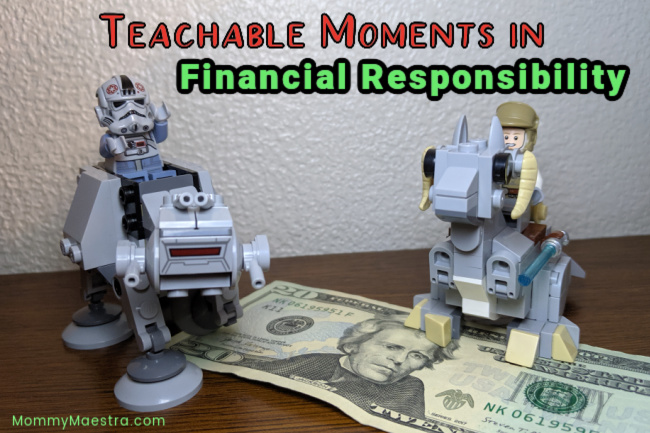
As part of their schooling this year, my children are learning about financial responsibility. I looked a long time for a curriculum to use and finally settled on Dave Ramsey's Financial Peace Junior (aff link). So far, it has been such a wonderful experience for all of us, but especially for me as I have long struggled with the entire concept of an allowance. (But more about that later.)

Anyway, earlier this week my son went through his savings and counted up all his money. He was quite surprised and pleased at the amount and asked me if he could spend $17 of it on a special toy he really wanted. I agreed since he had chosen to put some of his spending into his savings, but told him that he would have to wait until our next trip into town to get it. He wanted me to order it from Amazon, but I refused because I think he is too young to understand the dangers of ordering online. In my opinion, it is too easy to overspend online if you don't understand the idea of budgeting and the value of money to begin with.

So finally, after three days of waiting (somewhat impatiently), we prepared to go into town this evening. I told him to get $20 out of his savings, but when I walked up, I found him taking ALL of his money out of his savings and putting it in his pocket. I made him put it all back except for a twenty dollar bill. He wasn't mad, but a little annoyed that I made him do so. Then as we got into the car, I told him to put his twenty in his wallet, which he keeps inside the car.

I had a list of errands to run, so we made a few stops before we arrived at the store where he was going to buy his toy. And then we went in to purchase it.

But his money was gone.

He hadn't put it in his wallet like I had told him and somewhere along the way it must have fallen out of his pocket. We headed back out to the car to see if it had fallen out in his seat, but no such luck. As I shut the door and started the car, the realization sunk in and he began to cry.

I felt so bad for him. It was all I could do not to turn off the car and go in and buy him the toy with the $20 I had in my own wallet. I wanted to so badly, but I realized this was one of those invaluable teachable moments that I wanted him to remember forever. I hugged him and told him how sorry I was that he had lost it.

He wanted to go home and get another $20 out of his savings. That immediately snapped me out of thinking about buying him the toy because what kind of lesson would that teach? If you lose money, don't worry, there's plenty more of where that came from? You can just get more out of savings? Or if you lose money, someone will give it to you anyway?

I refused and told him he was going to have to earn it back with chores. Since the maximum he's allowed to receive each week is directly related to his age ($8), it's going to take three weeks to earn the twenty back since he has to put some away in giving (and spending).

He cried pretty much the whole half hour it took to get back home and then had to be comforted by his father for a little while. But fortunately for all of us, he's a pretty happy little kid so he was back to his smiley little self by dinner.

I hope I did the right thing and that the lessons he learned tonight are:
  1. You have to work hard to earn money. 
  2. Money is valuable and should be managed carefully. 
Do you let your children suffer loss and make mistakes without helping them out?


If you'd like to explore other resources that I have on financial literacy for children, try this post that lists 7 books that help teach financial literacy to kids or this one with lots of financial literacy resources for families and children.

Wednesday, December 4, 2013

5 Money Saving Apps for Kids


An article titiled, Give the Baby a Bottle and a Bank Account, plus the upcoming holiday shopping craze, really got me thinking. Our kids are busy with Santa's lists and asking for this and that and more! For some families, it isn't only this time of year. Some kids want it all, all the time!

I started to wonder if we have a plan on how to teach our boys the value of money and saving? The article suggests that children as young as the age of four should start being included in conversations regarding family money, budgets and other financial decisions. Our oldest is about to turn seven and we are guilty of not doing any of the above. I definitely see the advantages of starting now (well, maybe after the holidays).

My first thought was to turn to what kids love: a little screen time. I found these fun and educational apps to help start the conversation in the home. Some are as simple as teaching young children what money is and its value and others go as far as helping your child break down percentages of allowances to go to different accounts, including giving money to charity. Apps can be a great educational tool and if kids already have the tablets, have them use them for good too!

My list:

Just Saving My Money-Little Critter $1.99 Here at Mommy Maestra, we love books! Hurray for this interactive one! The best way to get started with money introduction and conversation is to read about it. This app is also perfect for the youngest members in your family. Critter, the popular book character, wants to buy a skateboard and little readers will go on a journey with him to help him earn money and save.

Kids Money  Free This app is perfect for the basics in saving and spending. Your child can create a wish list, insert the cost of a product, and based on allowance or gift money, the app will help teach how much money and time will be needed to purchase their item. It teaches easy math concepts like adding and subtracting.

KidsBank Free-$2.99 Found under the "finance" category in iTunes, KidsBank means business. Targeted to ages four and up, this app is super specific, which I found to be a great money management tool.  Parents can help children earn interest, track deposits and withdrawals and even email and print account statements.

My Make it Count Free Parents will love for their kids to start looking at spending habits and this app offers just that. It's a simple, "money-in, money-out" concept but it's cute and might be a good first app to try. Another perk? A French language option is available on the app!

Earn This Save That: Allowance, Chores, Banks, Goals & Rewards $2.99 Another serious app for parents who are ready to teach their children what it takes to make money and budget it all. A little bit more kid friendly than KidsBank (with its accounts), Earn This Save That has "banks" instead. I love that they both have an option for charity but this one has time earnings too. What kid doesn't beg for extra screen time? Now they can see how time can be earned as well.


--------------------------------------


Betty Galvan, is helping her readers "find the positive and seek the benefits" over at her blog, MyFriendBettySays.com.

LinkWithin

Related Posts Plugin for WordPress, Blogger...