Tuesday, November 16, 2010

Bilingualism and Language Delay: Part 1


Language and speech disorders don't recognize borders. They are not limited to monolingual children, or bilingual ones either. And for many - especially families raising bilingual children - they can be hard to identify or mistakenly diagnosed.

This is a rather obscure topic. And because many of you are teaching children who speak Spanish only, or who speak both English and Spanish, I thought it would be good to have someone who can talk knowledgeably about this issue.

We are so very, very fortunate today to have the first of a series of posts by Dr. Elizabeth D. Peña, professor of communication sciences and disorders at the University of Texas at Austin, and her colleague, Dr. Lisa M. Bedore, associate professor of communication sciences and disorders. Together, Dr. Peña and Dr. Bedore have been researching language disorders in bilingual children for the last 10 years in order to come up with an accurate test to assess this problem. This test would help school pathologists to determine if a bilingual student does indeed have a true speech-language disorder, or if he or she is simply in a normal stage of development for learning two languages at once.

~~~~~~~~~~~~~~~~~

by Dr. Elizabeth D. Peña and Dr. Lisa M. Bedore

The question of whether a child has a language impairment or delay comes up frequently with children who are learning two languages at one time. Often, parents and teachers wonder whether bilingualism can slow down language learning. Other questions concern whether a child has a language delay or disorder and whether it’s okay for children with delays to be exposed to two languages.

Can bilingualism slow down language learning?

The logic to this question is that if children spend half of their time in one language (L1) and half of their time in another language (L2) then they get less input (compared to monolinguals) in both their languages. The logical conclusion is that they may only learn half (or less) of what they need. But, this isn’t completely true. Work examining vocabulary learning in bilinguals does show that bilingual children as a group tend to know fewer words than monolingual children when tested in only one language. But, their test scores are generally within the normal range for their age. This effect is pretty consistent across studies including the work of Barbara Pearson and Ellen Bialystok. In our own work on a grant funded by the NIH, Diagnostic Markers of Language Impairment in Bilinguals, preliminary findings of a screening test given to about 1200 children also shows that bilingual children score lower in each of their two languages when compared to monolinguals.

On the other hand, bilingual children know another language. If you put their two languages together they know more total words than monolingual children of the same age. Consistent with the work of other researchers with younger children, we have found that preschool, kindergarten, and first grade Spanish-English bilinguals distribute their vocabulary knowledge across their two languages. Some of their vocabulary was duplicated in each language such as knowing mama and mommy, or water and agua. But other words bilinguals may know only in one language—logically the language they need that word for. In preschoolers for example, we’ve noticed that many of the children we work with know shape, color, and location words in English, and know familial relationships, furniture, kitchen tools, for example in Spanish. This division reflects the context in which these words are learned.

What about children with language impairment? Can they handle two languages?

The incidence of language impairment in the general monolingual English speaking population is about 7%. Children are said to have a language impairment or delay when they have special difficulties learning language and these difficulties do not have a physical or neurological cause. The research on language impairment in bilinguals is just emerging. But, given what we know about bilinguals with typical development it doesn’t seem that it would be logical to suggest that bilingualism is the cause of language impairment. Language development is not slowed down when you consider children’s total language knowledge. In addition, these children are tackling the somewhat more complex task of learning two languages. Furthermore, it does not make sense to limit bilinguals with language impairment to only one language. Children with language impairment learn both. Our emerging longitudinal work seems to indicate that bilingual children with language impairment continue to learn both languages at about the same rate as typical bilinguals, even though they perform lower than their typical peers. Furthermore, knowledge of one language can serve as the foundation for the other language.

Research with bilingual children who have language impairment seems to indicate that they will have delays in both languages—not because of bilingualism but because of their underlying difficulties that affect language learning. We know from the work on French-English bilinguals with language impairment that these children seem to show patterns of difficulty that are comparable to their monolingual language impaired peers.

Next time, we will post on characteristics of language impairment in bilinguals. To find out more about language impairment and bilingualism go to: http://2languages2worlds.wordpress.com/

UPDATE: To learn more, take a look at Part 2: Language Impairment in Bilingual Children.

Monday, November 15, 2010

International Education Week!


This week the U.S. Department of State and the U.S. Department of Education officially launch International Education Week (IEW), which promotes the benefits of international education and exchange, as well as encourages programs that prepare Americans to live and work in a global environment.

First Lady Michelle Obama has stated that studying abroad can advance our education, opening a world of opportunities, and making us more competitive in the world market. She’s not stating anything that those of us who were raised bilingually don’t already know, but it is great to hear it acknowledged.

Not too long ago, on a flight to Texas, I happened upon an article in one of the plane’s magazine. It was about how more and more companies are now actively searching out – and hiring - individuals who have studied abroad. Their reasoning? Employees who have traveled out of the country are better able to analyze situations from various angles, are more creative problem solvers, and are better at international relations. This outlook reinforces an idea that I firmly support: Learning a new language is not just about words, rather it is also about experiencing culture and traditions.

So what does all this have to do with Mommy Maestra? A lot, actually. Our biggest goal as parents is to provide our children with the tools they need to succeed as adults. The gift of bilingualism is one of those. So is the ability to think globally and to avoid stereotypes.

This week we will be celebrating International Education Week here on Mommy Maestra. And you can, too. Visit IEW’s website for ideas on how you can celebrate this week in your classroom or at home. Be sure to check out their Events list to see if there are any in your area. While you’re there, you can also test your Global IQ. They have three quizes: The Continent IQ Quiz, The Cultural Geography IQ Quiz, and the Physical and Cultural IQ Quiz.

To start this week off, we have a special guest post by Denise Leitch, the owner of Kultural Kids and creator of Foreign Language Friends. Denise has offered to talk about some of the benefits and challenges of learning a second language and has created a list of resources for those of you who have asked for more information about it…


Hi. My name is Denise Leitch and I am the owner, director, and instructor at Kultural Kids Learning Center. I am originally from Chile, South America, and I am a native speaker of the Spanish language. I also speak English and French fluently.

I grew up in Concepción, Chile and I attended Lyceé Charles De Gaulle school for 11 years. This school is unique in its style since it goes from preschool to High school and its curriculum is designed to use French full immersion.

My junior year of high school, I decided to leave Chile and become an exchange student. I was accepted in the Youth For Understanding program for a full year stay in Morton, IL. My responsibilities were to attend an American high school, finish my senior year in USA, and learn more about the North American culture.

After being in this country for only months, I was able to speak fluently and comprehend most of what was said to me. I truly enjoyed the American life style and education system. Therefore, by the end of my exchange student year, I decided to apply to Bradley University in Peoria, IL.

I attended Bradley University studying early childhood education and psychology. My focus was on Cognitive Psychology - language acquisition. While in college, I taught, tutored, and gained knowledge and experience working with children in many ways. Since graduating I have taught foreign language independently and through other local schools.


Benefits of Learning a Foreign Language

Parents tend to mention three main reasons why they want their children to learn a foreign language:

1 – Academic reasons: Research shows that learning a second language helps children do better with their native tongue. It helps them acquire and recognize unique sounds, accents, intonations, and more. In addition, children that are exposed to a second language tend to do better in various academic subjects including mathematics & science.

2 – To encourage understanding of other cultures: By learning a foreign language at our center, children are not only exposed to the full immersion foreign language, they also get to play traditional games from around the world and learn about other cultures: their costumes, eating habits, and much more.

3 - To build better communication skills/relationships for the future: Currently, it is a great benefit to be able to speak more than one language, and in the future it will be almost mandatory. Therefore, it is best to take advantage of the unique ability of a child's brain to learn a language naturally as early as possible through consistent exposure and enjoyable activities. Before children can speak, their brains are able to encode unique sounds. All this information shapes and helps develop the infant’s brain which, naturally, will be used through out his/her life. As the child grows, it becomes increasingly difficult to learn new words, develop new sentence structure, and flawlessly imitate new accents. Experts suggest that by age 10, humans have already lost the ability to hear and reproduce new sounds.

Full immersion is the best technique to grasp a second language quickly and almost effortlessly.


Challenges of Learning Another Language

There are various challenges a parent might face with raising a bilingual child when they themselves are not fully versed in the language. Some of those are:

1- Ability to challenge: Since children learn so quickly, it is very difficult for parents to be able to challenge their child's learning at home - especially when the parents do not speak the language themselves.

2 – Resistance at home: Many children do not want to speak the foreign language at home. For many years, children have only heard English being spoken at home, therefore, many of them tend to refuse to use the foreign language for their parents. At Kultural Kids, we recommend to all our families to try to add foreign language into their everyday life little by little. For example, on a car ride: talk about the colors they see while they are driving around town, or while eating lunch: talk about what they are eating (name the food) and say if they like it or not, if it is hot or cold, etc.

3 – Lack of educational material to support the foreign language learning: It is very difficult to find a good educational product for a reasonable price, that is interactive and age appropriate. This is one reason why I developed Foreign Language Friends, which was designed to encourage full immersion learning at home in a fun and inexpensive way. [Editor's note: Denise will be sharing more about Foreign Language Friends soon!]

4 – Trouble assessing their child's progress: For many parents it is hard to know how much their child has learned, this is why at Kultural Kids we provide a foreign language assessment form at the end of each session. Parents are informed of their child's progress as well as given some examples of what we have seen/heard in the classroom. In addition, they are always encouraged to stay and observe our classes.


The top books I recommend to Kultural Kids participants:


#2 - Raising a Bilingual Child (Living Language Series) by Barbara Zurer Pearson and Living Language

#3 - 7 Steps to Raising a Bilingual Child by Naomi Steiner MD, Susan L. Hayes, and Steven Parker M.D.

#4 - The Bilingual Family: A Handbook for Parents by Edith Harding-Esch and Philip Riley

#5 - Intercultural Marriage, 3rd edition: Promises and Pitfalls by Dugan Romano


Top five great websites for parents, teachers, anyone!

#1 - The National Network for Early Language Learning

#2 - Ñandutí

#3 - Primary Lanugages

#4 - Learn Lanugages

#5 - Multilingual Living

Each one of these sites has LOTS of content and articles.

~Denise Leitch


Denise will be sharing more about Kultural Kids and foreign language learning centers right after Thanksgiving, so be sure to keep an eye out for her next articles.

Friday, November 12, 2010

Weekend Links: Word Games to Free Books

• Engaging Vocabulary Word Game :: Teaching Español


• Gifts from Nature ~ Cinnamon Pine Cones :: The Magnifying Glass

• Project #66 Acorn Owls :: Bookhou Craft Projects (Love the crafts that she shares!)

• Native Sons :: Blue Yonder Ranch!


• Free Books for Kids :: Budget Saving Mom (A list of free audio books.)


And finally, don't miss out on The Old Schoolhouse's digital holiday supplement. It is filled with recipes, gift, and craft ideas for the holidays.

Thursday, November 11, 2010

Frijoles! The Snacktime Meal (And a Small Giveaway)

So for a really long time now, I've been wanting to write about nutrition and how it can affect your child's performance in school. I became interested in this after I began to notice how my daughter's ability to focus, sit still, and emotional state could really vary from one day to the next.

For a while, I worried about things like ADD and ADHD, but after talking to a friend, I did more research into nutrition and started monitoring what my daughter was eating. I eventually determined that she had a really high metabolism (like most kids her age) and she required a lot of fuel for her brain, as well as her body, for optimal performance during our classtime. She sounds like a car, doesn't she?

Well, it's very similar. And, in fact, thanks to this book by Dra. Isabel, that's how I explained it to my kids so that they could understand. Learning to read, or doing math, science, geography - or ANYTHING that requires a lot of concentration - uses up a lot of energy. And if we don't fill our kid's bodies with protein-rich foods, we're only making their learning experience more difficult.

Long story short (too late!), I started making some changes in their meals. But this was really difficult, because my son is a picky eater. My daughter will try almost anything once, but my son is not so adventurous. Fortunately for me, one of the foods they both wound up liking is FRIJOLES (or pinto beans for all you non-Spanish speakers.)

So now one of our favorite lunchtime meals is bean burritos. Served on corn tortillas, my daughter and I like to add fresh bell peppers and cheese to ours. But my son prefers it straight, with no additives. Honestly, after reading about the many benefits of these little beans, I don't even care. I'm just happy to have found a nutritious meal that he will actually eat. This picture is a sneak peek of our lunch today.

Anyway, when researching pinto beans, here are a few of the interesting facts that I discovered...

• Pinto beans originated in Peru (who knew?)

• It is the state vegetable of New Mexico

• There are four varieties of pinto beans: Burke, Sierra, Othello, and Maverick

• Pinto beans, or frijoles pintos, literally means painted bean. It gets its name from the splotched pattern on the beans (think pinto horse).

• In addition to being high in fiber, proteins, and minerals, they also restrain sugar levels in the blood.

Lots of really interesting stuff, and it makes me happy to have added this dish to our regular diet.

When I was growing up, my 'Buelita used to always have a big pot of frijoles bubbling on the stove. I don't know what her recipe was, but they were always YUMMY! (I liked to mix them together with a little Spanish rice and then scoop the mixture up on a tostada and down the hatch it went!)

But I have to be honest here.

I don't cook my beans like that. First of all, I don't have a good recipe. Second of all, I'm always in a rush. Third of all, I am not a good cook. There. I said it. Pass the Kleenex box, please.

So what do I do, you ask? I cheat. And I buy Old El Paso refried beans IN A CAN! Sniffle.

And you know what? They are good and we like them! Now, I have to say that I honestly don't know how much of their nutritional qualities they retain after being processed for mass distribution the way they have been, but I would imagine they retain SOME of their great qualities, don't you? 

We also have a traditional family taco night here at least once a week or once every other week. Sometimes we have a houseful of guests all squeezed in around our dining room table madly wolfing down their tacos, each one trying to outnumber the other for actual number of tacos eaten. (I think our taco nights are kind of popular around town because we use ground venison instead of beef - but that's another story.) 

So I actually do buy a lot of cans of OEP's refried beans. For those of you who do, too, here is a nice little coupon for $.60 off any two OEP products.

And for some extra giggles around the taco night table, go check out El Tacodor, a trivia game created by the PR gurus at Old El Paso. Once there you can download instructions, a score card, and a challenge sheet. Then let the fun begin!

THE GIVEAWAY:

The OEP guys are offering one you an Old El Paso "family taco night” prize pack which includes a packet of Old El Paso Taco Seasoning, a Cactus Chip & Dip Serving dish, a set of 3 Fiesta Chili Pepper serving dishes and a $10 gift card to purchase your taco fixings. (They sent me one to try out first, so I can tell you that the serving dishes are plastic, but cute, and your kids will love them. Oh. And I've already spent my $10 on mas frijoles! Hey! It's free grocery money, People.)

So if you'd like to enter to win, all you need to do is leave a little comment telling me how you like your beans best: refried, baked, in chili, etc...

Contest ends November 17th at 11:59 EST. Winner will be selected via Random.org.
This is a sponsored post. The prize pack and coupon are being provided by Old El Paso and My Blog Spark, but the history of beans and silly family stories are provided by me.

Wednesday, November 10, 2010

Who Are You? The Survey Results

When I conducted my survey a month ago, I learned that you, dear readers, are a very diverse lot. Some of you are homeschoolers, others are parents with children in public or private school, and some of you are foreign language teachers. And more surprising to me, a large number of you are not Latino.

In addition, in the section where I asked you what you would like to see more of on Mommy Maestra, you guys are all over the place. Some love the science aspect and want to see more about that. Others want to know more about how to teach your children Spanish. Or for me to share quality books/materials that are written in Spanish-only. Some of you want more resources for preschoolers, while others want more information for older children.

Gulp.

My work is cut out for me, no? Mommy Maestra has blossomed and grown quickly, which shows me how much you all love your children. I mean, why else would you be reading all about lesson plans, activities, crafts, books, and games – para niños?

So my goal for the next few months is to begin organizing the blog in a manner that will hopefully address many (if not all) of these issues about which you have asked. In addition, I am going to add a button to the sidebar for the survey, so that you may continue to request specific topics. I also want to continue to learn more about you, and filling out the survey helps me understand you better so that I can tailor the content of this blog.

Before I close, I went through and picked out a few of the requests that I have received in the survey so far, to give you an idea of who your fellow readers are...

“I'd like to see something about parents trying to teach their children Spanish, traditions, culture, but they are not home schooling. More like after-schooling :)”

“Maybe more step by step articles with pictures that go with text. It's just a suggestion cause I do love the content already.”

“I would love to see more resources, such as how to teach reading and math, in Spanish.”

“I am looking for ways to incorporate teaching a toddler Spanish in the home as a second language.”

“As I said above, love the science, love the resource recommendations - only thing I would change is more!”

“More bilingual ideas for kids 5 and older. There are a lot of toys and resources for todllers and younger kids, but for bigger kids there is a huge need of more.”

“I have a preschooler and a baby on the way, so some of the lessons are not quite for us, yet. Perhaps some more info relevant to preK/Kindergarten level?”

“Curriculum/teaching ideas for second generation bilingual families - my children are familiar with Spanish, but the conversation aspect is the most challenging. Tips on how to make that easier for them/us...”

“Language acquisition, brain development, research information...”

By the start of the new year, I hope to have started incorporating posts on all of these subjects. So when you see me jumping around between English and Spanish resources, toys for babies and word games for older children, you’ll understand that we are one big community of parents.

And I hope you will share your own experiences or discoveries with us, as well. If you would like to contribute a post about one of these, please contact me via email or on Facebook.

Con mucho cariño….

Tuesday, November 9, 2010

Project FeederWatch


This weekend we will begin a winter-long science project that we discovered last year. Project FeederWatch is a simple, international project in which citizens record and submit their observations of the birds in their area to a single website. The results are then analyzed by scientists, who then use the data to monitor the movements and populations of different bird species across North America. The best part of this project? Anyone can participate, including “children, families, individuals, classrooms, retired persons, youth groups, nature centers, and bird clubs.”

The number of birdwatchers across the nation is somewhat surprising. According to a Fish & Wildlife Service survey, one in five Americans are identified as bird watchers, and in 2006, they contributed 36 BILLION dollars to the US economy.

¡Híjole!

Who knew there were that many people out there so curious and appreciative about nature? And an incredible number of families and individuals are taking joy in creating a haven in their backyards for wintering bird species.

Now, it is no secret that we are an animal-loving family. Not in an overly-mushy kind of way, mind you, but since both my husband and I met while working in the zoo field… well, you get the picture. And, though, my husband is the official bird genius of the family (I am just the all-around genius - period.), my children and I have been the ones to embrace the art of bird watching here at home. So naturally, one of the first things we did when we moved into our new house a few years ago, was set up a bird feeder (or two or three) outside our kitchen and dining room windows. Last winter I was tickled to identify so many different species at and around our feeder. And this past summer, we monitored over 19 nests of 10 different species through Project NestWatch (more about that next spring).


SO, it is with great anticipation that we prepare to begin our FeederWatch Project. There is a $15 participation fee ($12 for Lab members), but knowing that this awesome program is funded almost entirely by these fees, makes me happy, too. In return, the participants receive a “Research Kit.” You get the option to choose what type of kit you’d like. We chose the “online data entry” kit to save paper. It includes an information handbook with instructions, a sample tally sheet, a bird watching days calendar, and a double-sided bird identification poster. We also received a subscription to the Lab of Ornithology's newsletter, BirdScope. (Canadian participants, receive Bird Studies Canada's quarterly publication, BirdWatch Canada.)

Okay, so the main reason we participate in this project is because we are bird lovers. But I also love how well this project can be incorporated into my daughter’s curriculum. First of all, she loves the idea of being a “citizen scientist.” And I love how by involving her, I will be helping her to develop her skills of observation, organization, math, science, writing, reading, PATIENCE, and probably a whole bunch of other things.

There is a good section on Education/Homeschooling for you to explore, as well. And here's a Homeschooler's Guide to the project with extra activities related to birdwatching.

I’ll be writing about this whole process a lot more over the winter, so I hope you will enjoy our learning experience, and maybe even be inspired to join in and do some bird watching of your own. You’ll be surprised at the passion and excitement that watching animals can create in not only your children, but also in yourself.

If you’d like to learn more about this and other Cornell projects, hop over and visit their site.

Con mucho cariño…

Monday, November 8, 2010

Homeschool Isn't for Every Day


The past week was a hard one for me. I was under a lot of pressure to meet two deadlines for some pretty major projects, as well as juggling sick kids, company from out of town, and - eventually - a sick me. So needless to say, our homeschool schedule was sort of shot. But I kept trying to make it work anyway, and the result was impatience, frustration, resistance, and some tears.

Some of my friends who have been homeschooling a long time had already warned me about this possibly happening. But sometimes it is hard to learn a lesson until you experience it yourself.

So here are a few things that I realized in the wee hours of the morning, as I was lying in bed with an aching neck, head, and sore throat:


Not Every Day (or Week) Will be Perfect

There are times when your kids are not going to perform well during your school time. I imagine this includes kids in a traditional school setting, as well. Yes, there are probably many things that can affect their performance, but a few of the more common culprits I want to mention include sickness (theirs or someone else's), the birth of a sibling, company, holidays, looming vacations, poor diet, and restlessness. I could probably write a complete post on each of these, but not today. I do, however, want to mention another biggie: the parent's frame of mind.

Teaching takes time and a lot of patience. Neither of which I had much of this past week. And that is something that is easily picked up on by our children/students. If you are not giving to them 100%, they know it. If you are anxious, impatient, or snappy, you can expect a similar reaction from your kids.


Know When to Stop

When your lessons start turning into what seems like a battling session between two bighorn sheep, just STOP! It's better to just wait until later that day - or the next - to come back to the subject with fresh attitudes.


Throw Out the Guilt

The truth of the matter is that your child is probably ahead of the game anyway. When you are homeschooling, you often cover a lot of ground at a faster pace because you are allowed to go as fast as your kid can learn. And if not, that's okay, too. There's no comparison here. Your goal is to help your child learn in the manner that works best for him or her.

One of the greatest things about homeschooling is that families can take breaks more frequently if they so choose - provided that they are getting the work done. So if you are working hard and your kids are completing a lot of material, sometimes, it is even better to work in more breaks. I remember reading a while back about a family that works in 4-week blocks, with 2-week breaks in between. I don't think that would work for us, but each family functions differently, and I say, "Hey if it works for you, go for it!"

So in the end, I spent most of this morning and afternoon, just laying on the couch snuggling my kids, watching cooking shows on public television, and catching up on all the catalogs/magazines that show up in my mailbox. It was so nice!

Incidentally, the two projects I was working to complete are now more or less over. One was a fundraiser at the park where my husband works, and I was in charge of organizing the live auction (Gracias a Dios, I was not the auctioneer!). But it was overwhelmingly successful, and for that I am grateful.

The other was the launch of a gift guide that has required a lot of communication with other moms and small business owners.

I'm ready for the break and to focus solely again on my kids.

Con mucho cariño...


Did you enjoy this article? Are you thinking about homeschooling your child? Let me help! My book - The Latino Family's Guide to Homeschooling - covers everything you see here and more. 

Friday, November 5, 2010

Weekend Links: Pastorelas to Giveaways

• LESTA to partner with HART for bilingual Christmas pastorela :: OregonLIVE

• FREE Thanksgiving / Fall Kit :: Paper Glitter

• Tiempo de Cosecha - Harvest!! :: Mi Escuelita Montessori

• Dia de Los Muertos/Day of The Dead Crafts & Treats for Kids :: The Crafty Crow

• Basics of Counting to Ten for Preschoolers in English and Spanish :: Boca Beth

• ORUGA de mascota / Our pet CATERPILLAR :: 2 Pequeños Traviesos

• Gifts from Nature ~ Kindling Bundles :: The Magnifying Glass

• Tourschooling: How to Make Any Trip Educational :: Simple Homeschool


GIVEAWAYS in the blogosphere...

• Inspiration from a Baby Abuelita Doll (Giveaway) :: Tiki Tiki Blog (So exciting! Try to win Baby Abuelita's newest doll!)

• November's Libro del Mes: Rosita y Conchita *GIVEAWAY*  :: The LBBC (Don't forget that Monday is your last chance to enter to win a copy of this gorgeous little book on our sister blog, LatinBabyBookClub.com)

Thursday, November 4, 2010

Teacher Resource: En Español


I am drowning in deadlines this week, so por favor, excuse this short post. But I just wanted to be sure and share this website with all of my Spanish-speaking familias out there who follow along on this blog for good Spanish resources. I have stumbled upon this wonderful website from the University of Illinois Extension. En Español has a whole section of Spanish lessons for young students. From insects to gardening, this site has a handful of subjects that will entertain young children. It even comes with a Teacher's Guide. They have done such a marvelous job creating this website, and for those of you raising your children in English, they also have an English version of the site.

Run over there now and see what you think!

Con mucho cariño...

Wednesday, November 3, 2010

Toy Story 3 Está Aquí


Like the rest of the country, we spent the beginning of this year anxiously awaiting the release of Disney's Toy Story 3. Our excitement was increased by the knowledge that the movie was incorporating Spanish language and music into the story line.

And, surprisingly, we were delighted with the movie. No disappointments. My children squealed in pleasure when Buzz took off talking in Spanish, gasped when they recognized the Gypsy Kings, and the best part for ALL of us was at the very end, when Buzz and Jessie dance El Paso Doble.

The video was the first item to go on the kids' Christmas list, and because I suspect that this may be the case for many of you, as well, I'm giving you a little link for a coupon to purchase this movie tan fabuloso. It expires, though, on the 8th, so you better get a move on.

And as a final little "pick-me-up" (for me as well as you), here's a little gift to brighten your día...

Tuesday, November 2, 2010

José Guadalupe Posada Lesson Plans


For this, our final day of Día de los Muertos, I thought I'd share a bit of history on one of the artists most closely associated with the holiday and some lesson plans.

This post contains affiliate links.

The son of a baker and homemaker, José Guadalupe Posada was one of eight, possibly nine, children. He was born in 1851 in the Mexican town of Aguascalientes, an artist's town known for centuries for its fine pottery, textiles, tiles and more.

At 16, José began learning the art of lithography as an apprentice to José Trinidad Pedroza, a publisher, printer, and graphic artist. Before long, he became a political satirist and routinely protested the rule of Mexico's then dictator, Porfirio Díaz.

Posada was a prolific artist, but remained unrecognized during his lifetime. However, both Mexican artists Diego Rivera and Jose Clemente Orozco were heavily influenced by José's art. Rivera eventually dedicated (posthumously) a mural in Posada's memory at the Hotel del Prado in Mexico City.

Posada's most famous illustration is "La Calavera de la Catrina", an image that is best associated with the Día de los Muertos holiday. And, in fact, the majority of his work has since come to be the iconic image of the Day of the Dead observance.

Articles & Websites about José Guadalupe Posada


Here are some more sites with some incredible information about Posada's life and work...

• The Posada Art Foundation has a remarkable website dedicated to the artist's works. You can find a lot of information about him there. 

• Jose Guadalupe Posada: His Art & Times quite possibly has the best and most comprehensive article on Posada. (However, this site is not for children, so I would strongly recommend that a parent or teacher go through this page first and copy and paste the information ahead of time.)

• HoustonCulture.org has a short, but nice piece on Posada.

• ArtCyclopedia has some good links.

• Mexican Folk Art Guide has this excellent and comprehensive page describing Posada's life and art. I really enjoyed this one.


Arts & Crafts Lessons


Here are a few crafts that would go great with studying this artist:

• Teach Kids Art has this fun “Day of the Dead Prints” activity inspired by Jose Posada

• This Calavera Poem activity of mine allows your children to write the poems that Posada frequently illustrated. Your kids can write and draw their own with this guided activity. 

• Here is a Day of the Dead (el Día de los Muertos) Calaveras Posada Drawing activity for high school students from Tiffany vs HS


Videos


• Eeek! I kid you not, this is the cutest and most clever thing I've seen. Watch this LEGO interpretation of José Guadalupe Posada y la Calavera Catrina. It's the BEST! And totally kid-friendly:


• Here is a long video from the Academic Film Archive of North America that is completely made up of Posada's work. Teachers, preview this first to make sure that it is appropriate for your students (there are some creepy images in it). Recommended for high school and college, only.

• There's a new documentary on the way called Searching for Posada: Art and Revolutions. Watch the trailer here. For middle and upper school students.


Picture Book


Author and illustrator Duncan Tonatiuh has a book featuring José Guadalupe Posada. Get your copy of Funny Bones: Posada and His Day of the Dead Calaveras.


Other Posts for Día de los Muertos


Monday, November 1, 2010

A Brief Description of Día de los Muertos for Children

Photo by Uteart

Explaining Día de los Muertos (or Day of the Dead) to children is important because without careful explanation, it may be easy for children to confuse the celebration with Halloween. However, this lovely holiday has a much more personal meaning to those who celebrate it. In honor of this holiday, here is a simple explanation of Day of the Dead for Children. For a more comprehensive list of resources, check out my Día de los Muertos, Day of the Dead Lesson Plans and Activities

This post may contain affiliate links. 

The History


Día de los Muertos is a very old holiday when people take the time to remember family members and friends who have died. It's best associated with Mexico, but other countries also celebrate it, including many people here in the United States. Today, it is traditionally celebrated on November 1st and 2nd.

Because it is colorful and joyful, it is now celebrated by more and more people around the world.

In Mexico, it is mostly celebrated in the rural areas - or countryside, towns, and villages - by indigenous people. Indigenous means those people who have lived there a very long time. Each of the towns or regions may celebrate the day in a slightly different way. For example, some towns may celebrate the day by going to the cemetery and preparing a feast at the gravesite of a relative on the eve of Nov. 2. And the custom of altar-building may differ from one state to another.

Some of the native people in Mexico believe that the souls of their family and friends first gather at major archaeological sites, such as the pyramids of Teotihuacan outside Mexico City or Monte Alban in Oaxaca. They then find their way back home by the church bells in their hometowns or by following trails of marigolds, or cempasúchiles.

Mexicans begin to get ready for the holiday about a week before Nov. 1. Panaderías (bakeries) are filled with pan de muertos (bread of the dead), and florists sell out of every kind of flower, especially the cempasúchil. Stores are filled with sugar skulls (calaveras) of every size, and museums proudly display their exhibits of skeleton figurines dressed as mariachis or everyday workers, such as plumbers, taxi drivers, or doctors.


The Altar


In the days leading up to the holiday, each family creates a beautiful altar, sometimes referred to as an ofrenda, in their home. These are not to worship. Instead, they are lovely displays that remember family and friends who are no longer living. The altars are carefully decorated and covered in gifts. The altar is constructed with at least three levels. It is lovingly decorated by all family members with pictures of the loved ones that are being remembered.

Gifts of water, flowers, candles, and more may be placed on the altar. Each item has a special meaning. Some of the deceased's favorite foods and other items may also be included to honor their memory or recall their habits.

Calaveras


Calaveras, or skulls, can be placed on the altar as decoration. Sugar skulls, especially, have become quite popular. As their name suggests, these little skulls are made of sugar and taste like candy. They are usually decorated with icing to make them more fun and colorful. Not only are they great for decorating, but they are also yummy to eat. Smashing it with your fist and eating the shattered pieces is a way of showing that you've conquered death, if only symbolically.

The calaveras are often misunderstood by people who do not know the history of the holiday. The skulls are not intended to be scary, but rather symbolic: The skull represents the death of the body or the passing away of the person, and the decorative designs represent the beauty of their life.

Miniature skulls and skeletons, therefore, are not thought to be scary and are often left as toys for the deceased or to poke fun at death.

If you'd like to try making your own sugar skulls, or to order your sugar skull kits, check out the resources listed below.

Photo by Alex Barth


Sugar Skull Resources


MexicanSugarSkull.com 
This is the most comprehensive website with detailed instructions for making your own sugar skulls, chocolate skulls(!), and much more. They also sell kits and molds.

Dia de los Muertos Cookie Kit 
Make your own sugar skull cookies and beautifully decorate them with this kit from Crafty Cooking Kits. Complete with food brushes, the kit contains sugar cookie and royal icing mix, skull cookie cutters, black icing pens, and edible watercolor palettes.

A fabulous recipe and (video) tutorial for making calaveras from the awesome Yvonne Condes over at MomsLA.

The Easiest Sugar Skull Tutorial-Great For Kids!
Hola Jalapeño has a fabulous kid-friendly tutorial for DIY sugar skulls. They make it look so easy!!

How to Make a Sugar Skull Craft for Kids
Marcie in Mommyland has this fun craft for making sugar skulls out of papier maché skulls. 


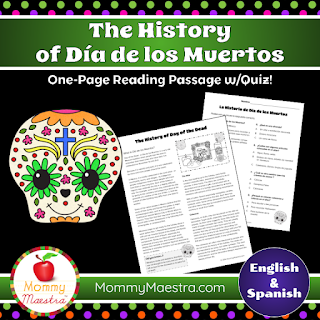
Printable Day of the Dead Reading Passages for Children


For kids in 4th grade and up!
Comes with a one-page reading passage and an 8-question comprehension quiz.
UPDATED! Now with Easel Activities and Assessments for teachers on TpT.


For PreK through 4th grades
This minibook is an introduction to the Mexican holiday, Día de los Muertos, or Day of the Dead. This book include coloring pages of items most closely associated with the holiday, as well as brief descriptions in English and Spanish that are easy for young children to understand.


Kid-Friendly Activities for Day of the Dead


There are a number of activities your child can do to provide your child with more opportunities to learn about Day of the Dead. Here are a few ideas for some easy activities:

* Make longer lasting skulls out of play-doh or clay.

* Create your own calavera mask using cardstock and a wooden craft stick as a handle. There is a great pattern in the Teacher's Packet listed below.

* Have your child write his or her own poem in honor of a loved one who has passed away, or to celebrate Day of the Dead.

* Use my miniature pan de muertos recipe and make it together.

* Make your own miniature marigolds out of yellow tissue paper and green pipe cleaners.

* Allow older kids to try their hand at making their own papel picado. To make your own pattern, fold your tissue paper in half twice, use scissors and hole punches to cut your designs. Or try one of the many free patterns and instructions from my friend, Dariela, over at Mami Talks!


Other Posts About Day of the Dead


LinkWithin

Related Posts Plugin for WordPress, Blogger...